Overview
New York, NY – Nov 03, 2026 – The global Glucose, Dextrose, and Maltodextrin Market plays an important role in food manufacturing, beverages, pharmaceuticals, nutrition, and industrial processing. These starch-based ingredients are produced from raw materials such as corn, wheat, rice, potatoes, and tapioca. They are widely used to provide sweetness, improve texture, support fermentation, maintain product consistency, and enhance ingredient functionality.
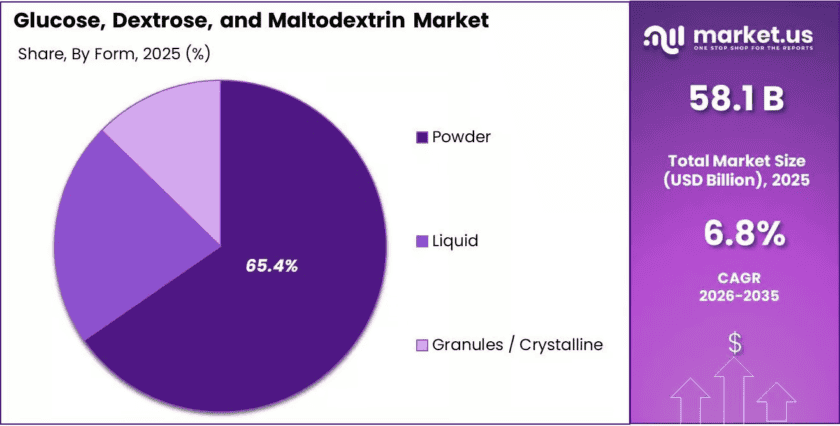
According to the supplied Market.us report, the market was valued at USD 58.1 billion in 2025 and is projected to reach USD 112.3 billion by 2035, growing at a compound annual growth rate (CAGR) of 6.8% from 2026 to 2035. Glucose is widely used in confectionery, beverages, and bakery products, while dextrose serves food and pharmaceutical applications. Maltodextrin is valued for its bulking, thickening, and stabilising properties.
Key Takeaways
- The global market was valued at USD 58.1 billion in 2025 and is projected to reach USD 112.3 billion by 2035.
- The market is expected to grow at a 6.8% CAGR during 2026–2035.
- Glucose dominates the product type segment with a 50.00% share.
- Corn leads the source segment with a 65.00% share.
- Powder accounts for 65.00% of the form segment.
- Food grade holds a leading position with a 62.00% share.
- Food and beverages represent 58.00% of the application segment.
- Bakery and confectionery account for 30.00% of the food and beverage application segment.
- Direct sales and business-to-business supply hold a 60.00% share.
- Asia Pacific dominates the regional market with 35.00%, valued at USD 20.3 billion.
Regional Analysis
Asia Pacific: Dominating Region
Asia Pacific dominated the Glucose, Dextrose, and Maltodextrin Market in 2025, accounting for 35.00% of global revenue, equivalent to USD 20.3 billion. The region benefits from a large food-processing industry, extensive starch production, and increasing demand for packaged foods, beverages, confectionery, and nutritional products.
China is a major contributor to starch processing and ingredient manufacturing, while Japan, South Korea, and Southeast Asian countries support demand through food, pharmaceutical, and industrial applications. The region’s established supply chains for corn, rice, tapioca, and other starch sources support ingredient production and processing.
North America: Established Processing and Consumption Base
North America remains an important market due to its developed food and beverage manufacturing industry, established pharmaceutical sector, and extensive corn-processing infrastructure.
According to the USDA, the United States produced a record 17.0 billion bushels of corn in 2025, representing a 14% increase from 2024. This agricultural supply supports starch-processing industries that manufacture glucose, dextrose, and maltodextrin. Demand is further supported by applications in bakery products, beverages, confectionery, nutritional formulations, and pharmaceutical preparations.
Market Dynamics
Driver: Expansion of Processed Food and Beverage Manufacturing
The expansion of processed food and beverage production is supporting demand for glucose, dextrose, and maltodextrin. These ingredients are widely used in bakery products, confectionery, beverages, dairy products, and convenience foods to manage sweetness, texture, moisture, and consistency.
Maltodextrin also acts as a bulking agent and carrier, while glucose supports fermentation and formulation needs. According to the USDA, the United States produced a record 17.0 billion bushels of corn in 2025, providing a substantial agricultural raw-material base for starch-derived ingredients. This supports the broader supply chain for carbohydrate processing.
Trend: Increasing Use of Functional Maltodextrin
Food manufacturers are increasingly using maltodextrin for its functional properties rather than only as a carbohydrate ingredient. It can support bulk, texture, stability, and ingredient blending in powdered beverages, snacks, sauces, nutritional products, and confectionery. The FDA identifies maltodextrin as a substance used for several technical functions, including stabilising, thickening, texturising, and nutritive sweetening.
Restraint: Raw Material and Energy Cost Fluctuations
The production of glucose, dextrose, and maltodextrin depends on agricultural starch sources, particularly corn, wheat, and tapioca. Changes in crop yields, weather conditions, transportation costs, and energy prices can affect processing expenses and ingredient prices. The USDA’s Sugar and Sweeteners Yearbook tracks production, deliveries, and stocks of corn sweeteners, including dextrose and glucose, highlighting the importance of agricultural supply and market balance.
Opportunity: Pharmaceutical and Specialised Nutrition Applications
Pharmaceutical and specialised nutrition applications offer opportunities for high-purity dextrose and customised maltodextrin ingredients. Dextrose is used in pharmaceutical preparations, including intravenous solutions, while maltodextrin can serve as an excipient or carrier in suitable formulations. The FDA’s drug labelling information identifies 5% dextrose injection as containing 5 grams of dextrose per 100 millilitres.
Emerging Trends in the Glucose, Dextrose, and Maltodextrin Market
1. Growing Demand for Functional Ingredients
Manufacturers are using maltodextrin for more than sweetness. Its stabilising, thickening, and texturising functions support food formulations. The FDA recognises multiple technical functions for maltodextrin, encouraging its use across different food categories.
2. Expansion of Corn-Based Processing
Corn remains a major raw material for glucose and maltodextrin production. USDA reported US corn output of 17.0 billion bushels in 2025, a 14% increase from 2024. This large supply supports starch processing and ingredient manufacturing.
3. Growth in Pharmaceutical-Grade Dextrose
Dextrose is used in pharmaceutical formulations that require specific purity and quality standards. A 5% dextrose injection contains 5 grams per 100 millilitres, demonstrating its established role in medical preparations and supporting specialised ingredient demand.
4. Development of Alternative Starch Sources
Ingredient manufacturers are exploring starch sources such as wheat, rice, potatoes, and tapioca to diversify raw-material sourcing. The FDA recognises maltodextrin produced from corn, potato, or rice starch, supporting multiple source options for commercial production.
5. Increased Focus on Ingredient Quality
Food and pharmaceutical manufacturers are prioritising consistency, purity, and compliance in ingredient selection. Maltodextrin is defined in US food regulations by a dextrose equivalent (DE) of less than 20, providing a technical specification for its identity and production.
Use Cases of Glucose, Dextrose, and Maltodextrin
1. Bakery and Confectionery Production
Glucose syrup and dextrose are used in bakery products, candies, and confectionery to manage sweetness, moisture, and texture. Maltodextrin provides bulk and supports formulation consistency. The segment accounts for 30.00% of the food and beverage application market.
2. Beverage Formulation
Glucose, dextrose, and maltodextrin are used in powdered beverages, energy drinks, and nutritional mixes. Maltodextrin supports bulk and blending, while dextrose contributes carbohydrates. The US FDA recognises maltodextrin as a nutritive sweetener and stabiliser in food applications.
3. Pharmaceutical Preparations
Dextrose is used in pharmaceutical products, including intravenous solutions and selected formulations. A 5% dextrose solution contains 5 grams per 100 millilitres, providing a defined carbohydrate concentration for medical use under applicable product specifications.
4. Sports and Nutritional Products
Dextrose and maltodextrin are used in sports nutrition powders, carbohydrate beverages, and nutritional supplements. They provide carbohydrate content and support formulation requirements. Their powder form also allows convenient blending, packaging, and dosage control for different nutritional products.
5. Industrial Fermentation
Glucose and dextrose serve as carbohydrate sources in fermentation processes used to manufacture selected food ingredients and industrial products. Corn-based starch processing provides a large raw-material base, with US corn production reaching 17.0 billion bushels in 2025.
Frequently Asked Questions on the Glucose, Dextrose, and Maltodextrin Market
1. What are glucose, dextrose, and maltodextrin?
Glucose is a simple sugar, dextrose is the commonly used name for glucose in commercial crystalline forms, and maltodextrin is a carbohydrate polymer produced through partial starch hydrolysis. They serve different functions in food, pharmaceutical, and industrial applications.
2. What is the market size in 2025?
According to the supplied Market.us report, the global Glucose, Dextrose, and Maltodextrin Market was valued at USD 58.1 billion in 2025. The market is projected to reach USD 112.3 billion by 2035.
3. What is the expected CAGR of the market?
The market is projected to grow at a 6.8% CAGR during 2026–2035. Growth is supported by processed food production, pharmaceutical applications, nutritional products, and demand for specialised starch-based ingredients.
4. Which product type dominates the market?
Glucose leads the product type segment with a 50.00% share in 2025. Its use in confectionery, bakery products, beverages, fermentation, and industrial formulations supports its position among starch-derived carbohydrate ingredients.
5. Which raw material is most widely used?
Corn dominates the source segment with a 65.00% share. It is widely processed into starch and carbohydrate ingredients. Other sources include wheat, potato, tapioca, rice, and alternative starch materials.
6. Which region dominates the market?
Asia Pacific dominates the global market with a 35.00% share, valued at approximately USD 20.3 billion in 2025. Its food-processing capacity, ingredient manufacturing, and demand for packaged foods support regional consumption.
Conclusion
The Glucose, Dextrose, and Maltodextrin Market is expected to maintain steady growth as food processors, pharmaceutical manufacturers, and nutrition companies increase their use of starch-derived ingredients. The market is projected to rise from USD 58.1 billion in 2025 to USD 112.3 billion by 2035, at a 6.8% CAGR.
Glucose, corn-based ingredients, powdered products, and food-grade applications remain important market segments. Asia Pacific continues to lead, supported by its large manufacturing base and expanding food industry. Future opportunities are expected from pharmaceutical-grade dextrose, specialised nutrition, functional maltodextrin, and improved starch-processing technologies. Ingredient quality, cost management, and raw-material availability will remain important competitive factors.
Discuss your needs with our analyst
Please share your requirements with more details so our analyst can check if they can solve your problem(s)