Overview
New York, NY – Oct 08, 2026 – The global Sodium Hypophosphite Market is expanding as demand rises from electroless nickel plating, electronics, chemical processing, water treatment, and specialty industrial applications. The market was valued at USD 1,772.2 million in 2025 and is projected to reach approximately USD 2,917.2 million by 2035, growing at a 5.1% CAGR from 2026 to 2035.
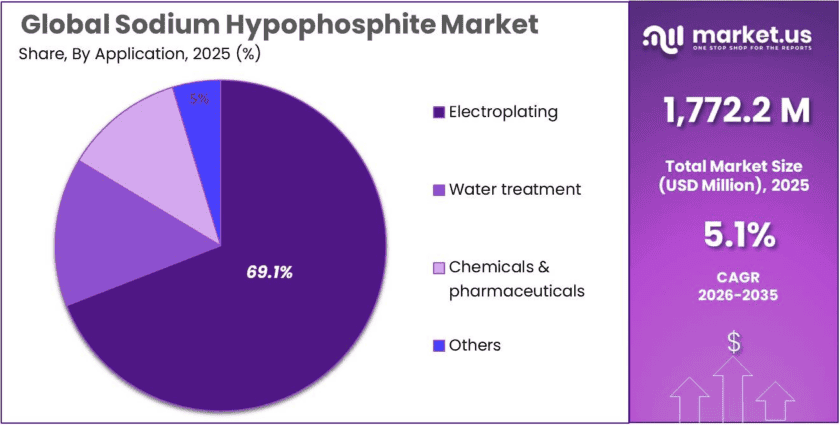
Sodium hypophosphite is a phosphorus-based specialty chemical commonly used as a reducing agent. Its strongest industrial application is electroless nickel plating, where it enables nickel deposition without an external electrical current. In 2025, Reducing Agents held 43.56%, while Industrial Grade accounted for 65.67% of the market. Electroplating remained the largest application with a 69.12% share.
Demand is also supported by semiconductor packaging, printed circuit boards, automotive electronics, machinery, aerospace parts, pumps, and valves. U.S. EPA technical guidance confirms that sodium hypophosphite is used as the reducing agent in electroless nickel processes for printed wiring boards, where nickel layers typically measure around 3–5 microns.
Government investment in semiconductor production is opening additional opportunities for higher-purity material. In January 2025, the U.S. Department of Commerce finalized USD 1.4 billion in advanced-packaging awards, supporting future demand for specialty surface-treatment chemicals.
Key Takeaways
- The Sodium Hypophosphite Market was valued at USD 1,772.2 million in 2025 and is projected to reach USD 2,917.2 million by 2035, growing at a 5.1% CAGR.
- Reducing Agents dominated the function category in 2025 with a 43.56% share.
- Industrial Grade held more than a 65.67% share, supported by broad use in metal finishing and industrial chemical processing.
- Electroplating was the leading application, capturing more than a 69.12% share in 2025.
- Asia-Pacific led the global market with a 43.22% share, generating approximately USD 765.5 million in 2025.
- Growth is being supported by semiconductor packaging, electronics, corrosion-resistant coatings, and high-purity specialty chemical requirements.
Regional Analysis
Asia-Pacific Leads with 43.22% Share and USD 765.5 Million
Asia-Pacific held the dominant Sodium Hypophosphite Market position in 2025, accounting for more than a 43.22% share and approximately USD 765.5 million in revenue. China, Japan, South Korea, and other manufacturing economies maintain large electronics, automotive, chemical, machinery, and surface-finishing industries that support demand for electroless nickel chemistry.
North America is also developing strongly as semiconductor and advanced-packaging investment increases. In January 2025, the U.S. Department of Commerce finalized USD 1.4 billion in advanced-packaging awards, including USD 300 million for substrates and materials research and USD 1.1 billion for an advanced-packaging piloting facility. These investments can expand demand for high-purity process chemicals and precision surface treatments.
Market Dynamics
Driver – Semiconductor Packaging Expands Specialty Chemical Demand
Advanced semiconductor manufacturing is creating an important demand driver for sodium hypophosphite because electroless nickel processes are used in electronics and printed wiring applications. In January 2025, the U.S. Department of Commerce finalized USD 1.4 billion in funding for advanced semiconductor packaging.
This included USD 300 million for substrate and materials research and USD 1.1 billion for an advanced-packaging piloting facility. Government investment is encouraging development of new packaging materials, substrates, and high-volume production processes. As electronics manufacturing becomes more advanced, demand can increase for high-purity reducing agents used in uniform nickel deposition and corrosion-resistant surface finishing.
Trend – High-Purity Chemicals Gain Importance in Advanced Electronics
A major trend is the shift toward higher-purity sodium hypophosphite for semiconductor, printed circuit board, and precision-electronics applications. U.S. EPA technical guidance identifies sodium hypophosphite as a reducing agent in electroless nickel processes used for printed wiring boards, where nickel deposits typically measure around 3–5 microns.
The trend is gaining momentum as governments expand semiconductor ecosystems. In June 2026, the European Commission proposed Chips Act 2.0 to strengthen advanced chip manufacturing and reduce strategic dependencies. The existing European Chips Act is supported by more than €43 billion in public investment measures, encouraging advanced electronics production and related specialty chemical demand.
Restraint – Nickel and Feedstock Volatility Raise Production Risks
Raw-material volatility remains an important restraint because sodium hypophosphite demand is closely connected with nickel-phosphorus plating operations. USGS estimated global nickel mine production at around 3.9 million tonnes in 2025, increasing 5%, but regional production changed sharply. Indonesian output increased around 13%, while Australian production declined approximately 54% and Philippine production fell around 24%.
Such uneven supply conditions can create fluctuations in nickel pricing and plating economics. Sodium hypophosphite manufacturers also remain exposed to phosphorus feedstocks, energy, transport, and chemical-processing costs, which can make long-term pricing difficult for industrial plating customers.
Opportunity – Local Semiconductor Supply Chains Create Premium Demand
Localization of advanced electronics manufacturing creates a strong opportunity for sodium hypophosphite suppliers that can provide consistent high-purity material. The U.S. Department of Commerce awarded USD 1.4 billion for advanced packaging in January 2025, while the European Chips Act is expected to mobilize more than €43 billion in public investment and more than €100 billion in policy-driven public and private investment through 2030.
These programmes encourage new semiconductor, packaging, and materials facilities. Sodium hypophosphite producers can benefit by developing tighter impurity controls, reliable batch consistency, traceability, local inventories, and specialized products for electroless nickel and electronics manufacturing.
Emerging Trends
1. Electronics-Grade Purity Is Becoming More Important
Electronics manufacturers increasingly require controlled plating chemistry. EPA guidance shows electroless nickel layers on printed wiring boards commonly measure around 3–5 microns, creating demand for stable sodium hypophosphite quality and carefully controlled deposition performance.
2. Semiconductor Packaging Investment Supports New Demand
The U.S. Department of Commerce finalized USD 1.4 billion in advanced-packaging awards in January 2025. Expansion of packaging lines, substrates, and materials research can increase future requirements for high-purity plating and specialty process chemicals.
3. European Chip Manufacturing Is Expanding
The European Chips Act is expected to mobilize more than €43 billion in public investment. In June 2026, Chips Act 2.0 was proposed to further strengthen advanced semiconductor manufacturing and supply-chain resilience across Europe.
4. Nickel Supply Is Becoming More Geographically Uneven
USGS estimated global nickel production at 3.9 million tonnes in 2025, up 5%. Indonesian production increased 13%, while Australian output fell 54%, highlighting supply shifts affecting electroless nickel and related chemical procurement.
5. Plating-Bath Efficiency Gains More Attention
EPA research shows that improving electroless nickel bath management can reduce chemical consumption and waste. One EPA-documented electrodialysis application operated beyond 15 bath regenerations and generated annual savings of approximately USD 50,570.
Use Cases
1. Electroless Nickel Plating
Sodium hypophosphite serves as the reducing agent in electroless nickel baths. EPA documentation shows printed wiring board nickel layers typically reach around 3–5 microns, helping protect copper surfaces and provide uniform corrosion-resistant coatings.
2. Printed Circuit Board Manufacturing
Electronics producers use hypophosphite-based nickel plating during printed wiring board finishing. The chemical provides electrons needed for nickel deposition without external current, supporting controlled coatings of approximately 120–200 microinches in common EPA-described processes.
3. Corrosion-Resistant Industrial Components
Electroless nickel-phosphorus coatings are applied to machinery and metal parts where uniform corrosion protection is needed. Sodium hypophosphite provides reducing chemistry, while global nickel mine production reached around 3.9 million tonnes in 2025, supporting a large downstream metal-processing base.
4. Food Antioxidant Applications
The U.S. FDA lists sodium hypophosphite under 21 CFR 184.1764 and identifies its technical function as an antioxidant. Its CAS number is 7681-53-0, confirming regulated use beyond traditional metal-finishing applications.
5. Semiconductor and Advanced Packaging
Sodium hypophosphite can support nickel-based surface finishing for electronic and packaging components. U.S. advanced-packaging programmes received USD 1.4 billion in finalized federal awards in 2025, creating a larger ecosystem for specialized materials and process chemicals.
Frequently Asked Questions on Sodium Hypophosphite
What is sodium hypophosphite?
Sodium hypophosphite is an inorganic phosphorus-based chemical widely used as a reducing agent. It is particularly important in electroless nickel plating, where it enables nickel deposition without applying an external electrical current.
How large is the Sodium Hypophosphite Market?
The global Sodium Hypophosphite Market was valued at USD 1,772.2 million in 2025 and is projected to reach approximately USD 2,917.2 million by 2035, growing at a 5.1% CAGR.
Which region dominates the Sodium Hypophosphite Market?
Asia-Pacific dominated the market in 2025, accounting for more than a 43.22% share and approximately USD 765.5 million in revenue, supported by large electronics, chemical, automotive, and metal-processing industries.
Which function dominates the market?
Reducing Agents represented the largest functional category in 2025, holding more than a 43.56% share. Sodium hypophosphite is widely used to reduce nickel ions during electroless nickel deposition.
Which grade leads the Sodium Hypophosphite Market?
Industrial Grade held the leading market position in 2025 with more than a 65.67% share, supported by applications across electroless plating, metal finishing, chemical processing, and corrosion-resistant industrial treatments.
Which application holds the largest market share?
Electroplating dominated the application category in 2025 with more than a 69.12% share, mainly because sodium hypophosphite provides the reducing action needed in electroless nickel-phosphorus coating processes.
Why is sodium hypophosphite important in electronics?
It is used in electroless nickel processes that create uniform metallic coatings on complex electronic surfaces. EPA guidance shows typical nickel layers on printed wiring boards can measure approximately 3–5 microns.
What factors are supporting future market growth?
Future growth is supported by semiconductor packaging, automotive electronics, precision machinery, corrosion-resistant coatings, and localized chemical supply. Government semiconductor programmes are also increasing investment in advanced manufacturing and related specialty materials.
Conclusion
The Sodium Hypophosphite Market is positioned for steady expansion as electronics, electroplating, semiconductor packaging, and industrial surface finishing continue to develop. The market, valued at USD 1,772.2 million in 2025, is expected to reach USD 2,917.2 million by 2035, advancing at a 5.1% CAGR.
Electroplating remains the strongest application with a 69.12% share, while Asia-Pacific leads with 43.22%. Government semiconductor investment and growing demand for precision nickel coatings should create new opportunities for higher-purity grades, localized supply, improved bath efficiency, and advanced specialty chemical formulations.
Discuss your needs with our analyst
Please share your requirements with more details so our analyst can check if they can solve your problem(s)