Brewing Enzymes Market
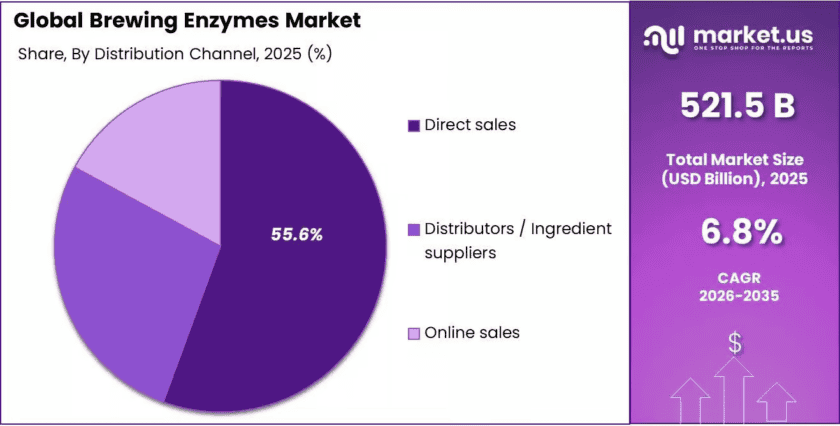
New York, NY – Oct 30, 2026 – The global Brewing Enzymes Market is projected to grow from USD 521.5 billion in 2025 to USD 1,002.2 billion by 2035, registering a compound annual growth rate (CAGR) of 6.8% during 2026–2035, according to the supplied Market.us report. Brewing enzymes help convert starch into fermentable sugars, manage grain viscosity, improve filtration, and support consistent beer production.
Amylase accounted for 43.00% of the enzyme-type segment in 2025, while microbial enzymes held 77.00% of the source segment. Liquid formulations captured 65.00%, and beer applications represented 77.00%. Direct sales accounted for 55.00% of distribution. Asia-Pacific led the regional market with a reported 46.00% share, equivalent to USD 239.8 billion.
Breweries use enzyme preparations to process malted barley and alternative grains such as corn, rice, oats, and sorghum. These products can support starch conversion, viscosity control, and production flexibility. Government research also confirms that added enzymes are used in certain beer styles, including low-alcohol and light beers.
Key Takeaways
- The market is reported to increase from USD 521.5 billion in 2025 to USD 1,002.2 billion by 2035, at a 6.8% CAGR.
- Amylase led the enzyme-type segment with a 43.00% share in 2025.
- Microbial enzymes dominated by source, accounting for 77.00% of the market.
- Liquid enzymes held a 65.00% share, reflecting their use in dosing and automated brewing processes.
- Beer remained the leading application, with a 77.00% share.
- Direct sales accounted for 55.00% of distribution, supported by technical service and direct brewery relationships.
- Asia-Pacific led the regional market with a reported 46.00% share, valued at USD 239.8 billion.
Regional Analysis
Asia-Pacific – Dominating Region
Asia-Pacific held the leading position in 2025, accounting for 46.00% of the global Brewing Enzymes Market, with reported revenue of USD 239.8 billion. The region benefits from large beer-producing countries, established beverage manufacturers, and demand for efficient grain processing. China is an important contributor to regional brewing activity. The BarthHaas Report 2024/2025, as cited in the Market.us report, recorded Chinese beer production of 341 million hectolitres in 2024, representing 18.2% of global production. Regional breweries use enzymes to improve starch conversion, manage viscosity, and support consistent production across different grain mixtures.
Asia-Pacific also has a broad agricultural base. The Food and Agriculture Organization reported that global cereal production reached 3.1 billion tonnes in 2024, an increase of 27% compared with 2010. This wider grain supply is relevant to brewing because barley and other cereals are key raw materials. However, cereal production figures should be treated as an indicator of agricultural supply, not as a direct measure of brewing-enzyme demand.
Market Dynamics
Driver: Demand for Efficient Grain Conversion
Breweries use enzymes to improve the conversion of starch into fermentable sugars and to manage grain components that can slow production. The United States Alcohol and Tobacco Tax and Trade Bureau (TTB) recognises several enzyme preparations for beer production, including alpha-amylase, glucoamylase, pullulanase, and beta-glucanase with xylanase.
These preparations support starch breakdown, fermentation control, and filtration. The TTB specifies, for example, a maximum use level of 49.5 mg total organic solids per kg of starch raw material for an approved maltogenic alpha-amylase preparation. Such applications support more controlled processing and flexible grain formulations.
Trend: More Targeted Enzyme Formulations
Brewing enzyme development is moving towards formulations designed for specific stages of production rather than relying on a single enzyme for several functions. Alpha-amylase and glucoamylase support starch conversion, while beta-glucanase and xylanase help break down gums that can affect wort filtration.
TTB has approved a mixed beta-glucanase and xylanase preparation for use during mashing, with a stated maximum of 150–300 grams per tonne of total raw materials. This shows how breweries can select enzyme combinations to address particular processing needs and improve consistency.
Restraint: Changes in Beer Production
Demand for brewing enzymes is closely linked to brewery output because enzyme consumption generally depends on the volume and type of beer produced. The United States Department of Agriculture reported that US beer production declined by more than 13% between marketing years 2016/17 and 2023/24.
It also forecast barley use for food, alcohol, and industrial purposes at 110.7 million bushels in 2024/25, down 27% from 151.6 million bushels in 2016/17. Lower beer output can limit enzyme purchases, particularly when breweries reduce production or postpone process upgrades.
Opportunity: Low-Alcohol and Speciality Beer Production
Breweries developing low-alcohol, light, and speciality beers can create opportunities for enzymes that help control sugar conversion and fermentation. The USDA Agricultural Marketing Service notes that added enzymes are used in certain beer styles, including low-alcohol and light beers.
TTB also recognises pullulanase preparations for converting starches and dextrins into fermentable sugars, particularly in low-calorie or light beer production. Its stated maximum use level is 129 mg total organic solids per kg of starch raw material. These applications provide opportunities for suppliers offering targeted enzyme solutions and technical guidance.
Emerging Trends
1. Specialised starch-conversion enzymes: Breweries are using alpha-amylase, glucoamylase, and pullulanase to manage starch conversion and fermentable sugar levels. TTB recognises an alpha-amylase preparation for beer production at up to 49.5 mg total organic solids per kg of starch raw material.
2. Improved filtration performance: Beta-glucanase and xylanase combinations help break down gums in wort, supporting smoother filtration. TTB lists a preparation with a maximum use level of 150–300 grams per tonne of total raw materials, depending on the brewing application.
3. Low-alcohol and light beer formulations: Enzymes such as pullulanase can help convert dextrins into fermentable sugars for selected low-calorie beer recipes. TTB specifies a maximum level of 129 mg total organic solids per kg of starch raw material for an approved preparation.
4. Greater use of microbial enzyme production: Microorganisms are an important source of commercial enzymes because controlled fermentation can produce preparations for different brewing functions. Market.us reports that microbial enzymes accounted for 77.00% of the market in 2025, indicating their leading position by source.
5. More attention to enzyme safety and approval: Food enzyme suppliers must address safety, technological need, and regulatory requirements in relevant markets. The European Commission states that more than 300 food enzyme applications were received for assessment under the EU authorisation process, showing the scale of regulatory review.
Use Cases
1. Starch conversion during mashing: Amylase helps break down grain starch into smaller carbohydrates and fermentable sugars. TTB recognises an alpha-amylase preparation for beer and cereal beverages at up to 49.5 mg total organic solids per kg of starch raw material.
2. Wort filtration and viscosity management: Beta-glucanase and xylanase help break down beta-glucans, pentosans, and other gums during mashing. TTB lists a mixed preparation with a maximum use level of 150–300 grams per tonne of total raw materials.
3. Low-calorie and light beer production: Pullulanase can convert starches and dextrins into fermentable sugars, supporting selected low-calorie and light beer recipes. TTB specifies a maximum use level of 129 mg total organic solids per kg of starch raw material.
4. Fermentation flavour management: ALDC enzyme preparation is used to help prevent diacetyl formation during fermentation. TTB lists an approved preparation for beer and cereal beverages at up to 0.133 mg total organic solids per litre of fermented wort.
5. Processing unmalted grains: Certain enzyme preparations help break down cell-wall materials, proteins, starches, and fats in unmalted grains. TTB lists an approved lipase preparation for beer production, with a recommended dosage of 1.2–2.5 kg per tonne of total raw grain.
Frequently Asked Questions on Brewing Enzymes and the Brewing Enzymes Market
1. What are brewing enzymes?
Brewing enzymes are biological catalysts used during beer production. They help break down starch, proteins, and grain fibres, supporting sugar conversion, fermentation, viscosity management, and filtration.
2. What is the projected size of the Brewing Enzymes Market?
According to Market.us, the market is valued at USD 521.5 billion in 2025 and is projected to reach USD 1,002.2 billion by 2035, growing at a CAGR of 6.8%.
3. Which enzyme type leads the market?
Amylase leads the enzyme-type segment with a 43.00% share in 2025. It supports starch breakdown during mashing, helping breweries produce fermentable sugars needed for the fermentation process.
4. Why are microbial enzymes widely used in brewing?
Microbial enzymes are produced using microorganisms under controlled conditions. They can be developed for different brewing functions, including starch conversion and viscosity management. Market.us reports a 77.00% share for this source segment in 2025.
5. Which enzyme formulation holds the largest form share?
Liquid formulations led the market with a 65.00% share in 2025. Their convenient dosing and suitability for automated production systems support their use in commercial brewing operations.
Conclusion
The Brewing Enzymes Market is supported by the need for efficient starch conversion, improved filtration, consistent product quality, and flexible brewing processes. Market.us identifies amylase, microbial enzymes, liquid formulations, and beer production as leading market segments in 2025.
Asia-Pacific holds the largest reported regional share at 46.00%. Government information from the United States and European Union confirms the use of specialised enzymes in brewing and highlights the importance of safety and regulatory compliance. However, changes in beer production and raw-material availability may affect demand. Opportunities remain in low-alcohol beer, specialised formulations, and process-specific enzyme solutions.
Discuss your needs with our analyst
Please share your requirements with more details so our analyst can check if they can solve your problem(s)