Overview
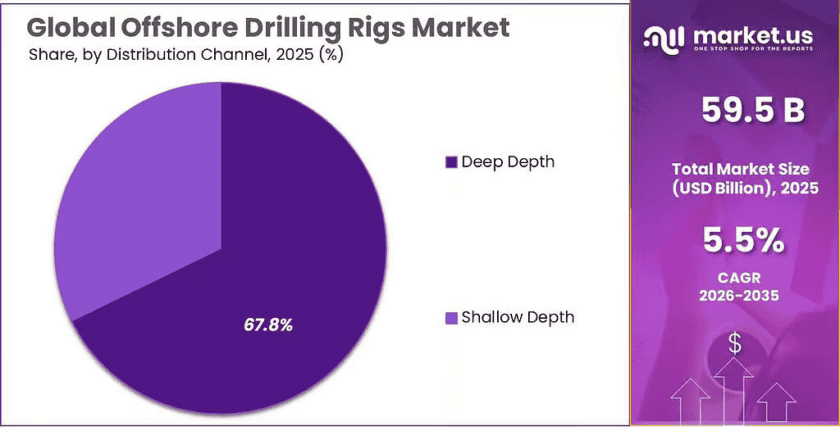
New York, NY – Oct 27, 2026 – The global Offshore Drilling Rigs Market is supported by continued offshore oil and gas exploration, development of deepwater fields, and the need to maintain production from existing reservoirs. According to the supplied Market.us report, the market was valued at USD 59.5 billion in 2025 and is projected to reach USD 101.9 billion by 2035, reflecting a compound annual growth rate (CAGR) of 5.5% from 2026 to 2035. North America accounted for 37.67%, equivalent to USD 22.3 billion, in 2025. Jack-up rigs and deep-depth drilling were the leading segments, with reported shares of 38.67% and 67.89%, respectively.
Offshore drilling rigs include jack-up platforms, semisubmersible units, drillships, and other specialized equipment used to drill beneath the seabed. Demand depends on exploration budgets, project approvals, oil and gas prices, rig availability, and the cost of developing offshore reserves. Official data also show continuing activity in important offshore regions. Norway completed 49 exploration wells and recorded 21 discoveries in 2025, while U.S. offshore agencies continue to publish deepwater permit and operating data.
Key Takeaways
- The Offshore Drilling Rigs Market was valued at USD 59.5 billion in 2025 and is forecast to reach USD 101.9 billion by 2035, at a reported CAGR of 5.5%.
- North America led the market in 2025, with a reported 37.67% share and revenue of USD 22.3 billion.
- Jack-up rigs held a reported 38.67% share, supported by their use in shallow-water exploration and development.
- Deep-depth applications accounted for a reported 67.89% share, reflecting the importance of advanced rigs in deeper offshore fields.
- Norway completed 49 exploration wells and made 21 discoveries in 2025, illustrating continued exploration activity on an established offshore shelf.
Regional Analysis
North America: North America was the leading region in the supplied market report, accounting for 37.67% of global revenue, or USD 22.3 billion, in 2025.
Europe: The North Sea remains a major center for mature-field development, exploration, and reservoir recovery. Norway completed 49 exploration wells in 2025, seven more than in 2024, and reported 21 discoveries.
Asia-Pacific: Demand is linked to offshore oil and gas projects, established production areas, and regional drilling programs. Rig requirements vary by water depth, reservoir conditions, local equipment availability, and the timing of project approvals. Operators may use jack-up rigs in shallower waters and floating rigs for deeper locations.
Market Dynamics
Driver: Continued Offshore Exploration and Field Development
Offshore drilling rigs remain important for finding new reserves and maintaining production from existing fields. In 2025, Norway completed 49 exploration wells and reported 21 discoveries, with estimated recoverable resources of 67 million standard cubic metres of oil equivalent.
Trend: Greater Use of Advanced Drilling Technology
Offshore operators are increasingly focused on technologies that improve drilling accuracy, safety, and operating efficiency. Modern rigs may use automated pipe handling, real-time monitoring, improved positioning systems, and digital tools that help crews identify operational problems earlier.
These technologies are especially useful in deepwater projects, where equipment failure or delays can be expensive. U.S. offshore regulators maintain permit and operational records for shallow- and deepwater wells, reflecting the different requirements across offshore environments.
Restraint: High Capital and Operating Costs
Offshore drilling requires significant spending on rigs, marine support, specialized crews, well-control equipment, maintenance, insurance, and transport. Deepwater operations are particularly demanding because rigs must work in challenging sea conditions and manage high-pressure wells.
If oil prices weaken or project approvals are delayed, operators may postpone drilling programs, reducing rig utilization and contractor revenue. Older units may also need expensive upgrades before returning to service. Government permit records show that offshore drilling plans are subject to formal review and approval, adding another step before work can begin.
Opportunity: Repurposing Offshore Expertise for Carbon Storage
Offshore drilling contractors may find new work in carbon capture and storage, where suitable wells are drilled or converted for carbon dioxide injection. The opportunity includes well construction, integrity testing, monitoring, intervention, and eventual abandonment. Existing offshore skills and marine equipment may be transferable, but each project needs site-specific engineering, regulatory approval, and suitable materials.
The opportunity is most relevant where proposed storage sites are close to established offshore infrastructure. However, carbon storage is not yet a replacement for conventional oil and gas drilling demand. Revenue depends on final investment decisions, storage permits, customer contracts, and whether contractors can meet the technical requirements of injection wells.
Emerging Trends
1. Automation and remote monitoring: Offshore operators are using digital monitoring and automated equipment to improve drilling consistency and reduce avoidable downtime. These systems can help crews track equipment performance and respond to problems. Norway completed 49 exploration wells in 2025, showing continuing demand for efficient offshore operations.
2. Deepwater drilling demand: Deepwater projects require floating rigs, advanced positioning, and reliable well-control equipment. The supplied market report assigns deep-depth applications a 67.89% share in 2025. This figure is a market-report estimate, while actual demand depends on project approvals and drilling schedules.
3. Rig efficiency upgrades: Contractors are upgrading older rigs with improved control systems, monitoring tools, and equipment designed to support safer operations. These investments can extend asset usefulness without building a new rig. Upgrade decisions depend on maintenance costs, customer requirements, expected utilization, and contract duration.
4. Focus on well integrity: Offshore operators are paying close attention to blowout prevention, pressure control, inspection, and well maintenance. U.S. offshore regulators publish permit data separately for wells in water depths below and above 500 feet, reflecting different regulatory requirements for shallow- and deepwater operations.
5. Carbon storage drilling services: Some offshore drilling capabilities may be adapted for carbon dioxide injection and storage wells. Contractors can explore work in drilling, completion, monitoring, and well intervention. Growth will depend on approved storage projects, safe well designs, financing, and the ability to meet site-specific regulatory requirements.
Use Cases
1. Exploration drilling: Operators use offshore rigs to test whether oil or natural gas exists beneath the seabed. In Norway, 40 of the 49 exploration wells completed in 2025 were wildcat wells, which are drilled to search for hydrocarbons.
2. Appraisal drilling: After a discovery, rigs drill appraisal wells to estimate the size, quality, and commercial potential of a reservoir. Norway completed 9 appraisal wells in 2025. The results help operators decide whether a discovery can support a development project.
3. Production development: Rigs drill production and injection wells that support an approved offshore field. These wells connect reservoir resources to planned production systems and help manage pressure. The number of wells required varies with reservoir size, geology, recovery strategy, and project design.
4. Existing-well maintenance: Offshore rigs and related units can support sidetracking, well intervention, and other work intended to improve or restore well performance. U.S. deepwater permit records include 16 sidetrack permits approved in 2025, indicating planned activity of this type, although permits do not confirm completed operations.
5. Carbon dioxide injection wells: Suitable offshore drilling equipment can be used to construct wells for carbon storage projects. These wells require careful pressure management, materials selection, and long-term integrity monitoring. Deployment depends on project approvals, storage-site geology, financing, and a clear plan for operating and monitoring the wells.
Frequently Asked Questions
1. What is the Offshore Drilling Rigs Market?
The Offshore Drilling Rigs Market covers rigs and related systems used to drill wells beneath the seabed for oil and natural gas exploration, appraisal, and development. It includes jack-up rigs, semisubmersibles, drillships, and other specialized units.
2. What was the market value in 2025?
According to the supplied Market.us report, the global Offshore Drilling Rigs Market was valued at USD 59.5 billion in 2025. This is a commercial market estimate rather than a government-published measurement.
3. What is the market forecast for 2035?
The supplied Market.us report projects that the market will reach USD 101.9 billion by 2035, with a reported CAGR of 5.5% over 2026–2035. Actual results may vary with oil prices, project approvals, rig availability, and offshore investment.
4. Which region led the market in 2025?
North America led the market in the supplied report, with a reported 37.67% share and revenue of USD 22.3 billion in 2025. U.S. offshore production and drilling activity contribute to the region’s importance.
5. What are the main types of offshore drilling rigs?
The main types include jack-up rigs, semisubmersible rigs, drillships, and other specialized units. Jack-up rigs are commonly used in shallower waters, while semisubmersibles and drillships support deeper-water operations. Rig choice depends on water depth, well design, and sea conditions.
6. What factors influence offshore rig demand?
Demand is affected by exploration budgets, oil and gas prices, new field approvals, reservoir conditions, rig availability, and contract rates. Maintenance requirements and the cost of reactivating older rigs also influence whether operators deploy existing units or seek newer equipment.
Conclusion
The Offshore Drilling Rigs Market is positioned for continued growth as operators explore new offshore reserves, develop deepwater fields, and maintain existing production assets. The supplied Market.us report estimates that the market will grow from USD 59.5 billion in 2025 to USD 101.9 billion by 2035, at a 5.5% CAGR.
North America remains the leading region in the report, while offshore exploration in regions such as the North Sea demonstrates continued drilling activity. At the same time, high capital costs, project delays, regulatory requirements, and equipment availability remain important challenges. Technology upgrades, efficient rig utilization, and emerging carbon storage projects may create additional opportunities.
Discuss your needs with our analyst
Please share your requirements with more details so our analyst can check if they can solve your problem(s)