Overview
New York, NY – Nov 02, 2026 – The global Floating Production Storage and Offloading (FPSO) Market is gaining importance as oil and gas companies expand offshore exploration and production, particularly in deepwater and ultra-deepwater fields. FPSO vessels combine oil and gas processing, crude storage, and offloading facilities in one floating unit. They are particularly useful in remote offshore locations where fixed platforms and long-distance pipelines may be costly or difficult to install.
According to the supplied Market.us report, the market was valued at USD 25.8 billion in 2025 and is projected to reach USD 48.5 billion by 2035, registering a compound annual growth rate (CAGR) of 6.5% from 2026 to 2035. Converted FPSOs, double-hull vessels, turret mooring systems, and crude oil processing units represent important market segments. Brazil’s offshore expansion is a major source of demand.
Brazil’s National Agency of Petroleum reported average oil production of 3.8 million barrels per day in 2025, with pre-salt fields contributing approximately 80% of national oil production. These developments support demand for offshore vessels, engineering, installation, and maintenance services.
Key Takeaways
- The global FPSO Market was valued at USD 25.8 billion in 2025.
- Market revenue is projected to reach USD 48.5 billion by 2035, at a 6.5% CAGR.
- Converted FPSOs dominated the construction type segment with a 65.00% share.
- Double-hull FPSOs accounted for 69.00% of the hull type segment.
- Turret mooring systems held a 42.00% share.
- FPSOs with 1–2 million barrels of storage capacity captured 57.00% of the storage capacity segment.
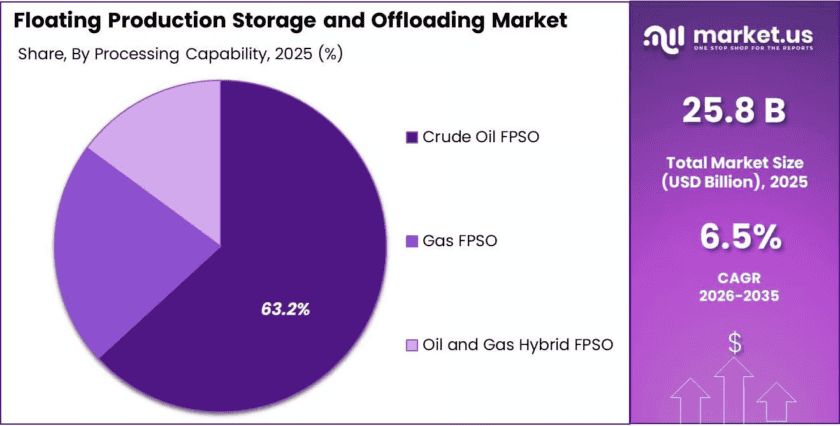
- Crude oil FPSOs dominated processing capability with a 63.00% share.
- National oil companies accounted for 37.00% of the end-user segment.
- Latin America led the regional market with a 38.00% share, valued at USD 9.8 billion.
Regional Analysis
Latin America: Dominating Region
Latin America dominated the FPSO Market in 2025, accounting for 38.00% of global revenue, equivalent to USD 9.8 billion. Brazil is the region’s main demand centre, supported by deepwater and pre-salt oil developments in the Santos and Campos basins.
The Brazilian National Agency of Petroleum reported average oil production of 3.8 million barrels per day in 2025, representing a 12% increase from 2024. Pre-salt production contributed approximately 3 million barrels per day, or around 80% of the country’s total oil output. These offshore developments require floating production, storage, and export facilities, supporting demand for FPSO construction, conversion, leasing, and maintenance.
Market Dynamics
Driver: Expansion of Deepwater and Pre-Salt Oil Production
The development of deepwater and pre-salt oil reserves is a major driver of the FPSO Market. These fields are often located far from existing pipelines and onshore processing facilities, making floating production and storage systems a practical development option.
Brazil reported average oil production of 3.8 million barrels per day in 2025, with pre-salt fields contributing approximately 80% of the national total. This growing offshore production base supports demand for FPSO vessels, processing equipment, subsea connections, and offloading systems. Continued investment in deepwater fields is expected to create opportunities for vessel builders, operators, and engineering contractors.
Trend: Larger and More Technologically Advanced FPSO Vessels
FPSO operators are increasingly focusing on vessels with higher processing capacity, improved storage systems, advanced mooring arrangements, and digital monitoring. These features help operators manage complex offshore production while improving equipment reliability and operational safety.
The US Bureau of Safety and Environmental Enforcement identifies FPSOs as vessels designed to process and store production from nearby subsea wells before transferring oil to shuttle tankers. The growth of deepwater projects is encouraging investment in more specialised floating facilities. Operators are also assessing technologies that improve energy efficiency, reduce emissions, and support remote monitoring throughout the operating life of an FPSO.
Restraint: High Capital Costs and Project Approval Delays
FPSO projects require substantial investment in vessel construction or conversion, topside processing equipment, subsea infrastructure, mooring systems, and offshore installation. Changes in crude oil prices, financing costs, and equipment expenses can affect project economics and delay final investment decisions.
The International Energy Agency estimated that global upstream oil and gas investment would be just under USD 570 billion in 2025, approximately 4% lower than in 2024. Lower oil prices and higher material costs can make operators more cautious about approving new offshore developments. These delays may affect vessel orders, construction schedules, and revenue for FPSO contractors.
Opportunity: Offshore Investment and New FPSO Projects
Expanding offshore investment is creating opportunities for FPSO construction, conversion, leasing, and lifecycle services. Brazil’s Ministry of Mines and Energy identified approximately USD 100 billion in expected offshore exploration and production investment during 2024–2026. This investment outlook supports demand for floating production infrastructure across the country’s deepwater fields.
Additional opportunities include vessel redeployment, subsea tiebacks, processing upgrades, digital monitoring, and emissions-reduction systems. FPSO suppliers that can deliver reliable vessels, manage project schedules, and provide long-term operating support may benefit from new offshore developments. Growth will depend on project approvals, financing availability, and the timely delivery of specialised equipment.
Emerging Trends in the FPSO Market
1. Converted FPSO Deployment: Operators are reusing existing oil tankers and converting them into offshore production vessels to reduce construction time and capital requirements. Converted FPSOs held a 65.00% market share in 2025, reflecting their importance in offshore development.
2. Adoption of Double-Hull Designs: Double-hull FPSOs are gaining importance because their additional structural protection helps reduce the risk of oil leakage. This design accounted for 69.00% of the hull type segment in 2025, reflecting the industry’s focus on vessel protection.
3. Advanced Mooring Technologies: Turret mooring systems are widely used in offshore locations where vessels must adjust to changing wind, wave, and current conditions. This mooring category held a 42.00% share in 2025, supporting demand for specialised positioning systems.
4. Digital Monitoring and Automation: FPSO operators are adopting digital monitoring to track production equipment, vessel performance, and maintenance requirements. These technologies can support continuous offshore operations, improve equipment planning, and reduce unexpected downtime across complex production facilities.
5. Lower-Emission Offshore Operations: Operators are exploring carbon capture, energy-efficient processing, and improved power systems to reduce offshore emissions. The International Energy Agency estimated global upstream oil and gas investment at just under USD 570 billion in 2025, supporting continued technology development.
Use Cases of Floating Production Storage and Offloading
1. Deepwater Oil Production: FPSOs support oil production in deepwater fields where fixed platforms and pipelines may be difficult to install. Brazil produced 3.8 million barrels of oil per day in 2025, with approximately 80% coming from pre-salt offshore fields.
2. Crude Oil Storage: FPSOs store crude oil in onboard tanks after processing, allowing operators to accumulate production before export. Vessels with 1–2 million barrels of storage capacity held a 57.00% market share in 2025.
3. Offshore Oil Processing: FPSOs separate oil, natural gas, and water from well fluids before storing or transferring the crude. Crude oil FPSOs accounted for 63.00% of the processing capability segment in 2025, reflecting their importance in offshore oil projects.
4. Shuttle Tanker Loading: FPSOs transfer stored crude oil to shuttle tankers for transportation to refineries and export terminals. The US Bureau of Safety and Environmental Enforcement describes this process as an important function of FPSOs in remote offshore fields without pipeline connections.
5. Offshore Gas and Oil Production: Hybrid FPSOs handle both oil and associated gas from offshore reservoirs. Their processing systems can separate and manage different production streams. Brazil’s natural gas production reached 179.2 million cubic metres per day in 2025, supporting offshore gas infrastructure requirements.
Frequently Asked Questions on the FPSO Market
1. What is a Floating Production Storage and Offloading vessel?
An FPSO is a floating offshore facility that processes crude oil and natural gas, stores produced oil, and transfers it to shuttle tankers. It is commonly used in deepwater fields where pipeline infrastructure is limited.
2. What is the global FPSO Market size in 2025?
According to the supplied Market.us report, the global FPSO Market was valued at USD 25.8 billion in 2025. It is projected to reach USD 48.5 billion by 2035, supported by offshore project development.
3. What is the expected CAGR of the FPSO Market?
The FPSO Market is projected to expand at a 6.5% CAGR between 2026 and 2035. Growth is supported by deepwater exploration, offshore production expansion, vessel conversion, and investment in floating production infrastructure.
4. Which region dominates the FPSO Market?
Latin America dominated the FPSO Market in 2025, accounting for 38.00% of global revenue, valued at approximately USD 9.8 billion. Brazil’s pre-salt developments and Guyana’s offshore projects support regional demand.
5. Which construction type leads the FPSO Market?
Converted FPSOs lead the construction type segment with a 65.00% share in 2025. These vessels are developed by modifying existing tankers, which can reduce construction costs and make use of available vessel structures.
Conclusion
The Floating Production Storage and Offloading Market is positioned for continued expansion as oil and gas companies develop offshore reserves and invest in deepwater production infrastructure. The market is projected to increase from USD 25.8 billion in 2025 to USD 48.5 billion by 2035, at a 6.5% CAGR.
Latin America remains the leading regional market, supported by Brazil’s pre-salt projects and Guyana’s offshore developments. Converted vessels, double-hull designs, and advanced mooring systems remain important industry segments. Future opportunities will depend on offshore investment, vessel availability, digital technologies, and improved environmental performance.
Discuss your needs with our analyst
Please share your requirements with more details so our analyst can check if they can solve your problem(s)