Overview
New York, NY – Oct 14, 2026 – The global Sprinkler Irrigation Systems Market is valued at USD 3.5 billion in 2025 and is projected to reach USD 6.3 billion by 2035, expanding at a compound annual growth rate (CAGR) of 6.2% from 2026 to 2035, according to the supplied Market.us report. North America held the leading regional position in 2025, accounting for 35.80% of the market, equivalent to approximately USD 1.26 billion.
Sprinkler irrigation systems distribute water through pressurized pipes, pumps, and sprinkler heads. They are used across cereal fields, oilseed farms, fruit and vegetable production, pastures, and landscaped areas. Demand is supported by the need to manage water more carefully, maintain crop production during irregular rainfall, and reduce the labour involved in field irrigation.
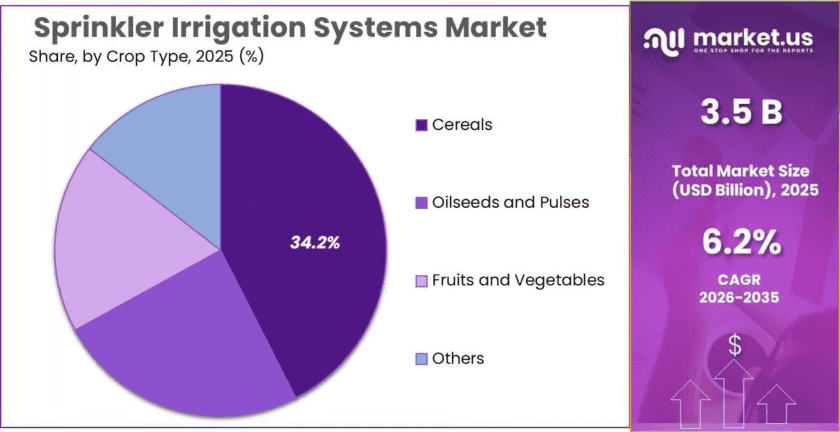
Center pivot systems led the type segment with a 45.00% share in 2025. Stationary systems accounted for 61.00%, cereals represented 42.50%, and agriculture made up 88.20% of the application segment. These figures indicate the importance of large-scale crop irrigation and fixed installations in the market. Future demand will depend on farm investment, water availability, energy costs, system affordability, and the adoption of automated irrigation controls.
Key Takeaways
- Market size: USD 3.5 billion in 2025, forecast to reach USD 6.3 billion by 2035.
- Growth rate: Projected CAGR of 6.2% from 2026 to 2035.
- Leading region: North America, with a 35.80% share and approximately USD 1.26 billion in 2025 revenue.
- Leading system type: Center pivot irrigation systems, with a 45.00% share.
- Leading mobility segment: Stationary systems, accounting for 61.00%.
- Leading crop segment: Cereals, representing 42.50%.
- Leading application: Agriculture, accounting for 88.20%.
Regional Analysis
North America held the leading position in 2025, accounting for 35.80% of the market, valued at approximately USD 1.26 billion, according to Market.us. Large commercial farms and mechanized crop production support demand for center pivot and other sprinkler systems. The United States Department of Agriculture reported that 212,714 farms irrigated 53.1 million acres in 2023, applying 81 million acre-feet of water. Its survey also recorded 12.6 million more irrigated acres using sprinkler systems than gravity irrigation, showing the scale of sprinkler use in the country.
Europe offers opportunities as farms respond to water stress, changing rainfall patterns, and the need for better water management. Demand varies by crop, climate, energy prices, and national irrigation infrastructure. Sprinkler systems can support cereal, forage, fruit, and vegetable production, but adoption depends on installation costs and local water rules.
Asia-Pacific is an important market for irrigation modernization because of its large agricultural base and varied water availability. Farms can use sprinkler systems to manage irrigation timing and distribute water across different field sizes. Uptake depends on farm economics, access to reliable pumps and power, local water resources, and government support.
Latin America has opportunities in cereal, oilseed, pasture, and other commercial crop production. Mechanized sprinkler systems can help larger farms manage water application across extensive fields. Investment is influenced by rainfall patterns, crop prices, financing conditions, and the availability of technical support.
The Middle East and Africa face a strong need to manage limited water supplies, although adoption is constrained in some areas by financing, infrastructure, energy access, and installation skills. Portable and shared systems may offer practical options for smaller farms, while large farms can consider mechanized systems where field conditions and budgets support them.
Globally, the Food and Agriculture Organization of the United Nations (FAO) reports that 23% of cropland is equipped for irrigation but produces 48% of global crop value. FAO also notes that more than 60% of irrigated land is in areas experiencing high or very high water stress. These figures highlight the importance of reliable irrigation infrastructure and careful water management.
Market Dynamics
1. Driver: Growing Need for Reliable Water Management
Water stress and unpredictable rainfall are increasing the need for reliable irrigation. FAO reports that irrigated land produces 48% of global crop value, despite covering 23% of cropland, and that irrigated yields average 76% higher than rain-fed yields.
Sprinkler systems help farmers apply water across fields in a controlled manner and schedule irrigation around crop requirements. Their value depends on correct design, pressure, weather, and maintenance. As farms seek to protect yields and manage limited water supplies, sprinkler systems remain an option for cereal, oilseed, forage, fruit, and vegetable production.
2. Trend: Automated and Sensor-Based Irrigation
Irrigation equipment is increasingly being paired with soil-moisture sensors, weather information, and automatic controls. These tools help farmers decide when and how much to irrigate rather than following fixed schedules.
USDA Agricultural Research Service research on variable-rate irrigation reported water-use reductions of 22% for corn and 11% for soybeans in a five-crop-year study in the Mississippi Delta. These results relate to a specific research method and location, not every sprinkler installation. Nevertheless, they show how precision controls can improve water management when the system is properly configured.
3. Restraint: High Installation and Operating Costs
Sprinkler systems require investment in pumps, pipes, sprinkler heads, valves, filtration, and sometimes automation. Farms may also need electrical upgrades, water storage, repairs, and trained installers. Operating costs can rise when pumping requires substantial energy or when equipment runs at unsuitable pressure.
These expenses may delay adoption by farms with limited credit or uncertain crop income. The cost-benefit case also varies by soil, field shape, crop, water source, and local climate. Suppliers can address some barriers through modular equipment, reliable after-sales service, shared systems, and clear estimates of total ownership costs.
4. Opportunity: Modernizing Existing Irrigation Infrastructure
Replacing poorly matched or ageing irrigation equipment with well-designed sprinkler systems can create opportunities for equipment suppliers, installers, and farm-service providers. USDA’s 2023 irrigation survey found 53.1 million irrigated acres across the United States and reported that sprinkler systems were used on substantially more acres than gravity irrigation.
Farms can also improve existing systems by upgrading pumps, correcting pressure, repairing leaks, and adding controls. The opportunity is not simply to install more equipment: site-specific design and scheduling are essential to ensure that water savings, crop performance, and energy use improve together.
Emerging Trends
1. Soil-Moisture Sensor Integration
Soil-moisture sensors help farmers determine when fields need watering. USDA research describes sensor-based irrigation scheduling as a way to match water application to crop and soil conditions. Linking sensors with sprinkler controls can reduce unnecessary irrigation, although results depend on sensor placement, calibration, and farm conditions.
2. Variable-Rate Irrigation
Variable-rate irrigation adjusts water delivery across different areas of a field instead of applying the same amount everywhere. USDA research reported water-use reductions of 22% in corn and 11% in soybeans in a specific five-crop-year study. This supports interest in more precise sprinkler management.
3. Center Pivot Automation
Center pivot systems can combine mechanized movement with remote monitoring and irrigation scheduling. USDA Agricultural Research Service notes that center pivots are used on 30 million acres in the United States. Adding sensors and control tools can help operators manage irrigation timing and reduce unnecessary pumping.
4. Water-Conservation-Focused System Design
Farmers and installers are placing greater attention on sprinkler spacing, operating pressure, nozzle selection, and irrigation scheduling. The USDA Natural Resources Conservation Service maintains a dedicated sprinkler-system conservation practice standard, reflecting the importance of proper system design. Effective installation can help reduce runoff and improve water distribution.
5. Climate-Adapted Irrigation Planning
Irrigation planning increasingly considers higher crop-water demand and changing weather patterns. FAO reports that climate change could raise evapotranspiration demand by 20% to 30% by 2050. Sprinkler systems combined with sound scheduling can help farms respond, although they cannot replace sustainable water-source management.
Use Cases
1. Cereal Farming
Wheat, maize, and other cereal farms can use sprinkler systems to distribute water across large fields during key growth stages. Center pivot systems are particularly suitable for some large, open fields. Water schedules should reflect soil moisture, rainfall, crop needs, and available pumping capacity.
2. Oilseed and Pulse Production
Oilseed and pulse growers can use sprinklers when rainfall does not meet crop requirements. Controlled application supports irrigation during sensitive growth stages, while scheduling helps avoid unnecessary watering. System selection depends on crop type, field layout, soil, water availability, and the cost of pumping.
3. Fruit and Vegetable Production
Vegetable farms and selected fruit-growing operations can use sprinkler systems to manage moisture across planted areas. Uniform distribution is important for crop quality, but excessive wetting can increase disease risks in some crops. Farmers need to consider crop sensitivity, local climate, nozzle type, and timing.
4. Pasture and Forage Production
Sprinkler irrigation can support pasture and forage crops used for livestock feed, especially where seasonal rainfall is unreliable. Systems help distribute water across grazing or cutting areas. Operators need to balance crop demand with available water, pump energy, and the costs of moving or maintaining equipment.
5. Parks, Sports Grounds, and Turf
Sprinkler systems are used to maintain grass in parks, sports fields, and landscaped properties. Automatic controllers can schedule watering outside peak daytime heat and help avoid overwatering. The appropriate schedule depends on local weather, soil drainage, turf requirements, and water restrictions.
Frequently Asked Questions on Sprinkler Irrigation Systems
1. What are sprinkler irrigation systems?
Sprinkler irrigation systems distribute water through pipes and sprinkler heads, applying it over crops or landscaped areas in a pattern similar to rainfall. They may be fixed, portable, towable, or mechanized, depending on field size and watering requirements.
2. What is the global Sprinkler Irrigation Systems Market size?
According to Market.us, the global market was valued at USD 3.5 billion in 2025. The report projects that it will reach USD 6.3 billion by 2035, with a compound annual growth rate of 6.2% over the forecast period.
3. Which region led the market in 2025?
Market.us identifies North America as the leading region in 2025, with a 35.80% market share and approximately USD 1.26 billion in revenue. Large-scale farming and established irrigation infrastructure support regional demand.
4. Which type of sprinkler irrigation system held the largest share?
Center pivot irrigation systems led the type segment in 2025, with a reported 45.00% share. They rotate around a central point and can irrigate broad fields, making them suitable for some large-scale farms with appropriate field layouts and water supplies.
5. Why are stationary systems widely used?
Stationary systems accounted for a reported 61.00% of the mobility segment in 2025. Their fixed installation can suit farms that require regular watering in designated areas. They can also be connected to pumps, valves, and controllers for scheduled operation.
6. Which crop segment held the largest share?
Cereals represented 42.50% of the market by crop type in 2025, according to Market.us. Sprinkler irrigation can support cereal crops by distributing water across cultivated fields, with the actual benefit depending on crop stage, rainfall, soil conditions, and system design.
Conclusion
The Sprinkler Irrigation Systems Market is positioned for continued growth as farms seek reliable ways to manage water and protect crop production. Market.us estimates that the market will increase from USD 3.5 billion in 2025 to USD 6.3 billion by 2035, at a CAGR of 6.2%. North America led the market in 2025, while center pivot systems, stationary installations, cereals, and agricultural applications held leading segment positions.
Automation, soil-moisture monitoring, and improved irrigation scheduling offer further opportunities. However, installation costs, energy requirements, and maintenance remain important barriers. Long-term growth will depend on cost-effective equipment, sound system design, and responsible water management.
Discuss your needs with our analyst
Please share your requirements with more details so our analyst can check if they can solve your problem(s)