Overview
New York, NY – Oct 15, 2026 – The global Water Cut Monitors Market supports oil and gas operations by measuring the percentage of water present in crude oil and other hydrocarbon streams. These instruments help operators monitor well performance, improve oil-water separation, maintain product quality, and reduce unnecessary water handling.
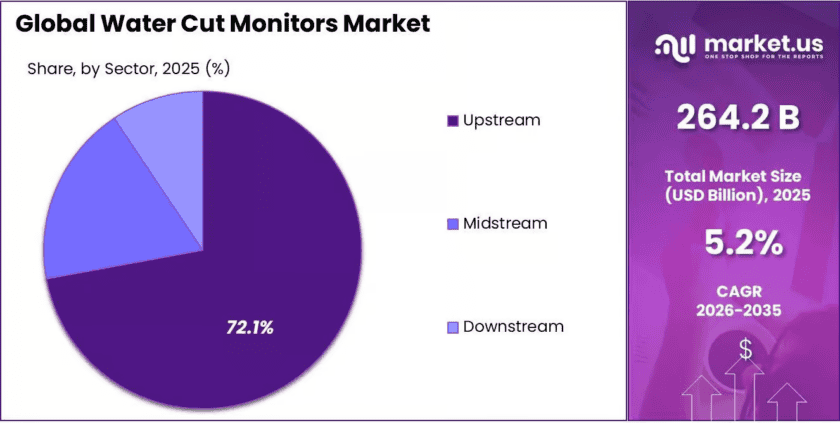
According to the supplied Market.us report, the market was valued at USD 264.2 billion in 2025 and is projected to reach USD 440.3 billion by 2035, at a compound annual growth rate (CAGR) of 5.2%. These figures are reproduced from the requested report and should be independently validated because the reported valuation appears unusually large for this specialized equipment category.
Demand is supported by oilfield automation, the management of increasing produced-water volumes, and the need for accurate real-time measurements. The United States produced a record 13.6 million barrels of crude oil per day in 2025, according to the U.S. Energy Information Administration (EIA), demonstrating the scale of operations that depend on reliable production monitoring.
Key Takeaways
- Market value: USD 264.2 billion in 2025, according to the supplied Market.us report.
- Forecast value: USD 440.3 billion by 2035.
- Projected growth: 5.2% CAGR from 2025 to 2035.
- Leading location segment: Onshore, with a reported 62.34% share in 2025.
- Leading sector: Upstream, with a reported 72.11% share.
- Leading application: Well testing, with a reported 26.89% share.
- Dominant region: North America, with a reported 33.21% share, equivalent to USD 87.7 billion.
Regional Analysis
North America
North America held the leading regional position in 2025, accounting for 33.21% of the reported market, valued at USD 87.7 billion. The region benefits from extensive oil and gas production, established pipeline infrastructure, and widespread investment in production monitoring. According to the EIA, U.S. crude oil output averaged a record 13.6 million barrels per day in 2025, up 3% from 2024. This production scale supports the need for reliable water-content measurement across wells, separation facilities, and processing operations.
Market Dynamics
1. Driver: Rising Need for Real-Time Production Monitoring
Water cut monitors help oil and gas operators measure water content continuously, identify changes in well output, and improve separation performance. As wells mature, water production can increase and raise treatment, transport, and disposal requirements.
The U.S. Environmental Protection Agency (EPA) identifies produced water as the largest wastewater stream by volume from oil and gas extraction. Reported water-to-oil ratios can range from less than 1:1 to more than 100:1, depending on the formation. This wide variation supports demand for accurate measurement systems that help operators manage fluid quality and operating costs.
2. Trend: Integration with Digital Oilfield Systems
A major trend is the integration of water cut monitors with digital control systems, remote dashboards, and automated production equipment. Real-time readings can help operators identify sudden changes in water content and adjust separation processes without waiting for repeated manual sampling.
The EIA reported that U.S. crude oil production averaged 13.6 million barrels per day in 2025, despite a lower number of active rigs than in 2024. Productivity improvements contributed to this result. As operators seek greater output from existing assets, digital monitoring and automated measurement can support more informed production decisions.
3. Restraint: High Installation and Calibration Costs
High installation costs can restrict adoption, especially at smaller wells and facilities with limited automation budgets. Water cut readings can also be affected by salinity, temperature, fluid composition, gas content, and changes in flow conditions. These factors may require site-specific calibration and periodic verification against representative samples.
The USGS maintains a national produced-water database containing approximately 113,000 samples from oil, gas, and geothermal operations, reflecting the range of water properties encountered in the field. Operators must select and maintain monitoring equipment suited to their actual fluid conditions.
4. Opportunity: Produced-Water Treatment and Reuse
Produced-water treatment and reuse create opportunities for monitoring equipment suppliers. Reliable measurements help operators understand fluid composition, improve separation, and manage water before treatment or reuse.
On March 12, 2025, the EPA announced a review of oil and gas wastewater rules to examine opportunities for beneficial reuse, including industrial cooling, power generation, irrigation, and other applications. Wider adoption of treatment and reuse systems could increase demand for continuous monitoring, particularly where water quality must be controlled throughout processing. The opportunity depends on applicable regulations, treatment performance, and the economics of local reuse projects.
Emerging Trends
1. Smart Sensors and Remote Monitoring
Smart water cut monitors can transmit readings to centralized control rooms, helping operators identify water-content changes without frequent site visits. This trend aligns with U.S. crude oil production reaching 13.6 million barrels per day in 2025, increasing the value of efficient monitoring across large production networks.
2. Improved Measurement Accuracy
Manufacturers are improving sensor designs to deliver reliable readings across changing water cuts, salinity levels, and fluid conditions. The EPA reports that produced-water-to-oil ratios can vary from less than 1:1 to more than 100:1, demonstrating why instruments need to suit different operating environments.
3. Integration with Automated Separators
Water cut monitors are increasingly relevant to automated separation systems, where readings can help operators adjust process settings and identify changes in fluid quality. The EPA’s March 2025 wastewater review also highlights the importance of improving produced-water management and treatment practices.
4. Support for Water Reuse
Treatment facilities need reliable monitoring to assess water before it is reused for suitable industrial or other permitted purposes. The EPA’s 2025 review considered reuse options such as cooling, power generation, and irrigation, creating potential opportunities for measurement suppliers.
5. Better Produced-Water Data
Digital records can help operators compare water properties across wells, improve treatment decisions, and track changes over time. The USGS produced-water database contains information from approximately 113,000 samples, providing a substantial scientific reference for understanding water chemistry and treatment needs.
Use Cases
1. Oil Well Testing
During well testing, water cut monitors measure the water proportion in produced fluids and help operators assess well performance. U.S. crude oil production averaged 13.6 million barrels per day in 2025, illustrating the scale of production operations where dependable fluid measurement is important.
2. Oil-Water Separation
At separation vessels, monitors help operators track changes in water content and evaluate whether separation is working as intended. The EPA notes that produced-water-to-oil ratios can exceed 100:1 in some formations, making effective fluid separation and water management important.
3. Pipeline and Storage Monitoring
Water cut monitors can help detect excess water before crude oil enters storage tanks or moves through processing systems. Early detection supports product-quality checks and helps reduce avoidable water-handling requirements. The equipment is particularly useful where multiple wells feed a shared pipeline or storage facility.
4. Refinery Feed Quality
Refineries can use water-content measurements to check incoming hydrocarbon streams and identify potential problems before processing. Reliable monitoring helps operators manage feed quality and reduce the risk of excess water affecting downstream equipment. Appropriate installation and calibration are essential because crude composition and operating conditions vary.
5. Produced-Water Treatment
At treatment facilities, water cut readings can support the initial separation and routing of water-rich streams before further treatment. The EPA’s March 2025 regulatory review identified beneficial reuse as an area for consideration, including industrial cooling and power generation. Monitoring can help operators manage these processes, although water cut alone does not establish whether water is safe for reuse.
Frequently Asked Questions on Water Cut Monitors and the Market
1. What are water cut monitors?
Water cut monitors are instruments that measure the percentage of water in crude oil or other hydrocarbon streams. They help operators monitor fluid quality, assess production performance, and improve oil-water separation during extraction and processing.
2. What is the reported Water Cut Monitors Market size?
The supplied Market.us report values the market at USD 264.2 billion in 2025 and projects it to reach USD 440.3 billion by 2035. These figures should be independently verified because the valuation appears unusually high for this equipment category.
3. What is driving demand for water cut monitors?
Demand is supported by oilfield automation, increasing produced-water management needs, and the requirement for accurate fluid measurements. The EPA reports that produced-water-to-oil ratios can range from less than 1:1 to more than 100:1, depending on the formation.
4. Which region leads the Water Cut Monitors Market?
According to the supplied report, North America led in 2025 with a 33.21% share, valued at USD 87.7 billion. Its established oil and gas infrastructure and large production volumes support demand for monitoring equipment.
5. What are the main applications of water cut monitors?
Major applications include well testing, separation vessels, lease automatic custody transfer systems, tank farms, pipelines, multiphase flow meters, and refineries. These instruments help operators monitor water content, maintain fluid quality, and improve production and separation decisions.
Conclusion
The Water Cut Monitors Market supports oil and gas operations by improving fluid measurement, production control, and water management. Demand is influenced by oilfield automation, mature wells, and the need to manage produced water more efficiently. North America remains the leading region according to the supplied market report, while treatment and reuse initiatives create additional opportunities.
Digital monitoring, improved sensor accuracy, and integration with automated separation equipment are important industry trends. However, installation costs, calibration requirements, and changing fluid conditions remain challenges. The reported market valuation and forecast should be independently validated before publication or use in investment decisions.
Discuss your needs with our analyst
Please share your requirements with more details so our analyst can check if they can solve your problem(s)