Overview
New York, NY – October 22, 2026 – The global Ultrasonic Flow Meter Market is gaining importance as industrial operators seek accurate, non-invasive methods to measure liquid and gas flow. Ultrasonic flow meters use sound waves to determine flow velocity and calculate the volume passing through a pipe. These instruments are used in oil and gas, water and wastewater treatment, chemical processing, power generation, and other industrial applications.
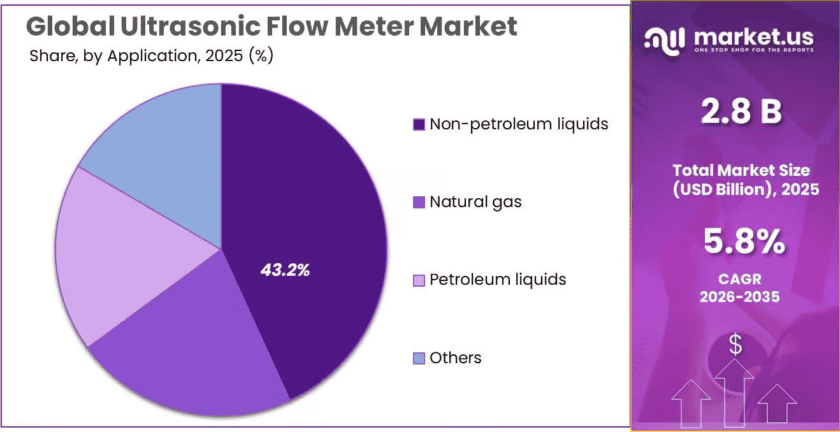
According to the Market.us Ultrasonic Flow Meter Market report, the market’s 2025 segmentation shows that spool-piece meters accounted for 34.0%, one-path configurations represented 38.0%, non-petroleum liquids contributed 43.0%, oil and gas accounted for 28.0%, and direct sales represented 53.5%. Asia-Pacific led the regional market with a 38.0% share, equivalent to approximately USD 1.0 billion.
Government agencies also support the wider adoption of accurate flow measurement through industrial energy-efficiency programmes, water management standards, and measurement guidance. As facilities modernise their operations, ultrasonic technology offers opportunities to improve process monitoring, identify abnormal flow conditions, and strengthen resource management.
Key Takeaways
- Market value: The Ultrasonic Flow Meter Market is estimated at USD 2.6 billion in 2025.
- Leading meter type: Spool-piece meters accounted for 34.0% of the market.
- Leading path configuration: One-path meters represented 38.0%.
- Leading fluid application: Non-petroleum liquids contributed 43.0%.
- Leading end-use industry: Oil and gas accounted for 28.0%.
- Leading sales channel: Direct sales represented 53.5%.
- Regional leader: Asia-Pacific held a 38.0% share, valued at approximately USD 1.0 billion.
Regional Analysis
Asia-Pacific: Dominating Region
Asia-Pacific held a 38.0% share of the Ultrasonic Flow Meter Market in 2025, representing approximately USD 1.0 billion. Demand is supported by industrial production, water infrastructure, energy distribution, and investments in process automation. Ultrasonic meters are useful in applications where operators need to monitor flow without introducing significant restrictions into a pipe.
The EPA notes that clamp-on ultrasonic meters are non-intrusive and can be used to measure wastewater and corrosive liquids in suitable installations. Industrial development and water management projects provide opportunities for suppliers, although requirements differ across countries and industries.
North America: Advanced Measurement Infrastructure
North America remains an important market because of its established oil and gas infrastructure, industrial facilities, and flow calibration capabilities. NIST operates natural gas flow calibration services in which ultrasonic meters are the most commonly calibrated meter type.
Its calibration service covers pipe sizes from 12 to 30 inches, demonstrating the relevance of ultrasonic measurement in larger gas-flow systems. Accurate flow measurement is important for process control, commercial transactions, and industrial monitoring. Demand also comes from water utilities, wastewater facilities, and plants seeking to modernise measurement systems.
Europe: Industrial Efficiency and Process Monitoring
Europe offers opportunities across chemical processing, energy infrastructure, water utilities, and manufacturing. Ultrasonic meters can help operators monitor flow without placing moving components in the fluid stream, making them useful for selected applications involving corrosive liquids and existing pipe systems.
Water management and industrial efficiency programmes also encourage businesses to improve measurement and identify process losses. However, instrument selection must account for fluid characteristics, pipe condition, installation geometry, and the required accuracy. Calibration and compliance with applicable measurement standards remain important for industrial deployment.
Latin America, Middle East and Africa: Infrastructure-Led Opportunities
These regions present opportunities in oil and gas production, water distribution, desalination, wastewater treatment, and industrial processing. Ultrasonic meters may be suitable for pipeline monitoring and applications where non-invasive installation reduces disruption. In oil and gas facilities, reliable flow measurement can support operational control and product accounting.
Water utilities can use portable clamp-on devices to assess flow at different points in a network. Adoption may be limited by capital costs, maintenance skills, calibration access, and the suitability of local operating conditions. Supplier training and regional service networks can help address these barriers.
Market Dynamics
1. Driver: Demand for Accurate Industrial Flow Measurement
Industries need reliable flow data to manage water consumption, monitor industrial processes, and measure gases and liquids moving through pipelines. Ultrasonic meters offer a useful option because they calculate flow using acoustic signals and can be installed externally in suitable clamp-on applications. The EPA identifies these meters as suitable for many commercial uses, including wastewater and corrosive liquids.
NIST also provides calibration services for ultrasonic gas meters, supporting reliable measurement in industrial applications. As facilities modernise monitoring systems and seek to reduce maintenance interruptions, demand for ultrasonic technology can benefit. However, performance depends on correct installation, calibration, and the properties of the measured fluid.
2. Trend: Non-Invasive and Digital Measurement
A major trend is the use of clamp-on ultrasonic meters that measure flow without requiring a pipe to be opened. This can reduce installation disruption and allow temporary measurements at different locations.
According to the EPA, portable ultrasonic meters can support spot checks during water assessments and routine monitoring. Digital models also provide electronic outputs that can be integrated into control and monitoring systems, depending on product capabilities. These features help operators review flow conditions and identify unusual consumption. In practice, users still need to consider pipe material, sensor positioning, flow profile, and calibration to obtain dependable results.
3. Restraint: Installation Conditions and Measurement Accuracy
Ultrasonic flow meters can be affected by distorted flow profiles, swirl, bubbles, suspended particles, and unsuitable sensor placement. NIST research on commercially available clamp-on meters reported errors ranging from 1% to 3% under nearly ideal water-flow installation conditions in its evaluated systems.
This historical study highlights why users should not assume that all ultrasonic meters deliver the same accuracy in every application. Pipe geometry, calibration, fluid properties, and the number of acoustic paths can affect results. Operators may need straight pipe sections, suitable installation procedures, and periodic verification, increasing the total cost and complexity of deployment.
4. Opportunity: Water Conservation and Pipeline Monitoring
Water utilities and industrial facilities can use ultrasonic meters to investigate leaks, compare consumption, and assess flow through existing pipelines. The EPA explains that portable ultrasonic meters can be used to spot-check flow during water assessments, while clamp-on models can avoid pressure loss caused by inserting a measuring element into the pipe.
These features create opportunities in commercial buildings, wastewater systems, industrial plants, and water distribution networks. In gas applications, NIST’s calibration services support reliable flow measurement over pipe sizes from 12 to 30 inches. Wider adoption will depend on cost, required accuracy, installation suitability, and access to calibration services.
Emerging Trends in Ultrasonic Flow Meter Technology
1. Wider Use of Clamp-On Meters
Clamp-on ultrasonic meters can measure flow without cutting into a pipe. The EPA identifies these meters as non-intrusive and low-maintenance. This approach can help facilities inspect existing pipelines while avoiding process interruptions and pressure losses associated with inserted measuring devices.
2. Better Calibration and Accuracy
Calibration is important for reliable ultrasonic measurement. NIST operates a natural gas flow calibration service covering pipe sizes from 12 to 30 inches. Improved calibration procedures help operators assess measurement uncertainty and maintain confidence in industrial gas-flow readings.
3. Multi-Path Measurement Technology
Multi-path ultrasonic meters use several acoustic paths to assess flow across a pipe. NIST research has examined an eight-path ultrasonic meter and reported measurement uncertainty of ±2% or better in the evaluated setup. Multi-path designs can help address uneven flow profiles.
4. Portable Flow Assessments
Portable ultrasonic meters allow technicians to check flow at different locations without permanent installation. The EPA recommends portable units for spot-checking flow during water assessments and routine monitoring. This supports facility audits, consumption investigations, and maintenance planning.
5. Integration With Industrial Monitoring
Ultrasonic meters with compatible electronic outputs can supply flow readings to industrial control and monitoring systems. Operators can use these data to track process conditions and investigate unusual consumption. Reliable readings still depend on suitable installation, calibration, and operating conditions.
Use Cases of Ultrasonic Flow Meters
1. Water Distribution Monitoring
Water utilities can use ultrasonic meters to measure flow through supply pipes and investigate unusual consumption. Portable devices support spot checks at multiple locations. The EPA identifies these meters as useful tools for commercial water assessments and routine monitoring.
2. Wastewater Treatment Plants
Wastewater facilities need dependable flow measurements to support treatment operations and regulatory monitoring. The EPA recognises ultrasonic meters as an option for closed-channel flow measurement. Correct installation, calibration, and maintenance are essential to ensure that the readings remain suitable for operational or reporting purposes.
3. Oil and Gas Pipelines
Oil and gas operators use ultrasonic meters to measure gas and liquid movement through pipelines. NIST offers natural gas flow calibration services covering 12- to 30-inch pipe sizes. Reliable measurements can support process control, flow accounting, and operational monitoring.
4. Industrial Energy Audits
Factories can use portable ultrasonic meters to measure water and other compatible fluids at selected points in their systems. These measurements help engineers compare flow rates, identify unusual consumption, and evaluate process performance without permanently modifying every pipeline.
5. Corrosive Liquid Applications
Ultrasonic meters can be useful for monitoring certain corrosive liquids because suitable clamp-on designs do not contact the fluid directly. The EPA identifies corrosive-liquid measurement as an application for these devices. Pipe material, liquid properties, and sensor compatibility must still be assessed.
Frequently Asked Questions on Ultrasonic Flow and the Ultrasonic Flow Meter Market
1. What is an ultrasonic flow meter?
An ultrasonic flow meter measures liquid or gas flow using sound waves. Depending on the design, it calculates flow from differences in acoustic travel time or frequency. These readings help determine fluid velocity and estimate volumetric flow.
2. What is the value of the Ultrasonic Flow Meter Market?
The supplied Market.us report data indicate a market value of approximately USD 2.6 billion in 2025. Asia-Pacific accounted for 38.0%, representing approximately USD 1.0 billion. Forecast figures should be verified against the report’s current published edition.
3. Which meter type leads the market?
Spool-piece meters accounted for 34.0% of the market in 2025, according to the supplied segmentation figures. These meters are installed directly within a pipeline and are selected according to pipe dimensions, fluid properties, operating conditions, and required measurement performance.
4. Which path configuration holds the largest share?
One-path configurations represented 38.0% of the market in 2025. These meters use a single acoustic path to measure flow. Their suitability depends on the application, required accuracy, flow profile, pipe geometry, and instrument design.
5. Which application leads the market?
Non-petroleum liquids accounted for 43.0% of the market in 2025. Applications can include water, wastewater, and compatible industrial liquids. Ultrasonic measurement offers advantages where non-invasive installation and limited interference with fluid flow are important.
Conclusion
The Ultrasonic Flow Meter Market supports industrial measurement across water management, oil and gas, wastewater treatment, and manufacturing. In 2025, spool-piece meters accounted for 34.0% of the market, while non-petroleum liquids represented 43.0%. Asia-Pacific led with a 38.0% share, valued at approximately USD 1.0 billion.
Non-invasive installation, portable measurement, and improvements in multi-path technology create opportunities for wider adoption. However, accuracy depends on calibration, pipe conditions, and correct sensor placement. As industrial operators seek better process monitoring and resource management, ultrasonic flow meters are expected to remain important tools for measuring liquid and gas movement.
Discuss your needs with our analyst
Please share your requirements with more details so our analyst can check if they can solve your problem(s)