Overview
New York, NY – Oct 16, 2026 – The humic-based biostimulants market is gaining attention as farmers seek practical ways to improve soil health, nutrient availability, and crop performance. Humic substances, including humic acid and fulvic acid, are used in agricultural products designed to support root development, improve nutrient uptake, and help crops manage environmental stress. These products are applied to soil, seeds, and crops through different farming systems.
Interest in humic-based biostimulants is supported by growing attention to soil quality, efficient fertilizer use, and sustainable agricultural practices. Their performance depends on soil conditions, crop type, product composition, application rate, and farm management practices. As a result, farmers and agricultural suppliers are placing greater importance on product quality and field-based evidence.
Government-backed soil conservation and nutrient management programs also provide a supportive setting for the industry. The United States Department of Agriculture (USDA) promotes soil health practices such as cover cropping, reduced tillage, and improved nutrient management, which can complement the use of soil amendments and biostimulant products. However, humic-based biostimulants are not a substitute for balanced fertilization or sound crop management. Future adoption will depend on reliable field results, clear product claims, affordability, and compatibility with existing farming practices.
Key Takeaways
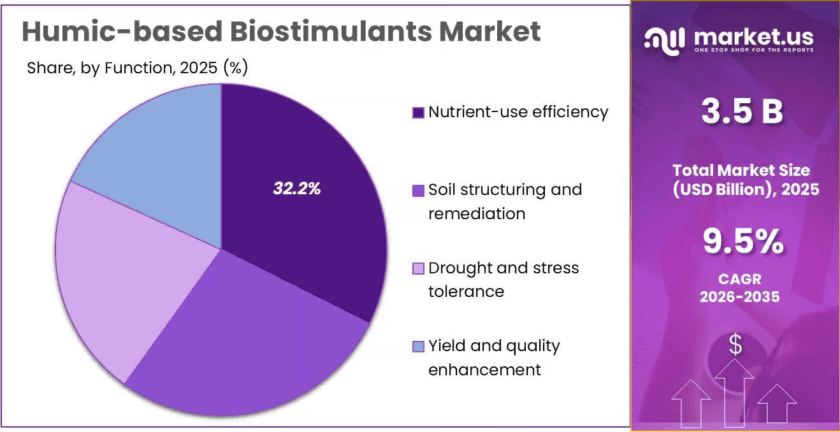
- Market value: The market was valued at USD 3.5 billion in 2025 and is projected to reach USD 8.6 billion by 2035, at a reported compound annual growth rate (CAGR) of 9.5%.
- Leading type: Humic acid accounted for more than 44.00% of the market in 2025.
- Leading raw material: Leonardite held more than 51.00% of the source segment.
- Leading product form: Liquid formulations captured more than 61.00% of the form segment.
- Leading application: Soil treatment accounted for more than 44.00% of the application-method segment.
- Leading crop group: Cereals and grains represented more than 42.00% of the crop-type segment.
- Leading function: Nutrient-use efficiency held more than 32.00% of the functional segment.
- Leading region: Europe accounted for 32.00%, representing USD 1.1 billion, in 2025.
Regional Analysis
Europe was the leading regional market in 2025, accounting for 32.00% of global revenue, equivalent to USD 1.1 billion. Demand is supported by soil-health initiatives, nutrient management, and a formal regulatory framework for plant biostimulants. European Union Regulation 2019/1009 sets requirements for product safety, quality, labelling, and contaminant limits.
These rules encourage suppliers to establish consistent product composition and support claims with suitable evidence. North America also offers opportunities through interest in soil conservation, improved nutrient use, and agricultural products designed to support crop resilience. Asia-Pacific, Latin America, and other agricultural regions offer potential as farmers address soil degradation, irregular rainfall, and input costs.
Market Dynamics
1. Driver: Growing Focus on Nutrient Efficiency and Soil Health
Farmers are increasingly looking for ways to improve nutrient use, maintain soil structure, and manage water more effectively. Humic-based biostimulants are used alongside fertilizers to support root development and nutrient availability, although results depend on crop and soil conditions.
The United States Department of Agriculture’s Natural Resources Conservation Service reports that soil organic matter can hold 10 to 1,000 times more water and nutrients than the same amount of soil minerals. This highlights the importance of organic matter in soil management and supports interest in products that complement soil-health practices.
2. Trend: Greater Focus on Product Quality and Regulatory Compliance
Manufacturers are placing more attention on formulation consistency, contaminant testing, and clear product claims. This is important because humic substances can vary according to their source and processing method.
In the European Union, Regulation 2019/1009 establishes requirements for plant biostimulants and sets contaminant limits, including 1.5 milligrams per kilogram for cadmium and 120 milligrams per kilogram for lead in relevant fertilising products. These requirements encourage quality control and product verification. Suppliers that maintain reliable composition and clear application guidance can strengthen customer confidence.
3. Restraint: Variable Results Across Crops and Soil Conditions
One of the main challenges is that humic-based biostimulants do not produce the same results in every field. Their performance can change with soil pH, crop type, weather, application rate, and formulation quality. Farmers may hesitate to purchase products when benefits are difficult to measure or repeat.
The USDA recommends assessing soil health through physical, chemical, and biological indicators, including soil pH, nutrient availability, infiltration, and organic matter. These measures can help growers evaluate field conditions before using biostimulants. Without suitable trials and clear instructions, inconsistent outcomes can limit repeat purchases.
4. Opportunity: Crop-Specific Products and Soil Monitoring Services
Manufacturers can expand by developing humic-based formulations for specific crops, soil types, and application methods. Products designed for fertigation, seed treatment, or targeted soil application may help growers integrate them into existing farm operations.
There is also an opportunity to combine products with soil testing, agronomic advice, and digital monitoring. The European Union’s carbon removal and carbon farming certification framework provides a pathway for verified agricultural climate activities, with monitoring and verification requirements. Suppliers may explore related services, provided that environmental benefits are measured and independently verified rather than assumed from product use alone.
Emerging Trends
1. Liquid Formulations for Easier Application
Liquid products are attractive because they can be incorporated into suitable irrigation and spraying systems. In 2025, liquid formulations represented more than 61.00% of the market’s form segment. Product compatibility, correct dilution, and label instructions remain important for effective use.
2. Greater Attention to Soil Organic Matter
Farmers are increasingly adopting soil-health practices to improve water retention, nutrient cycling, and soil structure. The USDA reports that soil organic matter supports these functions. Humic-based products may complement wider soil management practices, but they do not replace cover crops or other conservation measures.
3. More Crop-Specific Formulations
Suppliers are exploring products tailored to cereals, grains, fruits, vegetables, and other crop groups. Cereals and grains accounted for more than 42.00% of the market’s crop-type segment in 2025. Targeted trials can help identify which formulations suit particular crops and growing conditions.
4. Stronger Quality and Safety Checks
Product manufacturers are paying greater attention to contaminant levels, raw-material quality, and consistent composition. European Union rules specify limits for several contaminants in relevant fertilising products, including 1.5 milligrams per kilogram for cadmium. This encourages careful testing and traceability.
5. Integration With Precision Agriculture
Precision agriculture can help growers adjust inputs according to soil and crop conditions. Soil testing, irrigation data, and field records can guide the placement and evaluation of humic-based products. The USDA highlights the value of soil indicators such as pH, nutrient levels, and water infiltration in assessing soil health.
Use Cases
1. Soil Treatment for Cereal Crops
Humic-based products can be applied to soil around crops such as wheat and maize to support nutrient availability and root development. In 2025, soil treatment accounted for more than 44.00% of the application-method segment. Results depend on soil conditions and the product used.
2. Nutrient Management in Irrigated Farming
Suitable liquid humic formulations can be applied through compatible irrigation systems to complement fertilizer programs. The USDA notes that a 1% increase in soil organic matter can help soil retain an additional 20,000 gallons of water per acre. This relates to soil organic matter, not a guaranteed result from humic products.
3. Supporting Soil Management in Drought-Prone Areas
Growers may use humic-based products as part of broader soil and crop management programs in areas facing irregular rainfall. The USDA identifies water infiltration and soil water-holding capacity as important soil-health indicators. Field trials help determine whether a particular product benefits crops under local conditions.
4. Improving Nutrient Programs in Horticulture
Fruit and vegetable growers may incorporate humic-based biostimulants into soil or fertigation programs where permitted by product instructions. These products can complement nutrient management, but their performance should be checked through crop-specific trials. Soil pH, nutrient availability, and water conditions help guide application decisions.
5. Soil Restoration and Long-Term Farm Management
Farmers can evaluate humic-based products as part of wider soil restoration programs that include cover crops, reduced tillage, and residue management. The USDA identifies cover cropping as a practice that can reduce erosion and nutrient runoff while supporting soil organic matter and water infiltration.
Frequently Asked Questions
1. What is the humic-based biostimulants market?
The humic-based biostimulants market covers agricultural products made from humic acid, fulvic acid, and related substances. These products are used to support plant nutrition, soil management, and crop performance alongside established farming practices.
2. What was the market value in 2025?
According to the supplied market report, the global humic-based biostimulants market was valued at USD 3.5 billion in 2025. This is a market estimate from the referenced report, not a government-reported industry statistic.
3. What is the projected market value by 2035?
The referenced report projects that the market will reach USD 8.6 billion by 2035, with a reported compound annual growth rate of 9.5% over the 2026–2035 forecast period.
4. Which product type led the market in 2025?
Humic acid was the leading type in 2025, accounting for more than 44.00% of the market’s type segment. Its use in soil conditioning and nutrient management supports its position in agricultural formulations.
5. Which region held the largest market share?
Europe led the market in 2025, accounting for 32.00% of global revenue, valued at USD 1.1 billion. Soil-health priorities and a common regulatory framework for eligible plant biostimulants support regional demand.
Conclusion
The humic-based biostimulants market is attracting interest as agriculture places greater emphasis on soil health, nutrient efficiency, and crop resilience. The referenced report values the market at USD 3.5 billion in 2025 and projects USD 8.6 billion by 2035, at a 9.5% CAGR. Liquid formulations, humic acid products, and soil treatment held leading positions in their respective segments.
However, inconsistent field results, raw-material variability, and compliance requirements remain important challenges. Future opportunities lie in crop-specific formulations, reliable field testing, and integration with precision agriculture. Long-term adoption will depend on measurable benefits, product quality, and farmer confidence.
Discuss your needs with our analyst
Please share your requirements with more details so our analyst can check if they can solve your problem(s)