Overview
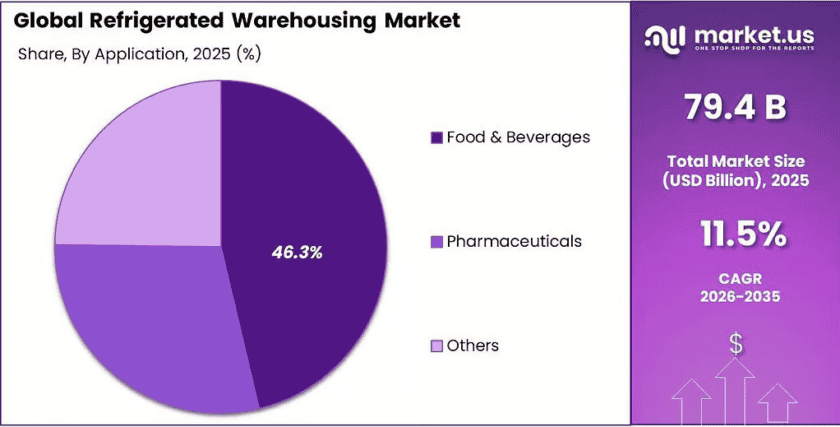
New York, NY – Oct 27, 2026 – The global Refrigerated Warehousing Market is expanding as food producers, retailers, pharmaceutical companies, and distributors seek reliable temperature-controlled storage. According to Market.us, the market was valued at USD 79.4 billion in 2025 and is projected to reach USD 234.8 billion by 2035, growing at a compound annual growth rate (CAGR) of 11.5% over the forecast period of 2026 to 2035.
Refrigerated warehouses protect products that can lose quality or become unsafe when exposed to unsuitable temperatures. They store frozen meat, seafood, dairy products, fruits, vegetables, ready meals, and selected medicines. Their services include temperature-controlled storage, inventory management, loading, order preparation, and distribution support.
In 2025, North America led the market with a 34.78% share, equivalent to USD 27.5 billion. Public refrigerated warehouses accounted for 66.56%, while frozen storage operating between -18°C and -25°C held 63.00%. Food and beverages represented 46.34% of the market.
Government data also highlights the importance of cold storage. The United States Department of Agriculture reported 931 refrigerated warehouses in the United States on October 1, 2025, with 3.99 billion cubic feet of gross capacity. Investment in efficient refrigeration, temperature monitoring, and modern warehouse systems remains important for reducing food losses and maintaining product quality.
Key Takeaways
- Market size in 2025: USD 79.4 billion.
- Projected market size by 2035: USD 234.8 billion.
- Forecast CAGR: 11.5% from 2026 to 2035.
- Leading region: North America, with a 34.78% share and USD 27.5 billion in revenue in 2025.
- Leading warehouse type: Public refrigerated warehouses, with a 66.56% share.
- Leading temperature range: Frozen storage from -18°C to -25°C, with a 63.00% share.
- Leading application: Food and beverages, accounting for 46.34%.
- Government capacity benchmark: The United States had 3.25 billion cubic feet of usable refrigerated warehouse capacity in 2025.
Regional Analysis
North America: North America led the market in 2025, accounting for 34.78% of global revenue, or USD 27.5 billion. The region benefits from established food distribution networks, large frozen-food supply chains, and demand from retailers and food manufacturers. The USDA counted 931 refrigerated warehouses in the United States in October 2025. Operators face growing pressure to improve energy performance, manage capacity efficiently, and meet changing refrigerant requirements.
Europe: Europe is supported by established food processing, supermarket distribution, pharmaceutical logistics, and cross-border trade. Demand includes chilled and frozen storage for dairy, meat, seafood, prepared food, and temperature-sensitive medicines. Energy efficiency and refrigerant transitions are important considerations for warehouse operators. Investment opportunities include automated handling, improved insulation, efficient cooling equipment, and digital temperature monitoring.
Market Dynamics
Driver: Rising Need to Protect Perishable Food
Demand for refrigerated warehousing is driven by the need to maintain food quality from production to consumption. Meat, seafood, dairy products, fruits, and vegetables can deteriorate when temperature control is inadequate. The Food and Agriculture Organization reports that insufficient refrigeration contributes to the loss or waste of 526 million tonnes of food, around 12% of the global total.
Reliable cold storage can reduce spoilage, support longer distribution routes, and help food businesses manage seasonal supply. Growth in frozen-food distribution and online grocery delivery also increases the need for warehouses that can handle different temperatures and prepare orders quickly.
Trend: Energy-Efficient Refrigeration and Lower-Impact Refrigerants
Warehouse operators are placing greater attention on energy use, refrigeration controls, and refrigerant selection. Cold storage requires continuous cooling, so inefficient equipment can increase operating costs and emissions.
The United States Environmental Protection Agency lists refrigerant global warming potential limits for cold storage warehouse systems, including an interim limit of 700 from July 27, 2026. From January 1, 2032, the limit becomes 150 or 300, depending on refrigerant charge size and system configuration. These requirements encourage operators to plan equipment upgrades carefully, assess compliant refrigerants, and consider energy-efficient systems when building or modernizing facilities.
Restraint: High Operating Costs and Dependence on Reliable Power
Refrigerated warehouses must maintain suitable temperatures continuously, making electricity supply and cooling equipment essential to daily operations. Power interruptions, equipment failures, poor insulation, and inadequate maintenance can threaten stored products and increase costs. Facilities may also need substantial investment in refrigeration machinery, backup power, temperature sensors, and insulated structures.
These requirements can be difficult for smaller operators or businesses in locations with unreliable electricity. The Food and Agriculture Organization highlights that limited access to dependable energy complicates cold-chain development in some food-producing areas. Operators therefore need sound maintenance plans, energy management, and contingency arrangements to protect inventory.
Opportunity: Expanding Cold Chains to Reduce Food Loss
A major opportunity lies in developing reliable cold storage closer to farms, seafood landing sites, food processors, ports, and urban distribution centers. The FAO reports that cold-chain technologies could prevent 144 million tonnes of food waste annually in developing countries.
New facilities and upgrades to existing warehouses can help food businesses extend product life, reduce losses during transport, and improve access to distant markets. Investment opportunities include solar-supported cooling where appropriate, improved insulation, automated handling, digital temperature records, and multi-temperature storage. Public-private investment and better links between storage and transport can also strengthen supply chains in underserved areas.
Emerging Trends
1. Automated storage and retrieval: Warehouses are increasingly using automated storage, conveyors, and digital inventory systems to move goods with fewer manual steps. Automation can improve stock tracking and picking accuracy, particularly in large facilities handling high volumes of frozen and chilled products.
2. Real-time temperature monitoring: Digital sensors can track warehouse temperatures and alert staff when conditions move outside set limits. Continuous monitoring supports product quality and creates records for audits. This is especially important for food and medicines that require controlled storage.
3. Lower-global-warming-potential refrigerants: Refrigerant rules are encouraging operators to assess alternatives and plan upgrades. The United States EPA lists an interim global warming potential limit of 700 from July 27, 2026, with stricter limits scheduled for 2032 for covered cold storage systems.
4. Energy-efficient facility upgrades: Improved insulation, efficient compressors, variable-speed equipment, and better control systems can help reduce power use. These measures are important because refrigerated warehouses need cooling around the clock and must maintain stable conditions despite changes in outdoor temperature.
5. Cold-chain expansion to reduce food losses: More investment in refrigerated storage and transport can help preserve food between farms, processors, retailers, and consumers. The FAO estimates that 526 million tonnes of food are lost or wasted globally because of insufficient refrigeration.
Use Cases
1. Frozen meat and seafood storage: Refrigerated warehouses maintain frozen meat, poultry, and seafood at suitable temperatures before distribution. USDA data shows that freezer space represented about 79% of usable refrigerated warehouse capacity in the United States in 2025, underlining the importance of frozen storage.
2. Fresh fruit and vegetable distribution: Chilled storage helps slow deterioration after harvesting and supports the movement of produce to retailers and food processors. Maintaining suitable conditions can reduce spoilage when products travel long distances or wait for shipment.
3. Dairy and prepared-food supply chains: Milk products, cheese, ready meals, and other temperature-sensitive foods rely on controlled storage between manufacturing and delivery. Warehouses can combine chilled zones, inventory tracking, and order preparation to support regular deliveries to supermarkets and food-service businesses.
4. Pharmaceutical and medical product storage: Some medicines require specified storage conditions to maintain stability and quality. Refrigerated facilities can use calibrated monitoring equipment, access controls, documented procedures, and alarm systems to help maintain the conditions required for sensitive products.
5. Food security and emergency supply: Refrigerated warehouses can hold perishable food before distribution during supply disruptions or emergencies. The FAO estimates that cold-chain technologies could prevent 144 million tonnes of food waste each year in developing countries, demonstrating the potential value of improved storage infrastructure.
Frequently Asked Questions
1. What is the Refrigerated Warehousing Market?
The Refrigerated Warehousing Market covers facilities that store products under controlled temperatures. These warehouses support food producers, retailers, distributors, and pharmaceutical businesses by protecting perishable goods and maintaining suitable storage conditions before products reach their destinations.
2. What was the market value in 2025?
According to Market.us, the global Refrigerated Warehousing Market was valued at USD 79.4 billion in 2025. The sector serves food and beverage supply chains, frozen goods distribution, and other industries that depend on temperature-controlled storage.
3. What is the projected market value by 2035?
Market.us projects the market will reach USD 234.8 billion by 2035. This outlook reflects the expected expansion of temperature-controlled logistics, although actual growth will depend on investment, operating costs, energy availability, and demand from end users.
4. What is the expected CAGR?
The market is projected to grow at a CAGR of 11.5% over the 2026–2035 forecast period, according to Market.us. CAGR represents the annualized growth rate over a period and does not mean the market will grow by exactly the same amount each year.
5. Which region led the market in 2025?
North America held the leading position in 2025, with a 34.78% share and revenue of USD 27.5 billion, according to Market.us. The region benefits from established food distribution networks and significant demand for frozen and chilled storage.
6. Which warehouse type held the largest market share?
Public refrigerated warehouses held the largest share, at 66.56% in 2025, according to Market.us. These facilities provide storage services to multiple customers, allowing food manufacturers, retailers, importers, and distributors to use shared temperature-controlled infrastructure.
7. Why is frozen storage important?
Frozen storage helps preserve meat, seafood, vegetables, prepared meals, and other products that need consistently low temperatures. USDA data shows that freezer space accounted for approximately 79% of usable refrigerated warehouse capacity in the United States in 2025.
Conclusion
The Refrigerated Warehousing Market plays an important role in protecting food quality, supporting pharmaceutical storage, and connecting producers with consumers. Market.us values the market at USD 79.4 billion in 2025 and projects it to reach USD 234.8 billion by 2035, at a CAGR of 11.5%.
North America led in 2025, while public warehouses, frozen storage, and food and beverages represented the largest reported segments. Government evidence also highlights the scale of the cold-chain challenge, with insufficient refrigeration linked to substantial food losses. Future growth will depend on reliable power, efficient cooling, digital monitoring, and investment in modern storage infrastructure.
Discuss your needs with our analyst
Please share your requirements with more details so our analyst can check if they can solve your problem(s)