Overview
New York, NY – Oct 30, 2026 – The global Water Hardness Test Strip Market is gaining attention as households, industrial facilities, laboratories, and water treatment operators increasingly focus on monitoring water quality. Water hardness test strips are simple chemical testing products used to estimate dissolved calcium and magnesium concentrations. They provide quick results through colour changes, allowing users to identify whether water is soft, moderately hard, hard, or very hard.
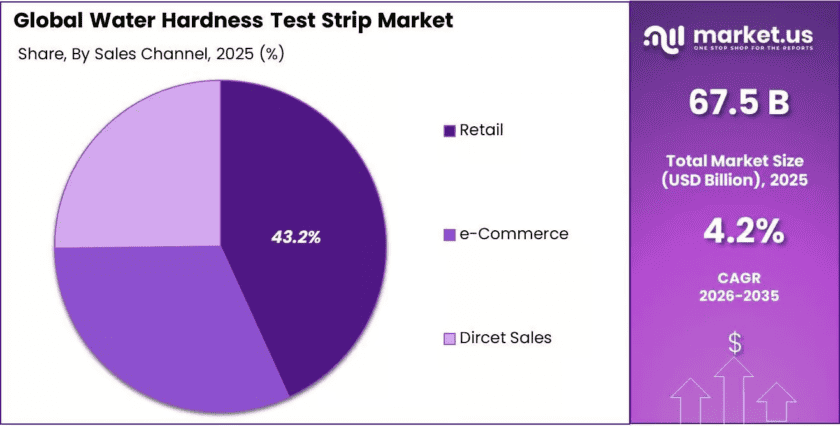
According to the supplied Market.us report, the global Water Hardness Test Strip Market was valued at USD 67.5 billion in 2025 and is projected to reach USD 101.4 billion by 2035, registering a compound annual growth rate (CAGR) of 4.2% during 2026–2035.
North America dominated the market in 2025, accounting for 32.12%, equivalent to USD 21.7 billion. Calcium concentration measurement led the type segment with a 77.45% share, while industrial applications accounted for 56.34%. Retail distribution held a 43.23% share. Increasing attention to equipment maintenance, mineral deposits, and convenient water-quality screening is supporting the use of these testing products.
Key Takeaways
- Market valuation: The global market reached USD 67.5 billion in 2025.
- Future projection: The market is expected to reach USD 101.4 billion by 2035.
- Growth rate: The market is projected to expand at a 4.2% CAGR during 2026–2035.
- Dominating region: North America accounted for 32.12%, representing USD 21.7 billion in 2025.
- Leading product type: Calcium Concentration Measurement held a 77.45% share.
- Leading application: Industrial applications captured 56.34% of the market.
- Leading distribution channel: Retail accounted for 43.23% of the market.
Regional Analysis
North America: Dominating Region
North America dominated the Water Hardness Test Strip Market in 2025, accounting for 32.12% of the global market, equivalent to USD 21.7 billion. Regional demand is supported by household water treatment, swimming pool maintenance, industrial water management, and regular equipment inspection.
The United States Geological Survey (USGS) explains that water hardness mainly results from dissolved calcium and magnesium. It classifies water with hardness of 0–60 mg/L as soft, 61–120 mg/L as moderately hard, 121–180 mg/L as hard, and above 180 mg/L as very hard. These classifications help households and industrial users understand water conditions and determine when further testing or treatment may be necessary.
Asia-Pacific: Emerging Growth Opportunities
Asia-Pacific offers growth opportunities through expanding industrial water treatment, commercial facilities, residential water filtration, and increasing attention to water quality. Manufacturing facilities, hotels, swimming pools, and equipment maintenance providers require convenient methods to monitor mineral concentrations. Water hardness test strips provide a simple preliminary screening option without requiring expensive laboratory instruments.
The region can also benefit from wider availability of multi-parameter water testing products and online distribution. The United Nations Sustainable Development Goal 6, which targets improved water quality and sustainable water management, provides a broader policy context for water monitoring. However, the supplied market report does not provide a verified regional CAGR establishing Asia-Pacific as the fastest-growing region.
Market Dynamics
Driver: Growing Need for Water Quality Monitoring
The increasing need to monitor water quality across residential, commercial, and industrial applications is supporting demand for water hardness test strips. Calcium and magnesium can contribute to mineral deposits in pipes, boilers, water heaters, and other equipment.
According to the USGS, water with hardness above 180 mg/L as calcium carbonate is classified as very hard. Such conditions can create scale-related maintenance problems. Test strips provide a convenient preliminary method for checking hardness and identifying whether additional treatment may be required. Their simple handling, portability, and relatively low testing complexity make them useful for households, maintenance teams, and industrial operators.
Trend: Increasing Adoption of Multi-Parameter Water Testing
Water testing products are increasingly being designed to measure multiple water quality indicators through convenient testing kits. Manufacturers are combining hardness testing with checks for pH, chlorine, alkalinity, and other parameters. This allows households and maintenance professionals to conduct broader preliminary water assessments using fewer products.
The USGS identifies calcium and magnesium as the primary contributors to water hardness and provides 4 hardness classifications, ranging from soft to very hard. These classifications support the interpretation of test results. Digital colour comparison and smartphone-assisted reading are also potential product development areas for improving result interpretation and reducing manual reading errors.
Restraint: Accuracy Limitations and Alternative Testing Methods
Water hardness test strips provide convenient screening, but their colour-based results may not offer the precision required for every industrial or laboratory application. Lighting conditions, colour interpretation, sample handling, and strip storage can influence readings. Laboratories may therefore prefer titration or instrumental methods when accurate quantitative measurements are required.
The USGS classifies hardness into 4 categories, using concentrations expressed as milligrams per litre of calcium carbonate. However, these categories do not replace detailed laboratory analysis where precise mineral concentrations are necessary. The availability of digital analysers and continuous water monitoring systems may also reduce repeated manual strip testing in certain industrial applications.
Opportunity: Heat Pumps and Industrial Water Treatment
Growing interest in energy-efficient heating systems and industrial water management creates opportunities for specialised hardness testing products. Heat pump installations, boilers, cooling systems, and water treatment equipment require suitable water conditions to limit mineral deposits and support equipment performance.
The USGS identifies hardness above 180 mg/L as calcium carbonate as very hard water, which can contribute to scale formation in pipes and heating equipment. Manufacturers can develop dedicated testing packs for installation contractors, maintenance companies, and water treatment service providers. Products with clear colour charts, multiple testing ranges, and convenient refill packaging can improve usability and encourage regular testing across residential and commercial applications.
Emerging Trends
1. Smartphone-Assisted Colour Interpretation
Manufacturers are exploring smartphone-assisted colour interpretation to improve the reading of water hardness test strips. Digital comparison may help users interpret results more consistently. The USGS recognises 4 hardness categories, providing a useful reference for digital result classification.
2. Multi-Parameter Water Testing Kits
Multi-parameter kits combine hardness testing with additional water checks, including pH and chlorine. These products offer convenient preliminary screening for households and maintenance teams. The USGS identifies calcium and magnesium as the main contributors to water hardness.
3. Industrial Equipment Protection
Industrial users increasingly focus on monitoring hardness to reduce scale formation in boilers, pipes, and heating systems. The USGS classifies water above 180 mg/L as very hard, making routine screening relevant to facilities using mineral-rich water supplies.
4. Improved Testing Range and Colour Charts
Manufacturers are focusing on clearer colour charts and easier result comparison. The USGS uses 4 hardness classifications, from soft to very hard, based on calcium carbonate concentration. Such reference ranges help users understand preliminary test results.
5. Sustainable Water Management Applications
Water hardness monitoring is becoming relevant to broader water management and treatment programmes. United Nations Sustainable Development Goal 6 includes targets covering water quality, wastewater treatment, and efficient water use, encouraging greater attention to routine water assessment.
Use Cases
1. Household Water Softener Monitoring
Households use hardness test strips to check water before and after softener installation. Results can help determine whether treatment is working effectively. The USGS classifies water above 180 mg/L as very hard, supporting basic household assessment.
2. Industrial Boiler Maintenance
Industrial maintenance teams use hardness testing to screen boiler feedwater and identify possible mineral-related problems. Water above 180 mg/L as calcium carbonate is classified as very hard by the USGS and may require additional treatment assessment.
3. Swimming Pool Water Management
Swimming pool operators use water hardness test strips as part of routine water checks. Calcium-related hardness can affect water balance and contribute to deposits. Users can compare results against product-specific testing charts and seek further analysis when needed.
4. Aquarium Water Testing
Aquarium owners use hardness test strips to check mineral conditions before adjusting water for fish and aquatic plants. Calcium and magnesium contribute to hardness, and the USGS provides 4 standard hardness categories that help explain water mineral levels.
5. Laboratory Water Screening
Laboratories use hardness strips for preliminary screening of water samples before selecting more detailed analytical methods. The USGS hardness classification includes 4 levels, from soft to very hard, providing a useful starting point for sample assessment.
Frequently Asked Questions on Water Hardness Test Strip Market
1. What is the Water Hardness Test Strip Market?
The Water Hardness Test Strip Market includes products used to measure dissolved calcium and magnesium in water. These strips provide quick colour-based results and are used in residential, industrial, laboratory, and commercial water treatment applications.
2. What was the market value in 2025?
According to Market.us, the global Water Hardness Test Strip Market was valued at USD 67.5 billion in 2025. Demand is supported by water treatment activities, industrial maintenance, and increasing attention to mineral concentration monitoring.
3. What will be the market value by 2035?
The market is projected to reach USD 101.4 billion by 2035, growing at a CAGR of 4.2% during 2026–2035, according to the supplied Market.us report.
4. Which region dominated the market in 2025?
North America dominated the market in 2025, accounting for 32.12% of global revenue, equivalent to USD 21.7 billion. Demand is supported by household water treatment, industrial applications, and equipment maintenance.
5. Which application segment dominated the market?
Industrial applications held a leading position in 2025, capturing 56.34% of the market. Industrial users employ hardness testing to monitor process water, boilers, cooling systems, and equipment where mineral deposits can affect performance.
Conclusion
The Water Hardness Test Strip Market is supported by increasing attention to water quality, equipment maintenance, and convenient mineral testing solutions. The market is projected to increase from USD 67.5 billion in 2025 to USD 101.4 billion by 2035, at a CAGR of 4.2%. North America remains the leading region, while calcium concentration measurement and industrial applications represent major market segments.
Future opportunities include digital testing, multi-parameter kits, and specialised solutions for heating and industrial water systems. Product accuracy, affordable pricing, and improved distribution will remain important factors influencing competition and long-term market development.
Discuss your needs with our analyst
Please share your requirements with more details so our analyst can check if they can solve your problem(s)