Overview
New York, NY – Oct 13, 2026 – The global Shelf-life Testing Market supports food and beverage manufacturers in determining how long products maintain their safety, quality, taste, texture, and nutritional value under defined storage conditions. Testing methods include microbial analysis, chemical testing, sensory evaluation, pH measurement, rancidity assessment, and real-time or accelerated stability studies. These services help manufacturers establish suitable expiry dates, evaluate packaging performance, improve product formulations, and reduce avoidable food waste.
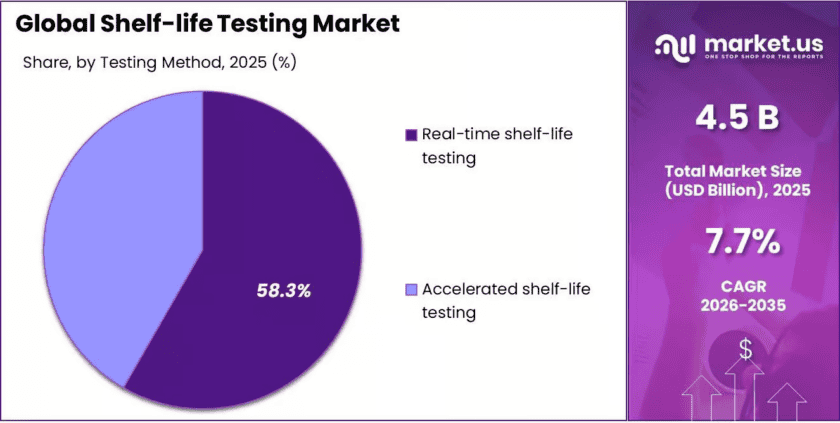
According to the supplied Market.us report, the market was valued at USD 4.5 billion in 2025 and is projected to reach USD 9.4 billion by 2035, representing a stated compound annual growth rate (CAGR) of 7.7%. North America held a leading 36.20% share, equivalent to USD 1.6 billion, in 2025. Kit-based testing accounted for 68.20%, microbial contamination testing represented 34.08%, real-time testing held 58.30%, and packaged food accounted for 28.90% of their respective segments.
Food safety requirements and growing attention to food waste are important factors supporting demand. The European Commission estimated in a 2018 study that up to 10% of food waste generated annually in the European Union was linked to date marking. Accurate shelf-life assessment can help manufacturers make better-informed decisions about storage, product dating, and packaging.
Key Takeaways
- Market value: The Shelf-life Testing Market was valued at USD 4.5 billion in 2025.
- Forecast: The market is projected to reach USD 9.4 billion by 2035, at a stated 7.7% CAGR.
- Leading region: North America held a 36.20% share, valued at USD 1.6 billion, in 2025.
- Leading technology: Kit-based testing accounted for 68.20% of the technology segment.
- Leading testing parameter: Microbial contamination testing held 34.08%.
- Leading testing method: Real-time shelf-life testing represented 58.30%.
- Leading food category: Packaged food accounted for 28.90%.
Regional Analysis
North America: Leading Regional Market
According to the supplied report, North America led the Shelf-life Testing Market in 2025, with a 36.20% share and USD 1.6 billion in revenue. The region benefits from established food processing industries, laboratory infrastructure, packaged food production, and food safety programmes.
In the United States, the Food and Drug Administration’s preventive controls framework requires covered food facilities to evaluate relevant hazards and establish suitable controls. Product testing and environmental monitoring can be part of a risk-based verification programme. These practices support demand for microbial analysis, stability assessment, and product quality testing.
Europe: Food Quality and Waste Prevention
Europe’s market is supported by food safety requirements, date-marking practices, and efforts to reduce food waste. The European Commission estimated in 2018 that up to 10% of annual European Union food waste was linked to date marking. Shelf-life studies can help manufacturers determine suitable product dates and assess how packaging, storage temperature, and formulation affect quality.
Market Dynamics
1. Driver: Growing Focus on Food Safety and Product Quality
Food manufacturers need reliable shelf-life data to understand when products may lose quality or become unsafe under defined storage conditions. The United States Food and Drug Administration’s preventive controls framework requires covered facilities to assess relevant hazards and implement appropriate controls. Product testing and environmental monitoring may be used according to the risks identified.
Shelf-life testing helps manufacturers evaluate microbial growth, chemical changes, and packaging performance before setting product dates. The European Commission also estimated that up to 10% of annual European Union food waste was linked to date marking, reinforcing the value of accurate product-life assessment.
2. Trend: Greater Use of Accelerated and Instrument-Based Testing
Laboratories are using more structured analytical methods to assess product stability and identify changes during storage. Accelerated testing exposes samples to selected conditions, such as elevated temperatures, to obtain early information about potential degradation. Real-time studies remain important because they observe products under intended storage conditions.
Testing may include microbial analysis, pH measurements, oxidation indicators, nutrient stability, and sensory evaluation. USDA guidance also shows that shelf-stable products require suitable processing to control microorganisms. For example, some commercially processed low-acid canned foods can retain best quality for 2 to 5 years when stored correctly, depending on the product and packaging.
3. Restraint: Long Testing Periods and Laboratory Costs
Shelf-life testing can require considerable time, sample storage, trained staff, laboratory equipment, and repeated analysis. Real-time studies may continue for months or longer, depending on the intended product life and the risks being assessed. Manufacturers also need to test different formulations and packaging formats when ingredients or processing conditions change.
These requirements can be costly for smaller businesses launching multiple products. Accelerated testing may provide earlier indications of stability, but it cannot always replace real-time evidence. Results must be interpreted carefully because changes observed under elevated temperatures may not directly match those occurring under normal storage conditions.
4. Opportunity: Reducing Food Waste Through Better Shelf-life Decisions
More accurate shelf-life assessment offers manufacturers an opportunity to reduce unnecessary product disposal while maintaining safety. The European Commission estimated that up to 10% of annual food waste in the European Union was linked to date marking. Better testing can help manufacturers understand how formulation, packaging, storage temperature, and handling influence product quality.
This may support more suitable date labels, improved inventory planning, and fewer premature write-offs. Laboratories can also develop services for packaging comparisons, storage-condition studies, and product reformulation. However, any extension of a product’s stated shelf life must be supported by appropriate evidence and must not compromise food safety.
Emerging Trends
1. Kit-Based Testing
Kit-based methods held a reported 68.20% share of the technology segment in 2025. Standardised kits can simplify routine checks and help food manufacturers assess selected quality or microbial indicators with less complex preparation, when used according to validated instructions.
2. Focus on Microbial Contamination
Microbial contamination testing represented a reported 34.08% share of the testing-parameter segment in 2025. Manufacturers use microbiological analysis to investigate spoilage risks and assess product stability. FDA guidance supports risk-based testing and verification within food safety programmes.
3. Real-Time Stability Studies
Real-time shelf-life testing held a reported 58.30% share of the testing-method segment in 2025. It follows products under intended storage conditions, helping manufacturers observe changes over time and establish suitable shelf-life claims based on collected evidence.
4. Better Date Marking
The European Commission estimated in 2018 that up to 10% of annual European Union food waste was linked to date marking. More accurate shelf-life evidence can help manufacturers choose appropriate product dates and improve consumer understanding of quality and safety.
5. Testing of Shelf-Stable Products
USDA guidance explains that some low-acid canned foods can retain best quality for 2 to 5 years when unopened and stored properly. Shelf-life testing helps validate product processing, packaging, and storage recommendations for products intended to remain stable without refrigeration.
Use Cases
1. Packaged Food Stability
Packaged food accounted for a reported 28.90% share of the market by food tested in 2025. Manufacturers test packaged meals, snacks, and other products to monitor microbial changes, texture, taste, and packaging performance during storage.
2. Beverage Quality Assessment
Beverage producers test products for microbial stability, pH changes, oxidation, colour, and flavour. These checks help assess storage performance and packaging suitability. Testing requirements vary according to the formulation, processing method, and whether the beverage needs refrigeration.
3. Meat and Dairy Product Testing
Meat and dairy products can be sensitive to temperature, microbial growth, and handling conditions. Shelf-life testing helps manufacturers evaluate storage recommendations and product dates. USDA guidance provides storage examples for meat products, including 1 to 2 days for raw ground meat and poultry under refrigeration at 40°F or below.
4. Shelf-Stable Food Validation
Shelf-life studies help manufacturers verify products designed for storage without refrigeration until opened. USDA notes that some low-acid canned foods can maintain best quality for 2 to 5 years when stored in suitable conditions. Product-specific processing and packaging remain essential.
5. Packaging and Formulation Comparisons
Manufacturers compare packaging materials and formulations to assess how well products resist oxygen, moisture, light, and other factors that affect stability. Testing can inform packaging selection and product development, helping companies improve quality retention and reduce unnecessary disposal.
Frequently Asked Questions
1. What is shelf-life testing?
Shelf-life testing evaluates how long a product maintains its intended safety, quality, and performance under defined storage conditions. Tests may measure microbial growth, chemical changes, taste, texture, pH, nutrient stability, and packaging performance.
2. What is the global Shelf-life Testing Market value?
According to the supplied Market.us report, the market was valued at USD 4.5 billion in 2025 and is projected to reach USD 9.4 billion by 2035, representing a stated CAGR of 7.7%.
3. Which region led the Shelf-life Testing Market in 2025?
North America led the market with a reported 36.20% share and USD 1.6 billion in revenue in 2025. Its established food processing industry, laboratory infrastructure, and food safety programmes support demand for testing services.
4. Which technology held the largest market share?
Kit-based testing held the leading technology position with a reported 68.20% share in 2025. Such kits can simplify routine analysis and support standardised testing when laboratories follow suitable procedures and the method is appropriate for the product.
5. Which testing parameter held the largest share?
Microbial contamination testing accounted for a reported 34.08% share of the testing-parameter segment in 2025. It helps manufacturers evaluate microorganisms that may cause spoilage or create safety concerns during storage and distribution.
6. Which testing method dominated the market?
Real-time shelf-life testing held a reported 58.30% share of the testing-method segment in 2025. It observes product changes under intended storage conditions, providing evidence for evaluating stability and determining suitable product-life claims.
Conclusion
The Shelf-life Testing Market supports manufacturers in maintaining product safety, quality, and stability throughout storage and distribution. According to the supplied Market.us report, the market is projected to grow from USD 4.5 billion in 2025 to USD 9.4 billion by 2035, at a stated CAGR of 7.7%.
North America led with a reported 36.20% share, while kit-based testing, microbial contamination analysis, real-time testing, and packaged food led their respective segments. Food safety programmes and efforts to reduce avoidable food waste support the industry’s relevance. Future opportunities include more efficient testing methods, stronger packaging validation, and better-supported product dating.
Discuss your needs with our analyst
Please share your requirements with more details so our analyst can check if they can solve your problem(s)