Overview
New York, NY – October 28, 2026 The global sand control solutions market plays an important role in oil and gas production by helping prevent sand and other formation particles from entering wellbores and production equipment. Sand production can damage pumps, valves, pipelines, and other components, while increasing maintenance requirements and causing unplanned production interruptions. Sand control solutions include screens, gravel packs, expandable systems, and other technologies designed to manage formation sand in onshore and offshore wells.
Demand is influenced by mature oilfield development, deepwater exploration, unconventional reservoirs, and efforts to improve well productivity. Operators select solutions according to reservoir conditions, formation characteristics, well depth, production pressure, and expected operating life. Effective sand management can help reduce equipment wear and support more stable production.
The industry is also focusing on improved completion designs, real-time well monitoring, and technologies that reduce intervention requirements. Offshore projects can create opportunities for advanced systems because equipment installation and well servicing are often complex and expensive. However, capital spending, drilling activity, reservoir uncertainty, and technical performance remain important considerations for buyers.
As energy companies seek reliable production from increasingly challenging reservoirs, sand control providers are expected to focus on durable equipment, customized completion designs, and technologies that improve operating efficiency.
Key Takeaways
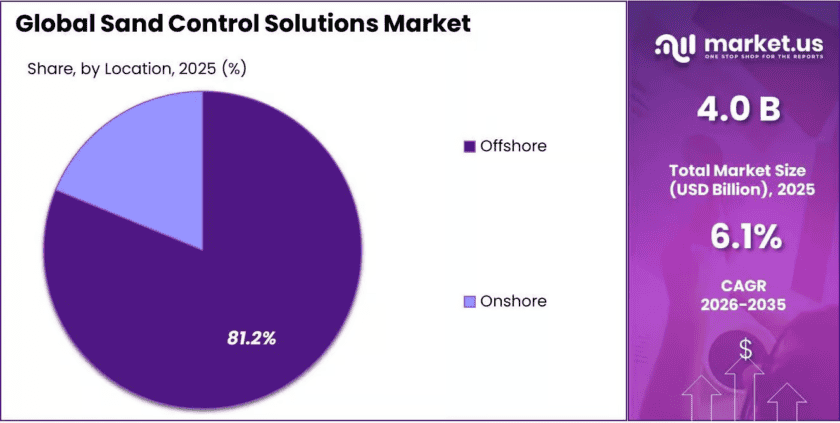
- 2025 market value: USD 4.0 billion.
- 2035 projected value: USD 7.2 billion.
- Forecast CAGR: 6.1% for 2026–2035, according to Market.us.
- Leading region: Asia-Pacific, with a reported 34.21% share and USD 1.3 billion in 2025 revenue.
- Leading type: Gravel pack, with a reported 43.78% share.
- Leading application: Cased hole, with a reported 56.34% share.
- Leading well type: Horizontal wells, with a reported 43.23% share.
- Leading location: Offshore, with a reported 81.23% share.
Regional Analysis
Asia-Pacific
Market.us reports that Asia-Pacific accounted for 34.21% of the market in 2025, equivalent to USD 1.3 billion. Offshore production, mature fields, and complex reservoir development support demand for screens, gravel packs, and related completion technologies. The U.S. Department of Energy also explains that subsea wells frequently require sand control because weakly consolidated formations can release particles during production.
North America
The United States and Canada provide demand through offshore production, shale development, conventional wells, and mature-field operations. The U.S. Bureau of Ocean Energy Management reported approximately 668 million barrels of offshore federal oil production in fiscal year 2024. Such activity creates a substantial operating base for well-completion and production-management equipment, although it does not measure sand control spending directly.
Market Dynamics
1. Driver: Growing Need for Reliable Well Production
Sand control solutions help operators limit the movement of formation particles into production tubing and surface equipment. The U.S. Environmental Protection Agency describes gravel packing and screens as established methods for preventing produced solids from entering production systems.
Offshore production makes reliability especially important: the Bureau of Ocean Energy Management reported 668 million barrels of federal offshore oil production in fiscal year 2024. This operating base supports demand for effective completion equipment. Operators increasingly consider sand control during well design because erosion, blockages, and unplanned interventions can reduce output and increase maintenance expenses.
2. Trend: More Integrated and Efficient Well Completions
Operators are seeking completion designs that reduce installation complexity and the number of costly intervention operations. Sand screens, gravel packs, and frac-pack systems are selected according to formation strength, particle size, pressure, and production requirements.
The U.S. Department of Energy identifies sand control as an important consideration in subsea completions, where weakly consolidated formations can release particles. Integrated completion planning can help coordinate well design, installation, and production monitoring. However, a system that works in one reservoir may not be suitable elsewhere. Companies must validate equipment performance against actual formation conditions and expected operating pressures.
3. Restraint: High Installation and Intervention Costs
Sand control installations can require specialized screens, packers, completion fluids, pumping equipment, and experienced well-completion teams. Costs rise when wells are deep, offshore, or difficult to access. If reservoir conditions differ from expectations, operators may face reduced production, additional intervention work, or the need to redesign the completion.
The U.S. Bureau of Ocean Energy Management notes that offshore development involves technically complex activities and resource-management decisions. These cost considerations can lead operators to defer projects or select less expensive completion methods. Suppliers must demonstrate reliable performance and total-life-cycle value to justify advanced equipment costs.
4. Opportunity: Deepwater and Mature-Field Development
Deepwater developments and mature producing fields offer opportunities for sand control suppliers because operators need to maintain production while managing formation instability. The Bureau of Ocean Energy Management estimates that the U.S. Outer Continental Shelf contains undiscovered resources of approximately 69 billion barrels of oil and 229 trillion cubic feet of natural gas.
These are estimates of potential resources, not guaranteed recoverable production or committed projects. Exploration and development of suitable resources could create demand for completion systems, including sand screens and gravel packs. Suppliers that support reservoir-specific designs and reliable installation may benefit when operators approve new wells.
Emerging Trends in Sand Control Solutions
1. Advanced sand screens
Manufacturers are developing screen designs to retain formation particles while allowing production fluids to pass. Screen selection depends on particle size, flow rate, and formation properties. The U.S. Department of Energy identifies sand control as important in subsea well completions.
2. Improved gravel-pack placement
Gravel packing uses sized material and a screen to restrict sand movement into production equipment. The U.S. Environmental Protection Agency identifies this as an established control method. Better placement helps operators address formation-specific risks during well completion.
3. Digital monitoring and diagnostics
Operators are increasingly interested in monitoring production conditions to identify changes that may indicate sand production or equipment problems. With U.S. federal offshore oil production reaching 668 million barrels in fiscal year 2024, dependable well monitoring remains relevant across a substantial production base.
4. Deepwater-ready completion systems
Subsea wells often encounter weakly consolidated formations that can release sand during production. The U.S. Department of Energy identifies sand control as a common requirement in subsea completions. Equipment design must account for well pressure, formation conditions, and intervention difficulty.
5. Reservoir-specific completion designs
Operators increasingly match completion methods to individual reservoir characteristics rather than using one standard design. Market.us reports a 43.23% share for horizontal wells in 2025. This segment figure highlights the reported importance of horizontal-well applications, not a government-verified statistic.
Use Cases of Sand Control Solutions
1. Gravel packing in unconsolidated formations
Operators place sized gravel around a screen to reduce sand entry into production tubing. The U.S. Environmental Protection Agency identifies gravel packing as an established method of controlling produced sand. The design must match formation particle sizes.
2. Horizontal well completions
Horizontal wells contact longer sections of a reservoir, making appropriate sand management important in formations prone to particle movement. Market.us reports a 43.23% market share for horizontal wells. Screen placement and completion design must account for flow distribution along the well.
3. Offshore and subsea production
Offshore operators use sand control to protect production equipment where well intervention is difficult. U.S. federal offshore production reached approximately 668 million barrels of oil in fiscal year 2024. This activity illustrates the operational scale where dependable completion systems matter.
4. Frac-pack completions
Frac-pack systems combine formation stimulation with sand control in suitable reservoirs. They can improve flow paths while limiting formation-particle production. Engineers must design the treatment around reservoir pressure, rock properties, fluid selection, and the required production rate.
5. Mature-well production management
Older wells may experience sand production as formation conditions and operating pressures change. Suitable screens, remedial treatments, and workover planning can help manage these problems. Operators assess intervention cost against expected production, remaining well life, and equipment condition.
Frequently Asked Questions on Sand Control Solutions
1. What are sand control solutions?
Sand control solutions are technologies used in oil and gas wells to prevent formation particles from entering production equipment. Common methods include gravel packing, sand screens, frac packs, and chemical consolidation, selected according to reservoir conditions.
2. What is the global sand control solutions market size?
According to Market.us, the global sand control solutions market was valued at USD 4.0 billion in 2025 and is projected to reach USD 7.2 billion by 2035, growing at a reported CAGR of 6.1%.
3. Which segment leads the sand control solutions market?
Market.us reports that gravel pack held a 43.78% share in 2025. This technique uses sized gravel and screens to limit formation-sand entry while allowing production fluids to flow into the well.
4. Why are sand control solutions important in offshore wells?
Offshore sand control helps protect production equipment from erosion, blockages, and excessive wear. Because subsea interventions can be complex and costly, reliable completion systems can help operators manage production risks and reduce avoidable maintenance requirements.
5. What is the difference between open-hole and cased-hole sand control?
Open-hole systems are installed across an uncased reservoir interval, commonly using screens and gravel packs. Cased-hole systems operate through a previously cased well section. The appropriate choice depends on well construction, formation stability, and completion objectives.
6. What factors are driving market growth?
Market growth is supported by offshore development, horizontal drilling, mature-field redevelopment, and the need to prevent formation sand from damaging production equipment. Demand also depends on upstream investment, reservoir conditions, oil prices, and the economics of well completion.
Conclusion
The sand control solutions market is expected to benefit from continued oil and gas development, offshore production, and the need to protect wells from formation-sand damage. Market.us projects the market to grow from USD 4.0 billion in 2025 to USD 7.2 billion by 2035, at a CAGR of 6.1%. Gravel packs, cased-hole applications, horizontal wells, and offshore operations represent important reported segments.
However, high completion costs, equipment erosion, and changes in upstream investment can influence demand. Future opportunities will depend on dependable screen technology, reservoir-specific completion designs, efficient installation, and improved production monitoring.
Discuss your needs with our analyst
Please share your requirements with more details so our analyst can check if they can solve your problem(s)