Overview
New York, NY – Nov 02, 2026 – The global Dairy Enzymes Market is gaining importance as dairy manufacturers seek better ways to improve product quality, processing efficiency, and nutritional value. Enzymes such as lactase, microbial rennet, lipase, and protease are widely used in milk processing, cheese production, yoghurt manufacturing, and whey treatment.
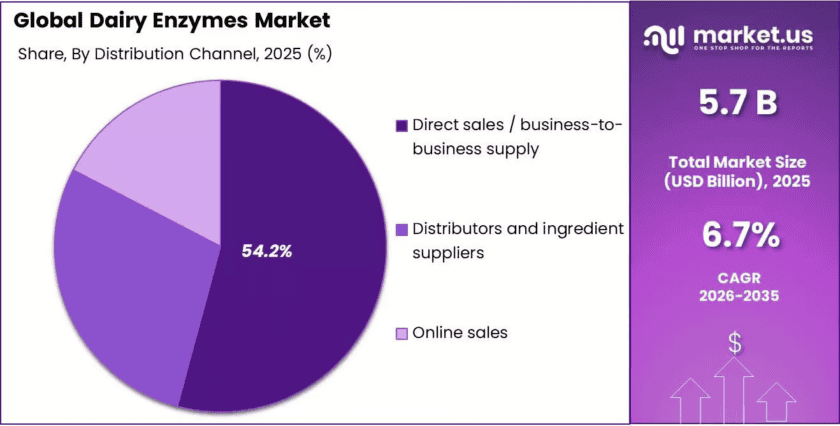
According to the supplied Market.us report, the market was valued at USD 5.7 billion in 2025 and is projected to reach USD 10.9 billion by 2035, growing at a compound annual growth rate (CAGR) of 6.7% from 2026 to 2035. Lactase supports lactose-free dairy production, while rennet helps convert milk into curds during cheese manufacturing. The United States Food and Drug Administration (FDA) lists lactase and chymosin among enzyme preparations used in food, including dairy processing.
Key Takeaways
- The Dairy Enzymes Market is valued at USD 5.7 billion in 2025 and is projected to reach USD 10.9 billion by 2035.
- The market is expected to expand at a 6.7% CAGR during 2026–2035.
- Lactase leads the enzyme type segment with a 33.60% share, supported by its use in lactose-free milk and yoghurt.
- Microbial enzymes account for 72.80% of the source segment, reflecting their suitability for controlled, large-scale production.
- Liquid enzymes hold a 58.00% share, supported by easy dosing and blending in dairy processing.
- Yoghurt represents 31.00% of the application segment.
- Direct business-to-business sales account for 54.00% of distribution, reflecting the importance of technical support and regular supply.
- Europe leads the market with a 37.00% share, valued at USD 2.1 billion.
Regional Analysis
Europe: Dominating Region
Europe dominated the Dairy Enzymes Market in 2025, accounting for 37.00% of global revenue, equivalent to USD 2.1 billion. Its position is supported by an established dairy-processing industry, strong cheese production, and demand for specialised dairy ingredients. Eurostat reported that EU farms produced 161.8 million tonnes of raw milk in 2024, of which 150.8 million tonnes was delivered to dairies. The region also produced 10.8 million tonnes of cheese during the year. These processing volumes create demand for microbial rennet, lactase, lipase, and protease in cheese, yoghurt, milk, and whey applications.
Market Dynamics
Driver: Growing Demand for Lactose-Free Dairy Products
The rising demand for lactose-free milk, yoghurt, and other dairy products is supporting the use of lactase enzymes. Lactase breaks down lactose into simpler sugars, allowing manufacturers to develop products with reduced lactose while retaining their dairy base.
The FDA lists lactase preparations derived from Kluyveromyces lactis for use in hydrolysing lactose in milk. This established food-processing application supports commercial adoption. As dairy brands expand specialised product ranges, processors require reliable enzyme activity, accurate dosing, and consistent results across production batches.
Trend: Increasing Use of Microbial Enzymes
Dairy processors are increasingly using microbial enzymes because controlled fermentation can provide a consistent supply of specialised enzyme preparations. Microbial chymosin is used to coagulate milk during cheese production and offers an alternative to animal-derived rennet.
The FDA lists chymosin preparations produced using microorganisms, including Aspergillus niger and Kluyveromyces species, for cheese and other dairy products. This regulatory recognition supports their use in commercial processing. The trend is encouraging enzyme suppliers to improve fermentation methods, product purity, and activity consistency for large-scale dairy manufacturing.
Restraint: Raw Milk and Dairy Price Volatility
Fluctuations in milk prices and dairy commodity values can limit investment in new processing ingredients. When raw-material costs rise or finished-product prices weaken, manufacturers may postpone product launches, reformulation projects, or enzyme trials.
The Food and Agriculture Organization’s Dairy Price Index averaged 129.8 points in 2024, increasing 4.9% from 2023. Such movements illustrate the cost uncertainty faced by dairy processors. Enzyme suppliers must demonstrate clear benefits, such as improved yield, reduced processing time, or lower production losses, to justify continued customer spending during periods of tight margins.
Opportunity: Better Use of Whey and Dairy By-products
Improved use of whey and other dairy by-products creates opportunities for specialised enzyme applications. Enzymes can help processors modify lactose and proteins to develop ingredients for food and nutrition applications.
The USDA reported that the United States produced 845 million pounds of dry whey and 1.14 billion pounds of lactose in 2025. These volumes demonstrate the scale of whey-related processing and the potential value of improving ingredient recovery and conversion. Suppliers that develop suitable enzyme formulations and provide technical support can help processors improve resource use and create higher-value dairy ingredients.
Emerging Trends in the Dairy Enzymes Market
1. Expansion of Lactose-Free Dairy: Dairy manufacturers are using lactase to develop lactose-free milk and yoghurt. The FDA lists lactase from Kluyveromyces lactis for lactose hydrolysis in milk, supporting its established role in specialised dairy production.
2. Growth of Microbial Rennet: Microbial chymosin is gaining importance as an alternative to animal-derived rennet. FDA regulations recognise chymosin preparations produced using microbial sources for cheese coagulation, supporting wider use in commercial cheese manufacturing.
3. Greater Focus on Cheese Processing: Cheese production continues to create demand for coagulating enzymes. USDA reported 14.8 billion pounds of US cheese production in 2025, an increase of 4.0% from 2024, supporting the need for reliable processing ingredients.
4. Development of Whey-Based Ingredients: Dairy processors are focusing on better whey utilisation and ingredient recovery. US production reached 845 million pounds of dry whey and 1.14 billion pounds of lactose in 2025, creating opportunities for specialised enzyme applications.
5. Improved Enzyme Regulation and Quality: Food safety and product consistency are becoming important in enzyme selection. The FDA identifies several food enzyme preparations, including lactase, lipase, and chymosin, giving manufacturers defined regulatory references for suitable dairy-processing applications.
Use Cases of Dairy Enzymes
1. Lactose-Free Milk Production: Lactase is added to milk to break lactose into glucose and galactose. This process helps manufacturers produce lactose-reduced milk while retaining its dairy ingredients. The FDA specifically lists lactase for hydrolysing lactose in milk.
2. Cheese Manufacturing: Chymosin helps coagulate milk and separate curds from whey during cheese production. US cheese production reached 14.8 billion pounds in 2025, demonstrating the large processing base served by milk-coagulating enzymes.
3. Yoghurt Processing: Enzyme applications can help manufacturers adjust lactose levels and manage selected protein characteristics in yoghurt. Lactase supports lactose-free yoghurt development, while consistent milk processing helps producers maintain product quality across different manufacturing batches.
4. Whey Ingredient Processing: Enzyme technologies can support the conversion and modification of dairy ingredients recovered from whey. US production included 845 million pounds of dry whey and 502 million pounds of whey protein concentrate in 2025, indicating substantial ingredient-processing activity.
5. Flavour Development in Cheese: Lipases and other enzyme preparations can help develop flavour characteristics in selected cheese varieties. The FDA lists animal lipase for hydrolysing fat and aminopeptidase for optional flavour development in cheddar cheese production.
Frequently Asked Questions on the Dairy Enzymes Market
1. What are dairy enzymes?
Dairy enzymes are biological substances used to support milk and dairy processing. Common examples include lactase, rennet, lipase, and protease, which help with lactose breakdown, milk coagulation, flavour development, and protein modification.
2. What is the global Dairy Enzymes Market value in 2025?
According to the supplied Market.us report, the global Dairy Enzymes Market was valued at USD 5.7 billion in 2025. The report projects the market to reach USD 10.9 billion by 2035.
3. Which enzyme type dominates the Dairy Enzymes Market?
Lactase leads the enzyme type segment with a 33.60% share in 2025. Its use in lactose-free milk, yoghurt, and other specialised dairy products supports demand among manufacturers expanding their product portfolios.
4. Why are microbial enzymes widely used in dairy processing?
Microbial enzymes can be produced through controlled fermentation, supporting consistent quality and scalable supply. They are used in cheese coagulation, lactose breakdown, and other dairy applications, while offering alternatives to certain animal-derived enzyme preparations.
5. Which region dominates the Dairy Enzymes Market?
Europe leads the market with a 37.00% share, representing approximately USD 2.1 billion in 2025 revenue. Its established dairy industry, cheese manufacturing base, and specialised ingredient demand support regional enzyme consumption.
Conclusion
The Dairy Enzymes Market is expected to experience steady growth as manufacturers focus on improving dairy processing, product quality, and ingredient efficiency. The projected increase from USD 5.7 billion in 2025 to USD 10.9 billion by 2035 reflects opportunities across lactose-free products, cheese manufacturing, yoghurt, and whey processing.
Lactase and microbial enzymes will remain important because of their established industrial applications. Europe currently leads the market, while Asia Pacific offers further expansion potential through growing dairy consumption and processing investment. Innovation in fermentation, enzyme performance, and specialised formulations will remain important for market participants.
Discuss your needs with our analyst
Please share your requirements with more details so our analyst can check if they can solve your problem(s)