Overview
New York, NY – Oct 21, 2026 – The industrial wastewater treatment service market is gaining importance as manufacturers face growing pressure to control water pollution, comply with environmental regulations, and improve water-use efficiency. These services include treatment plant design, installation, operations and maintenance, water quality monitoring, effluent management, and wastewater recycling. Major end-use industries include chemicals and petrochemicals, oil and gas, power generation, food and beverages, pharmaceuticals, textiles, and pulp and paper.
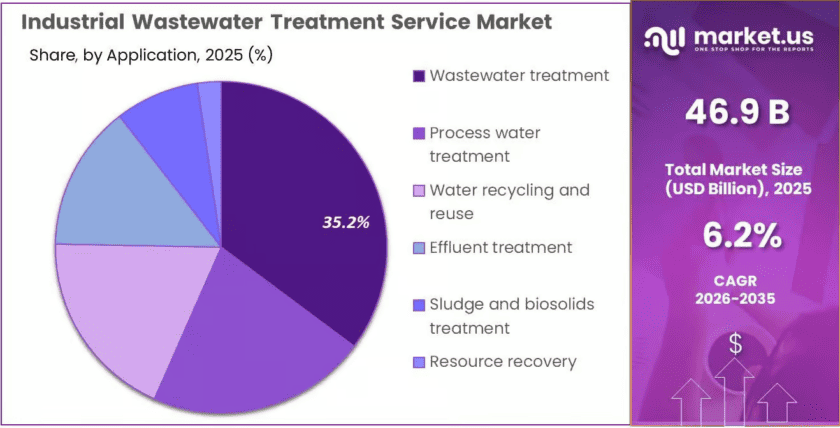
According to the referenced market report, the market was valued at USD 46.9 billion in 2025 and is projected to reach USD 85.1 billion by 2035, reflecting a compound annual growth rate (CAGR) of 6.2% from 2026 to 2035. North America accounted for 35.00% of the market in 2025, equivalent to USD 16.4 billion.
Environmental data highlight the need for further investment. The United Nations reported that, among 22 countries providing relevant industrial wastewater data for 2022, only 38% of industrial wastewater was treated and just 27% was safely treated. These limited reporting figures underline opportunities for treatment providers to deliver reliable, efficient, and reusable-water solutions.
Key Takeaways
- Market value: USD 46.9 billion in 2025, with a projected value of USD 85.1 billion by 2035.
- Growth outlook: A projected CAGR of 6.2% for 2026–2035.
- Leading region: North America, with a reported 35.00% share and USD 16.4 billion in 2025.
- Leading service type: Operations and maintenance, with a reported 37.00% share in 2025.
- Leading treatment method: Biological treatment, with a reported 27.00% share.
- Leading application: Wastewater treatment, with a reported 35.00% share.
- Leading end-use industry: Chemicals and petrochemicals, with a reported 20.00% share.
Regional Analysis
North America: Dominating Region
North America held the leading position in 2025, accounting for 35.00% of the market and a reported value of USD 16.4 billion. Its position is supported by established industrial infrastructure, wastewater discharge requirements, and demand for reliable treatment services in chemical manufacturing, petroleum refining, food processing, and power generation. The United States Environmental Protection Agency (EPA) maintains effluent guidelines for 59 industrial categories, supporting demand for treatment systems, monitoring, and compliance services.
Asia-Pacific: Growth Opportunities
Asia-Pacific offers significant opportunities as manufacturing activity, industrial water demand, and investment in pollution control expand. Demand is likely to benefit from new treatment facilities, modernization of existing plants, and industrial water recycling. The World Bank’s September 2025 water-reuse report found that global potable and industrial water reuse could increase eightfold by 2040, reaching 430 million cubic metres per day. This creates opportunities for treatment contractors, membrane technology suppliers, and operators offering water reuse services.
Middle East and Africa
Water scarcity and the need to protect limited freshwater resources support interest in wastewater recycling across industrial facilities in the Middle East and Africa. Oil and gas, power generation, mining, and manufacturing create demand for specialized treatment and water recovery. High installation costs, energy requirements, and technical skills shortages can constrain deployment, creating opportunities for long-term service contracts and systems designed for local operating conditions.
Market Dynamics
1. Driver: Stricter Industrial Wastewater Regulations
Industrial wastewater discharge requirements are a major driver of service demand. Manufacturers must control pollutants such as suspended solids, oils, metals, and chemical residues before releasing wastewater into waterways or municipal systems. The U.S. EPA’s effluent guidelines cover 59 industrial categories, including sectors with complex wastewater streams.
This encourages industrial facilities to invest in treatment plant maintenance, water quality testing, process upgrades, and regulatory compliance. As discharge requirements evolve, service providers can benefit from recurring maintenance contracts and specialist treatment services. The strength of this driver varies by country, industry, pollutant type, and enforcement practices.
2. Trend: Greater Focus on Water Reuse
Industrial water reuse is becoming more important as companies seek to reduce freshwater consumption, manage supply risks, and improve resource efficiency. The World Bank reported in September 2025 that potable and industrial water reuse could increase eightfold by 2040, reaching 430 million cubic metres per day.
Reuse projects require suitable treatment, water quality testing, and systems designed for their intended applications, such as cooling, cleaning, and manufacturing. This trend creates opportunities for service providers that can combine wastewater treatment with recycling and monitoring. Actual adoption will depend on local water prices, regulations, infrastructure, and project economics.
3. Restraint: High Capital and Operating Costs
Industrial wastewater treatment facilities can require substantial investment in tanks, pumps, membranes, biological systems, chemical dosing, and monitoring equipment. Operating costs also include energy, treatment chemicals, sludge handling, replacement parts, and skilled labour. These expenses can be difficult for smaller manufacturers or facilities operating on narrow margins.
Complex wastewater containing toxic chemicals or variable pollutant loads may require additional treatment stages and more frequent testing. As a result, some companies may delay upgrades or choose limited treatment improvements instead of comprehensive systems. Financing options, phased installation, and performance-based service agreements can help reduce the initial cost burden.
4. Opportunity: Resource Recovery and Advanced Treatment
Industrial wastewater can provide opportunities to recover reusable water, energy, and selected materials rather than treating every waste stream solely for disposal. Anaerobic treatment can produce biogas from suitable organic wastewater, while advanced filtration and membrane systems can support water recovery.
The U.S. EPA identifies industrial reuse applications in manufacturing, energy generation, mining, and food and beverage production. Service providers can develop projects that combine treatment, reuse, and resource recovery according to individual facility needs. However, the technical and financial value of recovered resources depends on wastewater composition, treatment requirements, energy prices, and the availability of buyers or reuse applications.
Emerging Trends
1. Industrial Water Recycling
Water recycling is gaining attention as industries seek dependable water supplies. The World Bank reported in 2025 that reuse could reach 430 million cubic metres per day by 2040. Treatment providers can support recycling through filtration, disinfection, and monitoring systems.
2. Advanced Membrane Treatment
Membrane filtration and reverse osmosis can remove selected contaminants and support water reuse where the feedwater and final application are suitable. The U.S. EPA provides industrial water reuse resources covering manufacturing, energy, and mining. These systems require maintenance and careful management of concentrated residuals.
3. Stricter Effluent Monitoring
Regulatory compliance is encouraging more frequent testing and better tracking of industrial wastewater quality. The U.S. EPA’s effluent guidelines cover 59 industrial categories. Service providers can offer sampling, process monitoring, reporting, and treatment performance reviews to help facilities manage discharge obligations.
4. Resource and Energy Recovery
Treatment plants are increasingly assessed for opportunities to recover energy and useful materials from suitable wastewater streams. Anaerobic digestion can generate biogas from biodegradable organic matter, while sludge processing can reduce waste volumes. The financial benefits depend on wastewater characteristics, energy needs, and the cost of managing treatment residues.
5. Integrated Treatment Service Contracts
Industrial operators may use external specialists to manage equipment, treatment chemicals, monitoring, and maintenance under longer-term service agreements. These arrangements can simplify plant management and provide access to technical expertise. They also help facilities plan maintenance and improve operating consistency, although performance depends on contract design and measurable service targets.
Use Cases
1. Chemical and Petrochemical Plants
Chemical plants can generate wastewater containing oils, solvents, acids, and organic compounds. Specialized treatment services help separate pollutants, control discharge quality, and manage process variations. The U.S. EPA’s guidelines cover 59 industrial categories, illustrating the range of regulated industrial wastewater sources.
2. Food and Beverage Processing
Food processors generate wastewater containing organic matter, fats, oils, and suspended solids from washing and production. Screening, separation, and biological treatment can reduce pollutant loads. Suitable treated water may be reused for selected non-product-contact purposes when quality and regulatory requirements are met.
3. Oil and Gas Operations
Oil and gas facilities may produce wastewater containing oil, salts, suspended solids, and treatment chemicals. Service providers can apply separation, filtration, and other processes to meet disposal or reuse requirements. The appropriate treatment depends on water composition, discharge rules, and the intended reuse application.
4. Power Generation and Cooling
Power plants require water for cooling, steam systems, and equipment cleaning. Treatment services help manage blowdown, suspended solids, dissolved minerals, and other contaminants. Reuse of suitably treated water can reduce freshwater demand, subject to cooling-system requirements and controls against scaling, corrosion, and biological growth.
5. Textile and Pulp-and-Paper Manufacturing
Textile and pulp-and-paper facilities may produce wastewater containing colour, fibres, organic matter, and process chemicals. Treatment contractors can combine physical, chemical, and biological processes to improve effluent quality. Monitoring and regular maintenance help facilities manage variations in production and maintain consistent treatment performance.
Frequently Asked Questions
1. What is the industrial wastewater treatment service market?
The market includes services used to treat, monitor, recycle, and manage wastewater generated by industrial facilities. It covers engineering, installation, operations and maintenance, treatment technology support, effluent testing, and water reuse.
2. What was the market value in 2025?
The referenced market report estimates that the industrial wastewater treatment service market reached USD 46.9 billion in 2025. This is a market-research estimate rather than an independently verified government valuation.
3. What is the projected market value by 2035?
The referenced report projects a market value of USD 85.1 billion by 2035, with a CAGR of 6.2% for 2026–2035. The outlook reflects anticipated demand for treatment, maintenance, compliance, and water reuse services.
4. Which region dominated the market in 2025?
North America was the leading region in the referenced report, with a reported 35.00% share and USD 16.4 billion in revenue in 2025. Industrial infrastructure and discharge regulations support demand for treatment services.
5. Why is industrial wastewater treatment important?
Industrial wastewater treatment removes or reduces pollutants before discharge or reuse. It helps protect water quality, supports compliance with environmental requirements, and can reduce freshwater demand. UN reporting found that only 27% of industrial wastewater was safely treated across 22 reporting countries in 2022.
Conclusion
The industrial wastewater treatment service market is positioned for continued development as industrial facilities work to control pollution, meet discharge requirements, and improve water efficiency. The referenced report estimates growth from USD 46.9 billion in 2025 to USD 85.1 billion by 2035, at a CAGR of 6.2%. North America leads the reported regional landscape, while water reuse offers opportunities across industrial markets.
Biological treatment, operations and maintenance, and wastewater treatment remain important market segments. Future opportunities will depend on regulation, water availability, investment costs, and the ability of service providers to deliver reliable treatment and practical recycling solutions.
Discuss your needs with our analyst
Please share your requirements with more details so our analyst can check if they can solve your problem(s)