Overview
New York, NY – October 22, 2026 – The global Residue Testing Market is gaining importance as food producers, agricultural businesses, pharmaceutical companies, and regulatory agencies strengthen product safety checks. Residue testing identifies unwanted substances, including pesticide residues, veterinary drug residues, toxins, heavy metals, and other chemical contaminants in food and related products.
According to the Market.us Residue Testing Market report, the market was valued at USD 2.2 billion in 2025 and is projected to reach USD 4.1 billion by 2035, growing at a compound annual growth rate (CAGR) of 6.4% from 2026 to 2035.
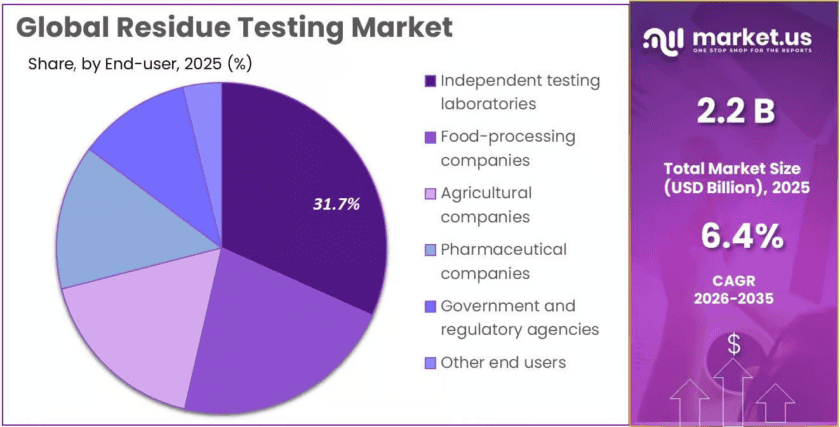
In 2025, pesticide residue testing accounted for 37.6% of the market, while chromatography represented 44.7%. Fruits and vegetables contributed 40.0%, and the food and beverage application segment held 66.0%. Independent testing laboratories accounted for 31.0%. Europe led the regional market with a 34.8% share, valued at approximately USD 0.7 billion.
Government monitoring programmes further demonstrate the importance of residue analysis. In January 2026, the United States Department of Agriculture reported that more than 99% of samples tested under its 2024 Pesticide Data Program had residues below established Environmental Protection Agency tolerances. These programmes support food safety, regulatory compliance, and confidence in domestic and international food supply chains.
Key Takeaways
- Market value: The Residue Testing Market reached USD 2.2 billion in 2025 and is projected to reach USD 4.1 billion by 2035.
- Market growth: The market is expected to grow at a 6.4% CAGR during 2026–2035.
- Leading residue type: Pesticide residues held a 37.6% share in 2025.
- Leading technology: Chromatography accounted for 44.7% of the market.
- Leading food category: Fruits and vegetables represented 40.0% of the market.
- Leading application: Food and beverages accounted for 66.0% of market demand.
- End-user demand: Independent testing laboratories held a 31.0% share.
- Regional leader: Europe accounted for 34.8%, equivalent to approximately USD 0.7 billion, in 2025.
Regional Analysis
Europe: Dominating Region
Europe held the leading position in the Residue Testing Market in 2025, accounting for 34.8% of global revenue, or approximately USD 0.7 billion. Its position is supported by established food safety legislation, routine monitoring programmes, international food trade, and requirements for checking pesticide and veterinary medicine residues.
The European Food Safety Authority and national authorities use residue monitoring to assess compliance and identify potential risks. The European Union also requires countries exporting animal-origin food to the region to maintain appropriate residue control plans. These regulatory requirements support continued demand for reliable laboratory analysis.
North America: Established Testing Infrastructure
North America remains an important market because government agencies and food businesses conduct regular residue testing across domestic and imported products. In the United States, the USDA’s 2024 Pesticide Data Program examined 9,872 samples from 19 commodities, while the Food and Drug Administration’s fiscal year 2024 programme assessed 3,528 human-food samples, including 2,635 imported samples from 76 countries and economies. These programmes demonstrate the scale of ongoing surveillance and the need for analytical laboratories, sample preparation equipment, and reliable testing methods.
Asia-Pacific: Expanding Testing Requirements
Asia-Pacific presents opportunities as agricultural production, food processing, exports, and cross-border supply chains require more consistent contaminant monitoring. Exporters need to demonstrate that their products meet destination-market residue limits, while domestic producers need testing to support food quality and regulatory compliance.
Laboratories can benefit from wider access to chromatography, mass spectrometry, and rapid screening methods. However, demand varies by country according to enforcement practices, laboratory capacity, export exposure, and investment in food safety infrastructure. Market growth should therefore be assessed using country-level testing requirements and official trade and food safety data rather than assuming uniform growth across the region.
Market Dynamics
1. Driver: Stronger Food Safety Monitoring
Food safety monitoring is a major driver of residue testing demand because regulators and food businesses need evidence that products comply with permitted residue limits. The USDA’s 2024 programme tested 9,872 samples across 19 commodities, while the FDA assessed 3,528 human-food samples in fiscal year 2024.
These programmes cover domestic and imported products and help authorities identify violations. Food manufacturers, agricultural exporters, retailers, and laboratories also use analytical results to manage product quality and supply-chain risks. Regular monitoring creates repeat demand for laboratory services, validated methods, sample preparation, and analytical instruments.
2. Trend: Greater Use of Advanced Analytical Methods
Residue testing is moving towards methods that can identify multiple substances in one analytical workflow. Chromatography combined with mass spectrometry can help laboratories detect and quantify residues at low concentrations, while immunoassays and rapid test kits support faster preliminary screening.
The Market.us report attributes 44.7% of the 2025 market to chromatography, reflecting the importance of this technology in the sector. Government monitoring programmes also rely on defined analytical methods and documented procedures. Laboratories are therefore investing in improved sensitivity, broader chemical coverage, automation, and quality controls to handle complex food samples more efficiently.
3. Restraint: High Testing Costs and Technical Requirements
Residue testing can be expensive because laboratories need specialised instruments, trained analysts, validated methods, reference materials, and controlled sample preparation. Testing for many compounds can require different extraction procedures and analytical conditions, increasing labour and maintenance costs.
Smaller laboratories may find it difficult to justify investment in advanced equipment when sample volumes are low. Complex food matrices can also affect measurement accuracy and require additional confirmation tests. These challenges may lengthen turnaround times and limit testing access in areas with less developed laboratory infrastructure. Laboratories can reduce costs through automation, shared facilities, efficient sampling plans, and validated screening methods followed by confirmatory analysis when needed.
4. Opportunity: Broader Testing Across Food Supply Chains
There is an opportunity to expand residue testing beyond routine fruit and vegetable analysis into meat, dairy, seafood, grains, processed foods, animal feed, and environmental samples. The USDA’s Pesticide Data Program covers 140 different commodities across its testing history and has examined more than 700 compounds, including pesticides, metabolites, and isomers. This illustrates the breadth of potential analytical work.
Laboratories can develop multi-residue panels, faster reporting services, and customised testing for exporters and food processors. Digital reporting and integrated compliance support can further improve customer value, particularly for businesses managing products across several countries with different residue requirements.
Emerging Trends in Residue Testing
1. Multi-Residue Testing
Laboratories are increasingly using analytical methods that can screen for many pesticide compounds in a single workflow. The USDA’s programme has tested more than 700 compounds, including pesticides and their metabolites. This approach can reduce repeated testing steps and help laboratories evaluate a wider range of chemical residues in food.
2. Wider Use of Chromatography
Chromatography remains an important technology for separating and measuring chemical residues in complex food samples. Market.us reports that it accounted for 44.7% of the Residue Testing Market in 2025. Continued improvements in separation, detection, and automation can help laboratories deliver reliable results for regulatory checks and commercial quality control.
3. Digital Reporting and Data Analysis
Residue monitoring is increasingly supported by digital databases and online reporting tools. In September 2026, the FDA listed its fiscal year 2024 pesticide monitoring results and supporting data files online. Digital access helps regulators, laboratories, and researchers review results, identify patterns, and improve the transparency of food safety monitoring.
4. Stronger Testing of Imported Food
International food trade creates a need to assess residues in products from different production systems. In fiscal year 2024, the FDA examined 2,635 imported human-food samples from 76 countries and economies. This demonstrates the role of import monitoring in identifying potential compliance issues and supporting risk-based decisions across international supply chains.
5. Testing Beyond Fresh Produce
Residue analysis is extending across different food groups, including dairy products, eggs, fish, grains, nuts, and animal-derived foods. The USDA’s 2024 programme covered 19 commodities, while its wider testing history includes 140 commodities. This broader scope encourages laboratories to develop methods suited to different food matrices and contaminant types.
Use Cases of Residue Testing
1. Fresh Fruit and Vegetable Safety
Growers, packers, and food retailers use residue testing to check whether pesticide levels comply with applicable limits. In 2024, the USDA tested 9,872 samples across 19 commodities. These results support food safety monitoring and help authorities assess residue exposure in commonly consumed agricultural products.
2. Imported Food Inspection
Importers and regulators use residue testing to evaluate food products entering national markets. The FDA assessed 2,635 imported human-food samples from 76 countries and economies in fiscal year 2024. Testing results help authorities identify products requiring further investigation and support decisions on regulatory compliance and consumer protection.
3. Food Export Certification and Quality Control
Food exporters use laboratory reports to demonstrate compliance with destination-market requirements. Testing can identify pesticide residues, veterinary drug residues, and other regulated substances before products are shipped. This helps businesses reduce the risk of rejected consignments, costly delays, product recalls, and damage to commercial relationships.
4. Dairy, Meat, and Animal-Origin Products
Residue testing helps monitor veterinary medicines and other chemical substances in milk, eggs, meat, and seafood. European Union rules require member countries to maintain control plans for pharmacologically active substance residues. Such testing helps identify illegal or improper use of veterinary medicines and supports food safety compliance.
5. Regulatory Surveillance and Risk Assessment
Government agencies use residue data to assess compliance, identify recurring problems, and support dietary exposure evaluations. The USDA’s pesticide database includes more than 52 million residue findings from 335,940 samples collected between 1994 and 2024. These records help researchers and authorities evaluate residue patterns over time.
Frequently Asked Questions on Residue Testing and the Residue Testing Market
1. What is residue testing?
Residue testing is the process of identifying and measuring unwanted substances, such as pesticides, veterinary medicines, toxins, and heavy metals, in food and related products. It helps determine whether products meet applicable safety and regulatory requirements.
2. What is the value of the Residue Testing Market?
According to Market.us, the global Residue Testing Market was valued at USD 2.2 billion in 2025. The report projects that it will reach USD 4.1 billion by 2035, reflecting a CAGR of 6.4% during 2026–2035.
3. Which segment dominates the Residue Testing Market?
Pesticide residue testing led the market in 2025, with a 37.6% share. Its position reflects the importance of monitoring agricultural chemicals in food products and verifying compliance with established residue limits.
4. Which technology holds the largest market share?
Chromatography held the leading technology position in 2025, accounting for 44.7% of the market, according to Market.us. It supports the separation and measurement of chemical residues and is widely used in laboratory analysis.
5. Which region dominates the Residue Testing Market?
Europe led the global market in 2025, accounting for 34.8% of revenue, equivalent to approximately USD 0.7 billion. Established food safety rules, residue monitoring programmes, and international trade requirements support regional demand.
Conclusion
The Residue Testing Market plays an important role in food safety, agricultural quality control, and regulatory compliance. Market.us estimates that the market will grow from USD 2.2 billion in 2025 to USD 4.1 billion by 2035, at a CAGR of 6.4%. Pesticide residues, chromatography, fruits and vegetables, and food and beverage applications represent major market segments.
Europe leads the regional landscape with a 34.8% share. Government monitoring programmes in the United States and Europe reinforce the need for reliable testing. Advanced analytical methods, broader contaminant coverage, and digital reporting offer opportunities for future industry development.
Discuss your needs with our analyst
Please share your requirements with more details so our analyst can check if they can solve your problem(s)