Overview
New York, NY – Oct 27, 2026 – The Proanthocyanidins Market is gaining attention as food, beverage, dietary supplement, and personal care manufacturers explore plant-based ingredients with antioxidant properties. Proanthocyanidins are naturally occurring polyphenols found in sources such as grape seeds, cranberries, cocoa, apples, and certain tree barks. They are studied for their ability to interact with free radicals and for their potential roles in supporting health, although the strength of evidence varies by application and product.
Demand is linked to consumer interest in botanical ingredients, clean-label formulations, and plant-derived antioxidants. Food and supplement manufacturers use proanthocyanidin-rich extracts in products where ingredient identity, concentration, taste, stability, and quality must be controlled.
The U.S. National Institutes of Health provides scientific information on cranberry products and other botanical ingredients, while the U.S. Department of Agriculture maintains food-composition data that can help researchers identify sources of relevant plant compounds. These public resources support ingredient research, but they do not establish commercial market revenue. Market performance will depend on reliable sourcing, manufacturing standards, product-specific evidence, regulatory compliance, and consumer acceptance.
Key Takeaways
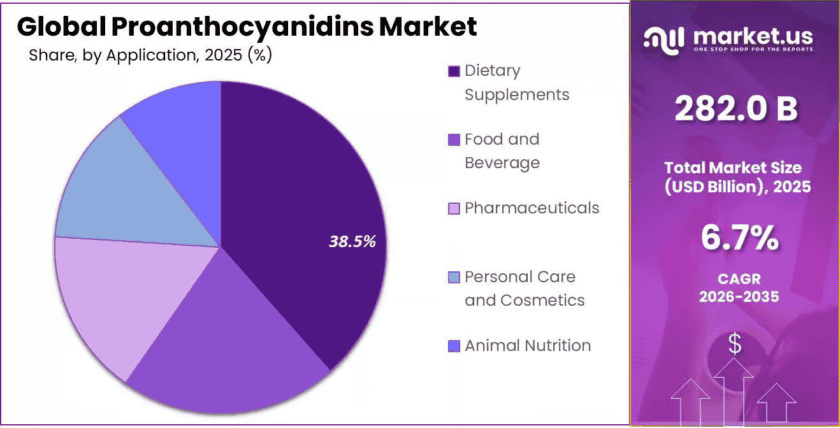
- The supplied Market.us report estimates the global Proanthocyanidins Market at USD 282.0 billion in 2025, with a forecast of USD 538.6 billion by 2035 and a reported 6.7% CAGR.
- Type-B proanthocyanidins held a reported 71.56% share in 2025.
- Grape seed was the leading source segment, with a reported 53.67% share.
- Dietary supplements led by application, with a reported 38.56% share.
- North America held a reported 31.11% share in 2025, representing approximately USD 87.7 billion based on the report’s total market value.
Regional Analysis
North America
North America led the market in the supplied report, with a reported 31.11% share in 2025, equivalent to approximately USD 87.7 billion. The region benefits from established dietary supplement manufacturers, botanical ingredient suppliers, and food-processing capabilities.
The USDA’s food-composition research supports the identification and measurement of plant polyphenols, while U.S. regulatory resources help companies assess ingredient safety and intended uses. Market performance will depend on consumer demand, product quality, scientific evidence, and compliance with applicable labeling and health-claim requirements.
Europe
Europe is an important region for grape-derived ingredients because of its wine and food-processing industries. Grape seeds and winery residues can provide raw materials for polyphenol extraction, although the availability and composition of these materials vary by grape variety and processing method.
European manufacturers must also consider food-safety rules, contaminant limits, labeling requirements, and restrictions on health claims. Demand for plant-based ingredients may support product development in dietary supplements, food, beverages, and cosmetics, but commercial growth depends on reliable sourcing and evidence supporting each product’s intended use.
Asia-Pacific
Asia-Pacific offers opportunities through its large food-processing industry, growing interest in botanical ingredients, and established supplement and personal-care manufacturing sectors. China, Japan, South Korea, India, and Australia are relevant markets for ingredient sourcing and product development.
Grape seed, cocoa, apple, and other plant materials provide possible sources of proanthocyanidins. However, differences in product registration, ingredient standards, and permitted claims can affect market entry. USDA food-composition resources and published scientific studies can support ingredient research, but they do not establish regional market shares or prove that Asia-Pacific is the fastest-growing region.
Market Dynamics
Driver: Demand for Plant-Based Ingredients
Interest in plant-derived ingredients is supporting research into proanthocyanidins for dietary supplements, functional foods, beverages, and cosmetics. These polyphenols occur in grape seeds, cranberries, cocoa, apples, and other plant materials. The USDA has documented proanthocyanidin levels in 206 selected foods and beverages, providing useful information for researchers and ingredient developers.
Manufacturers can use this information to investigate raw-material sources and formulate products with measurable ingredient levels. However, demand also depends on product safety, manufacturing consistency, consumer acceptance, and the strength of scientific evidence for the specific application.
Trend: Improved Extraction and Standardization
Manufacturers are exploring extraction methods that improve recovery, reduce solvent use, and maintain consistent proanthocyanidin profiles. Techniques such as ultrasound-assisted extraction and optimized solvent systems are studied for their potential to improve processing efficiency. A 2026 review discusses the relationship between proanthocyanidin structure, biological activity, application challenges, and emerging strategies.
Restraint: Limited Clinical Evidence for Some Health Claims
Although proanthocyanidins have antioxidant properties and are being studied for several potential health applications, evidence does not support every commercial claim. A 2026 systematic review of proanthocyanidins and skeletal muscle health identified 15 studies, including 10 animal studies, four in vitro studies, and one randomized human trial. The authors judged the clinical evidence very uncertain.
Opportunity: Value-Added Use of Agricultural By-Products
Grape seeds and winery residues offer opportunities to recover useful plant compounds from agricultural by-products. Instead of using these materials only for low-value purposes, processors can investigate extraction and purification for standardized proanthocyanidin ingredients.
The opportunity is relevant to regions with established grape and wine industries. Better collection, drying, storage, and extraction systems can help maintain raw-material quality and reduce waste. However, actual commercial returns depend on the amount of recoverable compounds, processing costs, solvent recovery, and customer demand. Suppliers must also verify purity, safety, and batch-to-batch consistency before selling extracts for food or supplement applications.
Emerging Trends
1. Plant-based supplement formulations: Manufacturers are incorporating grape seed and cranberry extracts into botanical supplement products. The USDA’s proanthocyanidin database covers 206 selected foods and beverages, helping researchers compare potential sources and investigate ingredient composition for formulation development.
2. More efficient extraction methods: Researchers are studying ultrasound-assisted extraction, improved solvents, and optimized processing conditions to recover proanthocyanidins from plant materials. These approaches aim to improve yields and consistency while managing energy use, solvent recovery, and production costs at commercial scale.
3. Greater focus on clinical evidence: Ingredient developers are examining potential health applications more carefully. A 2026 systematic review identified 15 studies on proanthocyanidins and skeletal muscle health, but only one was a randomized human trial, highlighting the need for stronger clinical evidence.
4. Agricultural by-product recovery: Grape seeds and winery residues are being investigated as sources of valuable polyphenols. This approach may help processors recover useful compounds from agricultural waste, although extract quality depends on grape variety, storage, and production conditions.
5. Stronger ingredient quality controls: Manufacturers are focusing on extract purity, concentration, stability, and contaminant testing. Consistent testing is important because proanthocyanidin composition differs between plant sources and extraction methods. Better specifications can improve product reliability and support international supply chains.
Use Cases
1. Dietary supplements: Grape seed and cranberry extracts are used in capsules, tablets, and powders containing plant polyphenols. Manufacturers must verify ingredient concentration and purity. Research continues into potential health effects, but evidence and permitted claims vary by application and product.
2. Food and beverage formulations: Proanthocyanidin-rich extracts can be evaluated for use in selected beverages and food products. The FDA reviewed a cranberry extract notification covering proposed uses at 150–300 mg per serving, depending on the food category.
3. Cosmetic products: Proanthocyanidins may be explored in creams, serums, and other personal-care products because of their antioxidant properties. Formulators need to assess stability, skin compatibility, color, and interactions with other ingredients before determining whether an extract suits a particular product.
4. Pharmaceutical research: Researchers study proanthocyanidins to understand their biological activity and possible therapeutic applications. Laboratory and early clinical findings can guide further investigation, but they do not establish that an extract treats disease. Appropriate clinical trials and regulatory review remain necessary.
5. Agricultural by-product processing: Food and wine processors can investigate grape seeds and other residues as feedstocks for polyphenol extraction. Recovery systems may add value to materials that would otherwise be discarded or used in lower-value applications, provided processing remains technically and economically viable.
Frequently Asked Questions
1. What are proanthocyanidins?
Proanthocyanidins are plant-derived polyphenols found in foods such as grape seeds, cranberries, cocoa, apples, and certain nuts. They are studied for their chemical properties and potential biological effects, including antioxidant activity.
2. What is the value of the Proanthocyanidins Market in 2025?
According to the supplied Market.us report, the global Proanthocyanidins Market was valued at USD 282.0 billion in 2025. This is a commercial market estimate, not an official government measurement.
3. What is the forecast market value for 2035?
The supplied report projects the market to reach USD 538.6 billion by 2035, with a reported compound annual growth rate of 6.7%. Actual performance will depend on demand, product development, sourcing, and regulatory requirements.
4. Which type leads the market?
Type-B proanthocyanidins held the leading position in the supplied report, with a reported 71.56% share in 2025. These compounds occur in several plant sources, supporting their use in botanical ingredients and supplement formulations.
5. Which source segment dominates the market?
Grape seed was the leading source segment in the supplied report, with a reported 53.67% share in 2025. Grape seeds contain proanthocyanidins and can be processed into extracts for selected food, supplement, and personal-care applications.
6. What are the main applications of proanthocyanidins?
Applications include dietary supplements, food and beverages, pharmaceutical research, personal care and cosmetics, and animal nutrition. Product suitability depends on ingredient purity, stability, safety, manufacturing quality, and the evidence supporting the intended use.
7. Are proanthocyanidins proven to prevent or treat disease?
No broad disease-prevention or treatment claim is established for all proanthocyanidins. Evidence differs by source, formulation, dose, and health outcome. Consumers should not use supplements as substitutes for prescribed treatment or medical advice.
8. What factors influence market growth?
Market growth depends on interest in botanical ingredients, reliable raw-material supplies, extraction technology, product quality, clinical research, and regulatory compliance. High processing costs and inconsistent evidence for some health claims may limit wider commercial adoption.
Conclusion
The Proanthocyanidins Market is gaining attention as manufacturers explore plant-derived ingredients for dietary supplements, food and beverages, cosmetics, and pharmaceutical research. The supplied Market.us report estimates market revenue at USD 282.0 billion in 2025, rising to USD 538.6 billion by 2035, with a reported 6.7% CAGR.
North America leads the reported regional landscape, while grape seed remains an important source of commercial extracts. Opportunities include improved extraction methods and the recovery of compounds from agricultural by-products. However, product consistency, processing costs, and limited clinical evidence remain challenges. Continued research and responsible product development will be important for long-term market growth.
Discuss your needs with our analyst
Please share your requirements with more details so our analyst can check if they can solve your problem(s)