Overview
New York, NY – Oct 14, 2026 –The global Small Marine Engines Market supports recreational boating, fishing, coastal transport, and small commercial vessel operations. These engines provide propulsion for outboard boats, inboard vessels, personal watercraft, and utility boats. Common engine types include gasoline, diesel, electric, and hybrid systems, with selection depending on vessel size, operating distance, power requirements, fuel availability, and maintenance needs.
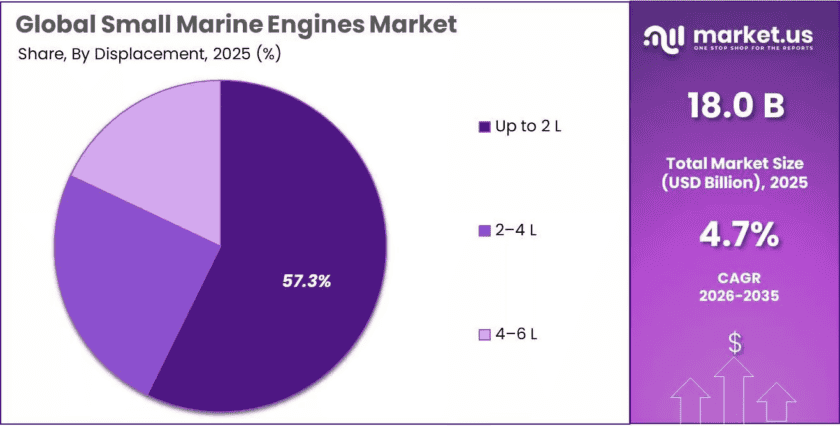
According to the supplied Market.us report, the market was valued at USD 18.0 billion in 2025 and is projected to reach USD 28.4 billion by 2035, at a stated compound annual growth rate (CAGR) of 4.7%. Gasoline engines held a 62.00% share by engine type, four-stroke engines accounted for 64.00%, outboard engines represented 68.00%, engines up to 2 liters displacement held 57.00%, and recreational boats accounted for 62.00% of their respective segments. North America led the regional market with a reported 39.50% share, equivalent to USD 7.1 billion in 2025.
Marine engine demand is influenced by boating activity, fishing operations, engine replacement, and environmental requirements. The United States Coast Guard recorded approximately 11.55 million registered recreational vessels in 2023, showing the scale of the country’s registered recreational boating fleet. The US Environmental Protection Agency also regulates exhaust emissions from gasoline marine engines and evaporative emissions from fuel tanks and fuel lines, encouraging manufacturers to meet applicable standards.
Market values and segment shares are taken from the supplied Market.us report. Government sources provide industry context and do not independently verify the commercial market estimates.
Key Takeaways
- Market value: The Small Marine Engines Market reached a reported USD 18.0 billion in 2025.
- Forecast: The market is projected to reach USD 28.4 billion by 2035, at a stated 4.7% CAGR.
- Leading region: North America held a 39.50% share, valued at USD 7.1 billion, in 2025.
- Leading engine type: Gasoline engines accounted for 62.00% of the market.
- Leading stroke type: Four-stroke engines represented 64.00%.
- Leading placement: Outboard engines held 68.00%.
- Leading displacement: Engines up to 2 liters accounted for 57.00%.
- Leading application: Recreational boats represented 62.00%.
Regional Analysis
North America: Leading Regional Market
According to the supplied report, North America held a 39.50% share of the Small Marine Engines Market in 2025, with reported revenue of USD 7.1 billion. The region benefits from recreational boating, fishing activity, engine replacement, and established marine service networks. The US Coast Guard recorded approximately 11.55 million registered recreational vessels in 2023, providing an indication of the scale of the registered boating fleet. Demand is supported by the need for reliable outboard engines, accessible maintenance, and compliance with emissions standards.
Asia-Pacific: Fishing and Coastal Activity
Asia-Pacific demand is supported by fishing, aquaculture, coastal transport, and recreational boating. The Food and Agriculture Organization of the United Nations reported that Asia accounted for 179 million tonnes, or 76% of global aquatic animal and algae production, in 2024. This does not measure marine engine sales directly, but it illustrates the scale of maritime and aquatic economic activity that can support demand for small fishing vessels and utility boats. Market development depends on fleet needs, local manufacturing, fuel costs, and access to engine servicing.
Market Dynamics
1. Driver: Recreational Boating and Engine Replacement
Recreational boating supports demand for small marine engines used in fishing, leisure, water sports, and short coastal trips. The US Coast Guard recorded approximately 11.55 million registered recreational vessels in 2023, illustrating the scale of the registered fleet in one major market.
Engines require regular servicing and may eventually need replacement as performance declines or repair costs rise. Outboard designs are particularly convenient for many small boats because they are accessible for maintenance and replacement. Demand nevertheless depends on consumer confidence, financing costs, fuel prices, and seasonal boating activity.
2. Trend: Cleaner and More Efficient Propulsion
Marine engine manufacturers are improving combustion, fuel delivery, and engine control to meet emissions requirements and improve operating performance. The US Environmental Protection Agency regulates exhaust emissions from gasoline marine engines and evaporative emissions from fuel tanks and fuel lines.
These rules encourage compliant designs and testing. Electric and hybrid propulsion is also gaining attention in applications where shorter routes, charging access, and operating patterns make it suitable. Buyers increasingly compare fuel consumption, noise, servicing requirements, and emissions performance. Adoption varies by vessel size, power needs, infrastructure, and the total cost of ownership.
3. Restraint: Purchase Costs and Ongoing Operating Expenses
The cost of buying and maintaining a small marine engine can delay replacement decisions, particularly for recreational owners and small fishing operators. Total ownership costs include fuel, scheduled maintenance, spare parts, installation, and repairs. More advanced engines may also require specialised diagnostic equipment and trained technicians.
Changes in fuel prices and the availability of replacement parts can affect operating budgets. For electric propulsion, battery costs and charging access may add further barriers. Manufacturers and dealers can reduce some concerns through warranty support, service packages, and transparent maintenance schedules, but affordability remains a key factor in purchase decisions.
4. Opportunity: Electric Propulsion and Integrated Marine Systems
Electric and hybrid propulsion offers growth opportunities in small vessels operating on short routes, in marinas, or in areas with restrictions on noise and local emissions. These systems can reduce direct exhaust emissions during electric operation and may lower routine maintenance needs, depending on design and usage.
Opportunities also exist in integrated controls, battery monitoring, and digital engine diagnostics. However, battery weight, range, charging time, and upfront cost remain important considerations. Manufacturers can develop suitable products by working with boatbuilders, charging providers, and marine service networks to match propulsion systems to real operating requirements.
Emerging Trends
1. Four-Stroke Engine Adoption
Four-stroke engines held a reported 64.00% share of the market by stroke type in 2025. Their demand reflects interest in reliable operation, fuel efficiency, and lower emissions compared with many older two-stroke designs, subject to engine model and operating conditions.
2. Continued Outboard Engine Demand
Outboard engines accounted for a reported 68.00% share in 2025. Their external mounting makes many models convenient to install, service, and replace. The US Coast Guard recorded approximately 11.55 million registered recreational vessels in 2023, indicating a substantial boating fleet.
3. Cleaner Gasoline Engine Technology
Gasoline engines held a reported 62.00% share of the market in 2025. The US EPA regulates exhaust and evaporative emissions from gasoline marine engines, encouraging manufacturers to improve fuel delivery, combustion, and emissions control.
4. Growth in Electric and Hybrid Options
Electric and hybrid engines are being considered for selected small-vessel applications. The best fit depends on route length, battery capacity, charging access, and vessel load. These technologies can reduce direct exhaust emissions during electric operation, although total environmental impact depends on the energy source.
5. Demand for Compact Engines
Engines with displacement up to 2 liters held a reported 57.00% share in 2025. Compact engines suit many small recreational and fishing boats where manageable weight, practical power, straightforward installation, and maintenance access influence engine selection.
Use Cases
1. Recreational Boating
Recreational boats represented a reported 62.00% share of the market by application in 2025. Small marine engines power leisure trips, water sports, and personal fishing. Owners commonly compare reliability, fuel consumption, engine weight, and the availability of local maintenance.
2. Small Fishing Vessels
Small engines power boats used for nearshore fishing and daily transport to fishing grounds. The FAO reported that Asia produced 179 million tonnes of aquatic animals and algae in 2024, highlighting the scale of related economic activity, though not engine demand directly.
3. Coastal and Utility Transport
Small marine engines provide propulsion for utility boats carrying people, equipment, or supplies between nearby coastal locations. Operators prioritise dependable starting, practical fuel use, and simple repairs. Engine power must match vessel size, load, distance, and local operating conditions.
4. Marina and Vessel Support
Small support boats use marine engines for vessel assistance, inspection, and maintenance around marinas and ports. Outboard engines can suit these tasks because they are accessible for servicing and replacement. Operators must choose suitable power and follow applicable emissions and safety requirements.
5. Electric Propulsion for Short Routes
Electric marine engines can serve small boats on short routes where charging is available. They may be suitable for marina transfers, quiet-water recreation, or selected inland applications. Range, battery weight, charging time, and purchase cost determine whether an electric system meets operational needs.
Frequently Asked Questions
1. What is the Small Marine Engines Market?
The Small Marine Engines Market covers engines used to propel recreational boats, fishing vessels, utility craft, and other small vessels. It includes gasoline, diesel, electric, and hybrid engines across outboard, inboard, and other configurations.
2. What is the projected market value by 2035?
According to the supplied Market.us report, the market was valued at USD 18.0 billion in 2025 and is projected to reach USD 28.4 billion by 2035, representing a stated CAGR of 4.7%.
3. Which region led the market in 2025?
North America led the market with a reported 39.50% share and USD 7.1 billion in revenue in 2025. Recreational boating, fishing, engine replacement, and established marine service networks support regional demand.
4. Which engine type held the largest share?
Gasoline engines held a reported 62.00% share of the market by engine type in 2025. Their broad availability and use in recreational boats and small fishing vessels support demand, subject to local emissions requirements.
5. Which stroke type dominated the market?
Four-stroke engines accounted for a reported 64.00% share in 2025. They are commonly selected for reliable operation and fuel efficiency, although actual performance depends on the engine model, vessel load, and operating conditions.
6. Which placement type led the market?
Outboard engines held a reported 68.00% share in 2025. Their external mounting can make installation, maintenance, and replacement easier for many small recreational and fishing boats compared with some integrated engine arrangements.
Conclusion
The Small Marine Engines Market supports recreational boating, fishing, coastal transport, and small-vessel operations. According to the supplied Market.us report, the market is projected to grow from USD 18.0 billion in 2025 to USD 28.4 billion by 2035, at a stated CAGR of 4.7%. North America led the market with a reported 39.50% share, while gasoline engines, four-stroke engines, outboard placement, compact displacement, and recreational boats led their respective segments.
Environmental requirements are encouraging cleaner engine designs, while electric and hybrid systems offer opportunities in selected applications. Future demand will depend on affordability, replacement needs, service access, and boating activity.
Discuss your needs with our analyst
Please share your requirements with more details so our analyst can check if they can solve your problem(s)