Overview
New York, NY – Oct 13, 2026 –The global Servo Motors and Drives Market supports industrial automation by enabling precise control of motor speed, position, torque, and movement. These systems are widely used in robotics, automotive production, semiconductor manufacturing, packaging machinery, machine tools, and automated assembly lines.
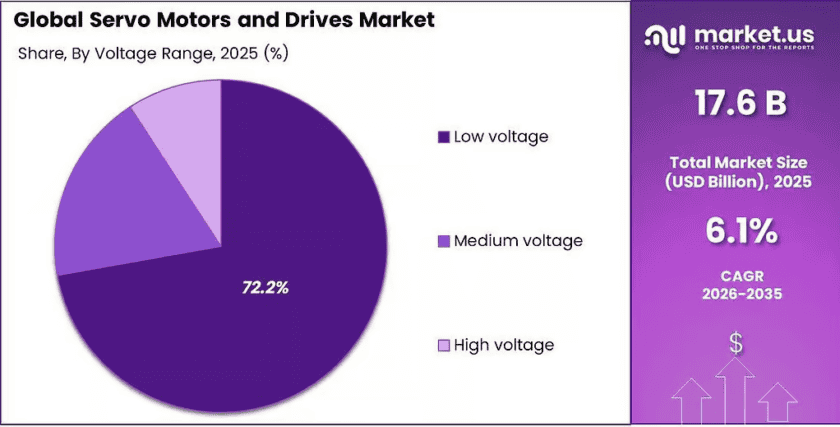
According to the supplied market report, the global market was valued at USD 17.6 billion in 2025 and is projected to reach USD 31.9 billion by 2035, representing a stated compound annual growth rate (CAGR) of 6.1%. Servo motors accounted for 63.47% of the product segment, AC servo motors held 76.05% of the motor-type segment, and rotary systems represented 78.00% of the system-type segment. Low-voltage systems accounted for 72.23%, hardware held 81.00%, and automotive and transportation represented 27.91% of the end-use segment.
Industrial automation is an important demand driver. The International Federation of Robotics reported that 542,000 industrial robots were installed worldwide in 2024, more than twice the annual number recorded a decade earlier. As manufacturers pursue higher productivity and more consistent production, servo systems remain important for precise, repeatable machine movement.
Key Takeaways
- Global market value: The market was valued at USD 17.6 billion in 2025.
- Forecast: Revenue is projected to reach USD 31.9 billion by 2035, at a stated 6.1% CAGR.
- Leading product type: Servo motors held a 63.47% share.
- Leading motor type: AC servo motors accounted for 76.05%.
- Leading system type: Rotary systems represented 78.00%.
- Leading voltage range: Low-voltage systems held 72.23%.
- Leading offering: Hardware accounted for 81.00%.
- Leading end-use industry: Automotive and transportation held 27.91%.
Regional Analysis
North America: Significant Industrial Automation Demand
The supplied market figures identify North America as a major regional market, with a reported 35.90% share and USD 6.3 billion in 2025 revenue. Demand is supported by automated manufacturing, automotive production, packaging equipment, and semiconductor-related investment. Servo systems help manufacturers improve positioning accuracy, control machine movement, and maintain repeatable production cycles.
The United States Department of Energy also highlights the importance of motor and drive efficiency: motor-driven machine applications account for approximately 54% of industrial electricity consumption in the US manufacturing sector. This creates a wider incentive to select efficient motors and optimise complete drive systems.
Asia-Pacific: Strong Robotics and Manufacturing Base
Asia-Pacific remains a key centre for industrial automation, electronics manufacturing, robotics, and machinery production. The International Federation of Robotics reported that 74% of new industrial robot deployments in 2024 were in Asia. This concentration supports demand for servo motors, drives, encoders, and integrated motion-control systems. The region’s market outlook depends on factory investment, electronics production, equipment exports, and adoption of automated manufacturing.
Europe: Energy Efficiency and System Optimisation
Europe’s servo motor and drive demand is influenced by industrial automation and energy-efficiency requirements. European Commission rules covering specified electric motors and variable-speed drives require products within scope to meet defined efficiency levels.
The Commission estimates that the measures could deliver around 107 terawatt-hours of annual electricity savings by 2030 across the covered motor and drive products. This encourages manufacturers to assess motor efficiency, speed control, and the performance of complete systems.
Other Markets: Modernisation of Industrial Equipment
Manufacturers in other regions can adopt servo systems as they upgrade production lines, introduce robotics, and automate material handling. Demand depends on investment budgets, access to technical expertise, equipment compatibility, and the expected productivity gains. Retrofit projects may create opportunities where existing machinery requires better positioning accuracy, controlled acceleration, or more flexible speed management.
Market Dynamics
1. Driver: Increasing Industrial Automation
Growing automation is driving demand for servo motors and drives because manufacturers need accurate, repeatable movement in robotics, assembly, packaging, and machine tools. The International Federation of Robotics recorded 542,000 industrial robot installations worldwide in 2024, more than twice the annual total a decade earlier.
Each automated production line may use multiple motion-control axes, creating demand for motors, drives, feedback devices, and controllers. Servo systems help control speed, torque, and position during complex operations. As factories invest in higher productivity and more consistent output, precision motion control becomes an important part of equipment design.
2. Trend: Greater Focus on Energy Efficiency
Manufacturers are increasingly assessing the energy use of complete motor and drive systems rather than selecting equipment only by purchase price. The European Commission estimates that applicable ecodesign measures for electric motors and variable-speed drives could deliver around 107 terawatt-hours of annual electricity savings by 2030.
Variable-speed control can reduce energy use where machinery operates under changing loads. The US Department of Energy explains that reducing the speed of a centrifugal pump or fan by 20% can reduce its power requirement by approximately 50%, under suitable operating conditions. These gains encourage efficient equipment selection and better control settings.
3. Restraint: High Initial and Integration Costs
Servo systems can require a higher initial investment than simpler motor arrangements because they may need a compatible drive, encoder, controller, safety components, and specialised commissioning. Integration can also involve machine redesign, software configuration, staff training, and production downtime.
The US Department of Energy identifies upfront cost and the need for additional installation and operating knowledge as barriers to wider adoption of advanced motor technologies and variable-speed drives. Smaller manufacturers may therefore delay upgrades when the return on investment is unclear. Suppliers can reduce this barrier through packaged solutions, easier commissioning tools, training, and lifecycle cost comparisons.
4. Opportunity: Smart Factories and Predictive Maintenance
Connected servo drives create opportunities to monitor motor temperature, load, vibration, and operating performance. These signals can help maintenance teams identify abnormal conditions before they cause unexpected stoppages. The European Commission’s motor and drive rules require efficiency information at different load points for products within scope, supporting more informed system optimisation.
Meanwhile, the International Federation of Robotics reported 542,000 industrial robot installations in 2024, reflecting the scale of automation equipment that may require precise motion control and ongoing maintenance. Suppliers can expand their offerings through diagnostic software, remote support, integrated safety functions, and condition-monitoring services.
Emerging Trends
1. Smart Servo Drives
Servo drives increasingly include diagnostic features that monitor operating conditions and support fault detection. The International Federation of Robotics recorded 542,000 industrial robot installations in 2024, expanding the wider installed base of automated equipment that needs dependable motion control and maintenance.
2. Energy-Efficient Motor Systems
Energy efficiency is influencing motor and drive selection. The European Commission estimates that applicable motor and variable-speed-drive ecodesign measures could save around 107 terawatt-hours of electricity annually by 2030, encouraging better motor selection and system optimisation.
3. More Compact Motion-Control Equipment
Manufacturers are seeking compact motor-drive packages that fit into smaller machines and automated production cells. Integrated electronics and improved power components can reduce installation complexity, while accurate control remains important for high-speed packaging, electronic assembly, and robotic handling.
4. Wider Use of AC Servo Motors
AC servo motors are widely used where accurate speed and position control are needed. They accounted for a reported 76.05% share of the motor-type segment in 2025, reflecting their strong position across industrial motion-control applications.
5. Digital Commissioning and Diagnostics
Software tools are helping engineers configure motion profiles, coordinate multiple axes, and diagnose operating faults. The European Commission’s efficiency rules require relevant motor and drive performance information at different load points, supporting more informed equipment selection and optimisation.
Use Cases
1. Automotive Assembly
Automotive manufacturers use servo motors in robotic welding, component positioning, automated fastening, and assembly lines. The automotive and transportation segment accounted for a reported 27.91% share of the market in 2025. Servo control supports repeatable movement and consistent production quality.
2. Semiconductor and Electronics Manufacturing
Servo systems control wafer handling, component placement, inspection equipment, and electronic assembly. The International Federation of Robotics recorded 128,899 industrial robot installations in the electrical and electronics industry in 2024, illustrating the importance of automation in this production sector.
3. Packaging and Material Handling
Packaging machinery uses servo drives to control conveyors, filling equipment, cutting mechanisms, labelling, and product placement. Accurate speed and position control helps coordinate multiple operations and reduce handling errors. Variable-speed operation can also help equipment match changing production demands.
4. CNC Machine Tools
Computer numerical control (CNC) machines use servo motors to move cutting tools and workpieces along defined paths. Rotary systems represented a reported 78.00% share of the market’s system-type segment in 2025. Accurate motion supports repeatable machining and controlled movement.
5. Pumps, Fans, and Industrial Equipment
Motor-drive systems can adjust equipment speed to match demand rather than operate continuously at full speed. The US Department of Energy explains that, for suitable centrifugal pump and fan applications, a 20% reduction in speed can reduce power requirements by approximately 50%.
Frequently Asked Questions
1. What are servo motors and drives?
Servo motors and drives form a motion-control system. The motor creates mechanical movement, while the drive controls speed, torque, and position using commands and feedback. They are used where machinery needs precise, repeatable movement.
2. What is the global Servo Motors and Drives Market value?
According to the supplied market report, the global Servo Motors and Drives Market was valued at USD 17.6 billion in 2025 and is projected to reach USD 31.9 billion by 2035, at a stated CAGR of 6.1%.
3. Which product segment led the market in 2025?
Servo motors led the product-type segment with a reported 63.47% share in 2025. Their role in accurate positioning, speed control, and repeatable movement supports their use in robotics, machine tools, packaging, and automated assembly.
4. Which motor type held the largest share?
AC servo motors held a reported 76.05% share of the motor-type segment in 2025. Their precise control and suitability for automated machinery support their use in robotics, CNC equipment, packaging systems, and industrial assembly applications.
5. Which system type dominated the market?
Rotary systems held a reported 78.00% share of the system-type segment in 2025. They support controlled rotational movement in robotic joints, machine tools, printing equipment, packaging machinery, and automated production systems.
6. Which voltage range held the largest share?
Low-voltage systems accounted for a reported 72.23% share in 2025. They are widely suited to factory automation, compact machinery, packaging equipment, electronics assembly, and other applications requiring accurate motion control.
Conclusion
The Servo Motors and Drives Market is supported by increasing industrial automation, demand for precise movement, and greater attention to equipment efficiency. According to the supplied report, the global market is projected to rise from USD 17.6 billion in 2025 to USD 31.9 billion by 2035, at a stated CAGR of 6.1%.
Servo motors, AC servo motors, rotary systems, low-voltage equipment, hardware, and automotive applications led their respective segments in 2025. Robotics and energy-efficiency initiatives provide additional industry context. Future opportunities include connected drives, improved diagnostics, and compact motion-control systems, while upfront costs and integration requirements remain important challenges.
Discuss your needs with our analyst
Please share your requirements with more details so our analyst can check if they can solve your problem(s)