Overview
New York, NY – Oct 08, 2026 – The global Food Authenticity Testing Market is expanding as regulators, food manufacturers, retailers, and laboratories increase efforts to identify adulteration, species substitution, incorrect labelling, and undeclared ingredients. The market was valued at USD 6.1 billion in 2025 and is projected to reach approximately USD 13.6 billion by 2035, growing at a 8.3% CAGR from 2026 to 2035.
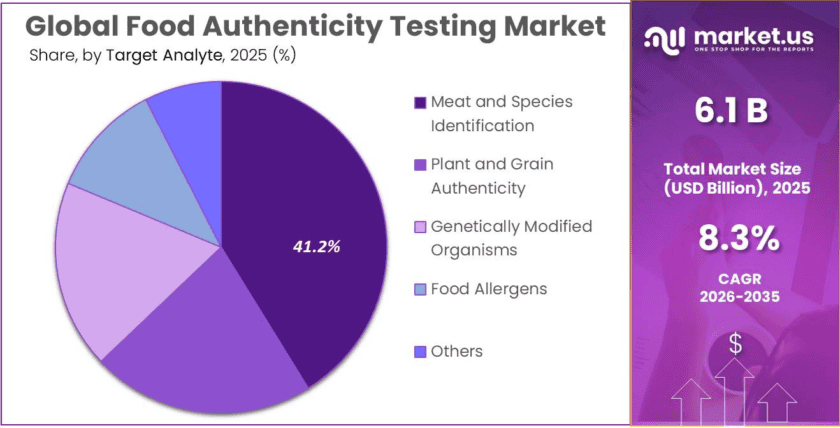
Food authenticity testing verifies whether a product matches its stated species, ingredients, origin, and composition. In 2025, Processed/Ready-to-Eat Food held 72.10% of the market, while PCR accounted for 32.10% of testing technology demand. Species Identification represented 41.23% of target-analyte testing.
Government surveillance demonstrates why stronger testing is needed. During FY2025, the U.S. FDA tested 102 honey samples and identified undeclared sweeteners in 4 samples. Canada tested 886 authenticity samples during 2024–2025 and prevented more than 150,000 kg of misrepresented food from entering the market.
Growing food trade, complex processing, premium products, and advanced technologies such as PCR, DNA sequencing, mass spectrometry, isotope analysis, and NMR are strengthening long-term testing demand.
Key Takeaways
- The Food Authenticity Testing Market was valued at USD 6.1 billion in 2025 and is expected to reach USD 13.6 billion by 2035, growing at an 8.3% CAGR.
- Processed/Ready-to-Eat Food dominated the sample-type category with more than a 72.10% share in 2025.
- PCR led the technology segment with more than a 32.10% share.
- Species Identification accounted for more than a 41.23% share of the target-analyte category.
- Europe led globally with more than a 33.78% share, generating approximately USD 2.0 billion in 2025.
- Regulatory surveillance of meat, honey, fish, juices, oils, spices, and processed foods continues to create laboratory-testing opportunities.
Regional Analysis
Europe Leads with 33.78% Share and USD 2.0 Billion
Europe held the leading Food Authenticity Testing Market position in 2025, capturing more than a 33.78% share and generating approximately USD 2.0 billion. The region benefits from strong food-control regulation, established laboratory networks, cross-border food trade, and growing enforcement against adulteration and species substitution.
UK surveillance illustrates the testing requirement. The Food Standards Agency’s 2025/26 retail programme collected 845 food products, with 800 samples examined for regulatory compliance. Overall, 72% of targeted surveillance samples were satisfactory. Authenticity investigations covered meat, fish, composition, allergens, and unauthorized ingredients.
European Commission laboratories are also advancing authentication technologies. The Joint Research Centre uses LC-HRMS, isotope-ratio mass spectrometry, real-time PCR, metabarcoding, and NMR to detect product tampering, origin fraud, and species substitution. These regulatory and scientific capabilities continue to strengthen Europe’s food-authenticity testing infrastructure.
Market Dynamics
Driver – Food Fraud Surveillance Increases Laboratory Testing Demand
Government enforcement against food fraud is becoming a major market driver. Canada’s CFIA tested 886 samples for authenticity during 2024–2025, including 246 marketplace samples and 640 targeted inspectorate samples. Enforcement prevented more than 150,000 kg of misrepresented food from being sold.
Targeted testing found satisfactory results in 90% of fish, 88% of fruit juice, and 81% of honey samples. These findings demonstrate continued risks across premium and frequently adulterated foods. As regulators increase targeted surveillance, manufacturers and importers are expected to use PCR, isotope analysis, chromatography, spectroscopy, and DNA techniques more frequently.
Trend – Advanced Molecular and Spectrometric Methods Expand
Food authenticity laboratories are increasingly combining several analytical technologies rather than depending on one method. The European Commission’s JRC food-fraud laboratory uses LC-HRMS, IRMS, real-time PCR, metabarcoding, and NMR to investigate origin, species, composition, and product tampering.
JRC scientists have also developed authenticity methods for 6 commonly consumed herbs and spices, including saffron, turmeric, cumin, oregano, paprika/chilli, and black pepper. This shift toward multi-technology testing improves confidence when foods have complex ingredient mixtures. Laboratories are therefore investing in sequencing, molecular databases, certified reference materials, and advanced spectrometric instruments.
Restraint – Complex Foods Require Multiple Validation Methods
A major restraint is the difficulty of developing one reliable method for every food and adulterant. Honey illustrates this challenge because fraudsters can use different sugar syrups with chemical properties that resemble genuine products. The FDA tested 102 honey samples in 2025, with 4 samples found to contain undeclared sweeteners.
The European JRC has previously noted that no simple single test can identify every form of honey adulteration. Laboratories may therefore require isotope analysis, molecular testing, reference databases, and confirmatory techniques. This raises analytical costs, requires specialist skills, and lengthens validation and reporting timelines.
Opportunity – Risk-Based Testing Creates Recurring Surveillance Demand
Risk-based surveillance provides a strong opportunity for testing laboratories and technology suppliers. The UK Food Standards Agency’s 2025/26 survey collected 845 products, of which 800 underwent compliance assessment across authenticity, allergens, composition, contaminants, and unauthorized ingredients. Canada similarly used targeted sampling to identify higher-risk products and removed more than 150,000 kg of misrepresented food during 2024–2025.
These programmes show how testing is moving from occasional investigation toward continuous surveillance. Laboratories can develop recurring programmes covering supplier screening, incoming ingredients, species verification, origin confirmation, and suspicious-product investigation, creating opportunities for integrated analytical and digital traceability services.
Emerging Trends
1. PCR Expands for Species Verification
Government laboratories increasingly use real-time PCR for food species identification. The European JRC has developed authenticity methods for 6 major herbs and spices, supporting faster detection of undeclared plant material and substitution in complex products.
2. Certified Reference Materials Improve Reliability
In 2025, the European JRC introduced a certified Atlantic cod reference material to support fish authenticity testing. Reference materials help laboratories validate methods and improve comparability when verifying species claims across different food-testing facilities.
3. Honey Testing Remains a Priority
The U.S. FDA analysed 102 honey samples in 2025, including 54 domestic and 48 imported samples. Four contained undeclared added sweeteners, keeping honey among the important commodities requiring continued authenticity surveillance.
4. Targeted Surveillance Is Becoming More Data Driven
Canada tested 886 food-authenticity samples during 2024–2025. Of these, 640 came from targeted inspectorate sampling, showing how regulators increasingly use risk intelligence and previous non-compliance to direct laboratory resources toward vulnerable commodities.
5. Digital Authenticity Databases Gain Importance
In November 2025, the UK Government Chemist announced work on a framework for evaluating honey-authenticity databases. The initiative aims to improve transparency and confidence in non-targeted analytical databases used to support commercial authenticity decisions.
Use Cases
1. Meat Species Identification
Food laboratories use DNA and PCR testing to identify undeclared animal species in processed meat. The UK’s 2025/26 surveillance programme tested 125 meat products, identifying several cases where the detected species differed from declared ingredients.
2. Honey Adulteration Detection
Stable carbon isotope analysis can identify undeclared sweeteners added to honey. FDA tested 102 honey samples during 2025 and found 4 violative products, demonstrating the practical role of analytical authentication in protecting premium food categories.
3. Fish Species Verification
DNA methods help determine whether seafood matches its label. Canada tested fish for species substitution during 2024–2025 and reported 90% satisfactory results, meaning authenticity testing remained necessary to identify incorrectly represented products.
4. Fruit Juice Authenticity
Laboratories test fruit juices for foreign sugars, water dilution, dyes, acids, and substitution with cheaper juices. Canada examined 172 targeted fruit-juice samples, with 88% receiving satisfactory authenticity results during its 2024–2025 programme.
5. Allergen and Ingredient Verification
Authenticity testing also supports accurate ingredient claims. Australia’s regulator coordinated 92 food recalls in 2025, with undeclared allergens responsible for 38% of recalls, highlighting the commercial importance of accurate formulation and label verification.
Frequently Asked Questions on Food Authenticity Testing
What is food authenticity testing?
Food authenticity testing verifies whether a food product matches its claimed species, ingredients, composition, geographical origin, or production method. Laboratories use molecular, chemical, spectroscopic, and isotope-based techniques to detect substitution, dilution, and mislabelling.
How large is the Food Authenticity Testing Market?
The global Food Authenticity Testing Market was valued at USD 6.1 billion in 2025 and is projected to reach around USD 13.6 billion by 2035, expanding at an 8.3% CAGR.
Which region dominates the Food Authenticity Testing Market?
Europe led the market in 2025 with more than a 33.78% share, generating approximately USD 2.0 billion, supported by regulatory enforcement, sophisticated laboratories, international food trade, and advanced authenticity research.
Which sample type dominates the market?
Processed and Ready-to-Eat Food held the largest share in 2025 at more than 72.10%. Complex ingredient mixtures make visual verification difficult, increasing demand for laboratory-based identification and compositional testing.
Which technology leads food authenticity testing?
PCR held the dominant technology position in 2025, accounting for more than a 32.10% share. It can identify animal or plant DNA even when products have undergone processing or contain several ingredients.
Which target analyte has the largest share?
Species Identification dominated the target-analyte category in 2025 with more than a 41.23% share. Meat and seafood substitution remain important regulatory concerns because cheaper species can be sold as higher-value products.
Why is food authenticity testing becoming more important?
Globalized supply chains and complicated processed foods create more opportunities for substitution and incorrect claims. Canada prevented more than 150,000 kg of misrepresented food from entering its market during 2024–2025.
What methods are commonly used for food authenticity testing?
Common techniques include PCR, DNA sequencing, metabarcoding, mass spectrometry, isotope-ratio analysis, chromatography, and NMR. European Commission laboratories use several of these methods together to identify species, composition, origin, and product tampering.
Conclusion
The Food Authenticity Testing Market is becoming increasingly important as regulators and manufacturers strengthen controls against adulteration, substitution, and incorrect labelling. The market stood at USD 6.1 billion in 2025 and is projected to reach USD 13.6 billion by 2035, growing at an 8.3% CAGR.
Europe leads with a 33.78% share, while Processed/Ready-to-Eat Food holds 72.10%. Government surveillance of honey, meat, fish, oils, and juices is creating recurring demand for reliable analytical testing. PCR, sequencing, isotope analysis, reference materials, and digital authenticity databases are expected to improve detection capabilities and strengthen food-chain transparency.
Discuss your needs with our analyst
Please share your requirements with more details so our analyst can check if they can solve your problem(s)