Overview
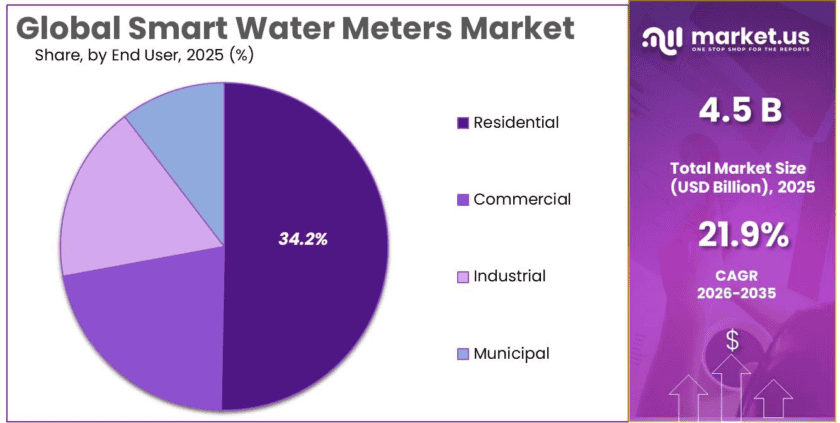
New York, NY – Oct 01, 2026 – The global Smart Water Meters Market is gaining strong momentum as water utilities modernize aging infrastructure, improve billing accuracy, detect leaks faster, and manage water consumption through digital networks. The market was valued at USD 4.5 billion in 2025 and is projected to reach around USD 35.0 billion by 2035, expanding at a 21.9% CAGR from 2026 to 2035.
Smart water meters automatically record water consumption and communicate usage information to utilities through Automatic Meter Reading (AMR) or Advanced Metering Infrastructure (AMI). EPA notes that AMI systems can provide hourly or even more frequent readings, helping users and utilities identify unusual consumption and leaks sooner than conventional billing systems.
Water conservation needs are strengthening deployment. The Environment Agency reported that nearly 19% of supplied water in England was still lost through leakage during 2024–2025, while around 12% of homes already had smart water meters.
Government-backed infrastructure programs are also supporting adoption. Ofwat approved approximately £1.7 billion for installing 10.4 million smart meters between 2025 and 2030. Meanwhile, the European Commission estimates smart metering could reduce water use by as much as 25%, strengthening the long-term business case for connected water-management technology.
Key Takeaways
- The global Smart Water Meters Market was valued at USD 4.5 billion in 2025 and is expected to reach approximately USD 35.0 billion by 2035, growing at a 21.9% CAGR during 2026–2035.
- Ultrasonic Meters led the meter-type category in 2025 with more than 38.50% market share, supported by accurate flow measurement and low-maintenance digital operation.
- Meters and Accessories accounted for more than 50.00% of the component segment, reflecting continuing demand for meter hardware, communication endpoints, valves, registers, and installation equipment.
- Automatic Meter Reading held over 57.20% of the technology segment in 2025 as utilities continued replacing labor-intensive manual readings with remote data collection.
- The Residential segment captured more than 50.2% of the market, supported by household leak detection, consumption monitoring, and automated billing applications.
- North America dominated the global market with more than 34.50% share, representing around USD 1.55 billion in 2025.
Regional Analysis
North America Leads with 34.50% Share and USD 1.55 Billion Market Value
In 2025, North America held a dominant position in the Smart Water Meters Market, accounting for more than 34.50% share and approximately USD 1.55 billion in revenue. The region benefits from established utility networks, growing AMI deployment, digital billing systems, and increasing attention to water conservation and leakage management.
Water consumption remains substantial across the United States. EPA states that an average American uses approximately 82 gallons of water per day, while a four-person household can consume around 10,000 gallons within 30 days. Such consumption levels create a strong operating case for real-time monitoring, customer usage alerts, and early leak detection.
Europe is also moving rapidly toward digital metering. Ofwat has approved £1.7 billion for 10.4 million smart meters between 2025 and 2030 and expects leakage to fall another 17% over the same five-year regulatory period.
The European Commission is further supporting digital water infrastructure. Its 2026 digitalisation initiative states that smart meters can reduce water use by as much as 25%, while digital systems may provide another 5–8% saving.
Market Dynamics
Driver – Rising Need to Reduce Water Leakage
Leakage reduction is becoming one of the strongest drivers for smart water meter adoption. In England, nearly 19% of water supplied was still being lost through leakage in 2024–2025. Smart metering provides multiple automatic readings every day, helping utilities identify continuous flows and customer-side leaks much earlier.
Ofwat has consequently approved more than £700 million specifically for leakage-related measures while targeting another 17% reduction during the 2025–2030 period. EPA also reports that leaks can account for more than 6% of total water use in an average commercial facility, supporting demand for continuous monitoring technologies.
Trend – Shift Toward AMI and Real-Time Data
The market is increasingly shifting from basic meter reading toward Advanced Metering Infrastructure that connects meters, communication networks, analytics, and utility billing platforms. EPA states that AMI can generate hourly or more frequent water-use information, giving utilities much better visibility than monthly manual readings.
England plans to install around 10.4 million smart meters between 2025 and 2030, showing how utility programs are moving toward large connected-meter networks. The European Commission is also preparing an EU-wide digital water action plan incorporating IoT, smart sensors, meters, and artificial intelligence to improve infrastructure management and water efficiency.
Restraint – Cost, Integration and Cybersecurity Requirements
Large smart-meter programs require spending on meters, communication equipment, installation, software, data platforms, billing integration, and cybersecurity. This can slow adoption among smaller utilities with limited investment capacity. Cybersecurity is becoming particularly important as more water infrastructure becomes digitally connected.
GAO reported that the U.S. water and wastewater sector includes close to 170,000 systems, many facing persistent cybersecurity risks. During 2025, EPA identified vulnerabilities at 277 water systems and addressed 350 vulnerabilities, highlighting the need to include cyber protection within digital infrastructure upgrades. EPA also made more than USD 9 million available in 2025 for cybersecurity and resilience improvements.
Opportunity – Large-Scale Smart Meter Rollouts
Government-backed water modernization programs are creating major opportunities for smart meter manufacturers, communication providers, analytics platforms, and installation services. Ofwat approved approximately £1.7 billion to install 10.4 million smart meters from 2025 to 2030, alongside more than £700 million for leakage reduction.
Europe provides another long-term opportunity as the European Commission develops a digital water action plan incorporating smart meters and IoT technologies. The Commission estimates that smart metering could reduce water consumption by as much as 25%, digital solutions by another 5–8%, and leak detection by 7–14%, strengthening the economic case for digital water management.
Emerging Trends
1. Advanced Metering Infrastructure Expansion
Water utilities are moving toward AMI networks that provide hourly or more frequent usage information. These systems support automated billing, consumption analysis, and rapid leak alerts while reducing dependence on physical meter-reading visits.
2. Smart Meter-Based Leak Detection
Leak monitoring is becoming a core smart-meter feature. England currently loses nearly 19% of supplied water through leakage, strengthening utility demand for meters capable of identifying continuous flows and unusual consumption patterns.
3. AI and Digital Water Analytics
Artificial intelligence is increasingly being combined with smart-meter information for abnormal-use detection and predictive network management. The European Commission estimates broader digital systems could provide another 5–8% reduction in water consumption.
4. Large Government-Supported Meter Rollouts
Utility-scale deployment is accelerating. Ofwat approved £1.7 billion for the rollout of 10.4 million smart meters across England and Wales between 2025 and 2030, supporting hardware, communications, and analytics demand.
5. Stronger Cybersecurity Integration
Cybersecurity is becoming part of smart water infrastructure planning. EPA identified cybersecurity weaknesses at 277 water systems in 2025 and corrected 350 vulnerabilities, encouraging utilities to strengthen authentication, access controls, network monitoring, and procurement standards.
Use Cases
1. Household Water Consumption Monitoring
Residential smart meters help households understand daily consumption and identify unusual usage. The average American uses around 82 gallons per person each day, making detailed consumption information useful for household conservation programs and customer portals.
2. Household Leak Detection
Smart meters can detect continuous water flows that suggest hidden leaks. EPA notes that undetected household leaks can waste thousands of gallons every year, making automated alerts valuable for controlling water bills and property damage.
3. Commercial Building Water Management
Commercial facilities can use meter information to locate inefficient equipment and continuous leaks. EPA estimates leaks can represent more than 6% of a facility’s overall water consumption, creating measurable opportunities for monitoring-based savings.
4. Utility Network Leakage Management
Water utilities can analyze high-frequency smart-meter readings to identify abnormal demand zones. England still loses nearly 19% of supplied water through leakage, while regulators are targeting an additional 17% reduction during 2025–2030.
5. Automated Billing and Remote Reading
AMR and AMI meters remove much of the need for manual readings. England’s planned deployment of 10.4 million smart meters by 2030 illustrates the growing use of connected meters for automated billing and remote customer management.
Frequently Asked Questions on Smart Water Meters and Smart Water Meters Market
What is the Smart Water Meters Market size?
The global Smart Water Meters Market was valued at approximately USD 4.5 billion in 2025 and is projected to reach around USD 35.0 billion by 2035, representing a 21.9% CAGR between 2026 and 2035.
What is a smart water meter?
A smart water meter digitally measures water consumption and communicates the information remotely. Connected AMI systems can deliver hourly or more frequent readings, helping utilities improve billing, identify leaks, study demand, and communicate usage information to customers.
Which meter type dominated the market in 2025?
Ultrasonic Meters held the leading market position in 2025, accounting for more than 38.50% share. Their digital operation, measurement accuracy, limited moving components, and compatibility with remote monitoring systems support their use in modern water networks.
Which technology held the largest market share?
Automatic Meter Reading dominated the technology category in 2025 with more than 57.20% share. AMR enables utilities to obtain meter information remotely, reducing manual field-reading requirements and supporting faster and more consistent billing operations.
Which end user dominated the Smart Water Meters Market?
The Residential segment held more than 50.2% market share in 2025. Residential adoption is supported by automated billing, household consumption monitoring, leak alerts, water conservation programs, and increasing utility investment in connected metering infrastructure.
Which region leads the Smart Water Meters Market?
North America led the global market in 2025 with more than 34.50% share, corresponding to approximately USD 1.55 billion. Established utility infrastructure and continuing adoption of digital water-management systems support regional demand.
How can smart water meters reduce water consumption?
Smart meters provide regular consumption information and help detect abnormal flows quickly. The European Commission estimates that smart meters can lower water use by up to 25%, while digital leak-detection measures can provide additional savings.
Why are utilities investing in smart water meters?
Utilities are adopting smart meters to improve billing accuracy, detect leakage, monitor consumption, and reduce operating costs. Ofwat has approved £1.7 billion for 10.4 million smart meters scheduled for installation between 2025 and 2030.
What are the major challenges facing smart water meters?
Major challenges include high deployment costs, integration with older billing systems, connectivity limitations, data management, and cybersecurity. EPA found vulnerabilities at 277 water systems during 2025, demonstrating the growing importance of cybersecurity in connected water infrastructure.
What is the future outlook for smart water meters?
The outlook remains strongly linked with digital water infrastructure, leakage reduction, AMI adoption, and conservation programs. The market is projected to increase from USD 4.5 billion in 2025 to USD 35.0 billion by 2035.
Conclusion
The Smart Water Meters Market is moving into a major infrastructure modernization phase as utilities seek better consumption visibility, accurate billing, and faster leakage detection. The market is projected to rise from USD 4.5 billion in 2025 to USD 35.0 billion by 2035, growing at a 21.9% CAGR.
Government-backed deployments are strengthening this outlook, including Ofwat’s £1.7 billion program covering 10.4 million meters through 2030. With smart meters potentially reducing water use by up to 25%, digital water management is expected to become an increasingly important part of utility efficiency, conservation, billing, and infrastructure-resilience strategies.
Discuss your needs with our analyst
Please share your requirements with more details so our analyst can check if they can solve your problem(s)