Overview
New York, NY – Sep 09, 2026 – The global Food Service Packaging Market supports restaurants, cafés, takeaway counters, catering businesses, institutions, and food-delivery operations by providing containers, cups, lids, trays, wraps, bags, cartons, and cutlery that protect food during serving and transport.
The market was valued at USD 359.7 billion in 2025 and is projected to reach approximately USD 631.7 billion by 2035, expanding at a CAGR of 5.8%. Demand is rising as consumers spend more on meals prepared outside the home and expect convenient, portable, leak-resistant, and safe packaging. USDA reported that U.S. food-away-from-home spending reached USD 1.41 trillion in 2025 and represented 56.3% of total food expenditures.
Sustainability is also changing product design. Producers are increasing the use of recyclable paperboard, molded fiber, reusable systems, and other lower-waste formats while responding to tighter rules for chemicals and single-use packaging. Plastic remained the largest material segment with a 42.5% share, containers led product types with 34.5%, and rigid packaging accounted for 62.4%.
Asia Pacific dominated regional demand with a 40.3% share, equal to about USD 145.0 billion, supported by large foodservice networks, urban consumption, takeaway demand, and expanding catering activity across major economies. These factors make packaging an essential link between preparation, distribution, convenience, and safety.
Key Takeaways
- The global Food Service Packaging Market was valued at USD 359.7 billion in 2025 and is projected to reach approximately USD 631.7 billion by 2035, registering a 5.8% CAGR.
- Plastic held the dominant material position with approximately a 42.5% share, supported by lightweight construction, moisture resistance, flexibility, and broad use across foodservice formats.
- Containers dominated the product-type segment with around a 34.5% share, driven by takeaway meals, food delivery, institutional catering, and ready-to-eat applications.
- Rigid packaging captured approximately 62.4% of the market because containers, trays, cups, and clamshells provide strong protection, stackability, and spill resistance.
- Thermoforming led fabrication processes with about a 45.6% share, reflecting its suitability for high-volume production of trays, cups, containers, and clamshell packaging.
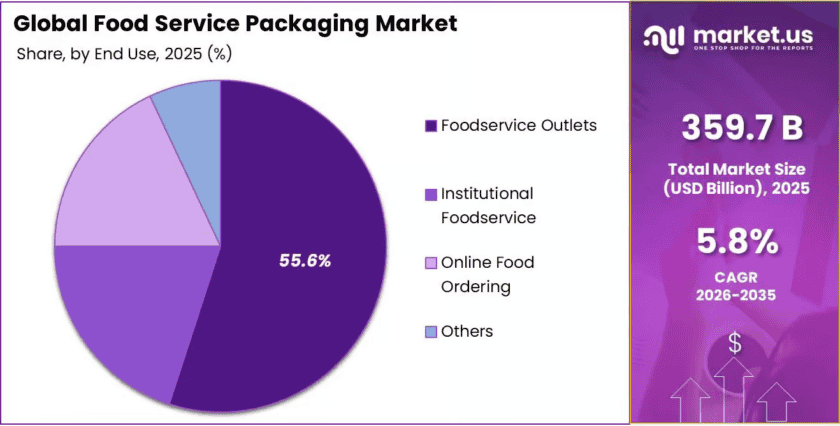
- Foodservice outlets represented around 55.6% of total market demand as restaurants, cafés, quick-service chains, and takeaway operators consumed large volumes of disposable and reusable packaging.
- Asia Pacific led the global market with a 40.3% share, generating approximately USD 145.0 billion in 2025.
Regional Analysis
In 2025, Asia Pacific held a dominant market position, capturing more than a 40.3% share, representing approximately USD 145.0 billion in Food Service Packaging Market revenue. Large populations, growing cities, takeaway consumption, organized restaurant chains, cloud kitchens, and institutional foodservice support strong packaging demand across China, Japan, South Korea, Southeast Asia, and other regional markets.
China provides a strong indication of this demand base. The National Bureau of Statistics reported that catering revenue reached CNY 5.7982 trillion in 2025, increasing 3.2% year over year. During the first quarter of 2026, catering income reached CNY 1.4623 trillion, up 4.2%.
North America also represents an important foodservice packaging market because U.S. food-away-from-home spending reached USD 1.41 trillion in 2025 and represented 56.3% of total food expenditure. Europe is increasingly shaped by circular-packaging rules, including requirements for takeaway businesses to support customer-owned containers by 2027 and reusable takeaway options by 2028.
Market Dynamics
Driver – Rising Food-Away-From-Home Spending
Rising spending on meals prepared outside the home is a major driver for food service packaging. USDA reported that U.S. food-away-from-home spending reached USD 1.41 trillion in 2025, representing 56.3% of total food expenditures, compared with USD 1.10 trillion for food at home. Higher restaurant, café, takeaway, catering, and institutional meal activity increases demand for containers, cups, lids, wraps, trays, bags, and cutlery. Packaging is essential for portion control, hygiene, transport, temperature retention, and spill prevention. As consumers continue choosing convenient prepared meals, foodservice operators need larger volumes of reliable packaging that supports both dine-out and off-premise consumption every day.
Trend – Reusable and Sustainable Packaging
Reusable, recyclable, and lower-impact packaging is becoming an important trend as regulators and buyers focus on waste reduction. The U.S. EPA recommends reusable food service ware as the preferred option and places certified compostable products ahead of recyclable single-use items when local collection exists. In Europe, Regulation (EU) 2025/40 requires takeaway businesses to allow customers to bring their own containers by 2027 and to offer reusable takeaway packaging by 2028. These changes are encouraging restaurants and packaging suppliers to redesign cups, containers, trays, and lids for repeated use, easier recovery, better material separation, and lower environmental impact across foodservice operations.
Restraint – Waste and Regulatory Compliance
Environmental compliance and end-of-life challenges can restrain growth for conventional food service packaging. Eurostat reported that the EU generated 79.7 million tonnes of packaging waste in 2023, equal to 177.8 kilograms per person, while plastic packaging waste averaged 35.3 kilograms per person. Regulatory changes also require suppliers to reformulate materials. In January 2025, the FDA determined that 35 food-contact notifications covering PFAS-based grease-proofing substances for paper and paperboard packaging were no longer effective. Manufacturers must therefore balance food safety, grease resistance, heat performance, recyclability, cost, and changing legal requirements, which can raise testing expenses and complicate material selection for suppliers.
Opportunity – Expanding Asia-Pacific Foodservice
Asia Pacific offers a strong opportunity as large foodservice economies continue expanding. China’s National Bureau of Statistics reported catering revenue of CNY 5.7982 trillion in 2025, up 3.2% from the previous year. In the first quarter of 2026, catering revenue reached CNY 1.4623 trillion, increasing 4.2% year on year. Rising organized dining, takeaway activity, urban food consumption, and convenience formats create demand for containers, cups, cartons, trays, and flexible packaging. Suppliers that combine cost efficiency with recyclable, fiber-based, PFAS-free, or reusable designs can benefit as foodservice operators seek packaging that meets performance requirements while responding to stricter environmental expectations regionally.
Emerging Trends
1. Reusable Food Service Packaging
Reusable food service ware is gaining attention as waste policies become stricter. EPA identifies reusable ware as the preferred purchasing choice, while EU rules require takeaway businesses to accept customer containers by 2027 and offer reusable takeaway packaging by 2028.
2. PFAS-Free Barrier Coatings
PFAS-free grease barriers are becoming standard for paper food packaging. FDA confirmed that 35 food-contact notifications for PFAS grease-proofing uses became ineffective in January 2025, increasing demand for alternative coatings that can resist oil, moisture, and heat safely across markets.
3. Growth of Paper and Fiber Formats
Paper and fiber formats are expanding as buyers seek easier recycling. Eurostat reported that paper and cardboard represented 40.4% of the EU’s 79.7 million tonnes of packaging waste in 2023, highlighting both material scale and recovery opportunities across foodservice systems.
4. Commercially Compostable Foodware
Compostable packaging is receiving more attention where collection infrastructure exists. EPA recommends certified commercially compostable food service ware when reusables are impractical and local programs accept it, encouraging growth in compostable cups, containers, plates, lids, and fiber-based products at scale.
5. Circular Packaging Design
Packaging design is shifting toward circularity and lower material use. EU Regulation 2025/40 sets new reuse, refill, and packaging-reduction requirements, including a 40% reusable target for certain transport packaging from 2030, influencing foodservice supply-chain packaging decisions across European food networks.
Use Cases
1. Restaurants and Takeaway Outlets
Restaurants use food service packaging for takeaway meals, leftovers, delivery, and portion control. The U.S. Census Bureau counted 608,144 restaurant and other eating-place establishments in 2022, generating about USD 800.1 billion in revenue, showing a large packaging user base nationally.
2. School Meal Programs
School meal programs require trays, cups, cartons, wraps, and containers for safe portioning and distribution. USDA reported that the National School Lunch Program served more than 4.8 billion lunches in fiscal 2024, creating substantial recurring institutional packaging requirements nationwide annually.
3. Catering and Event Foodservice
Catering companies depend on portable packaging for events, offices, conferences, weddings, and off-site meal service. U.S. Census data identified 12,289 catering firms in 2022, illustrating a broad commercial customer group requiring trays, boxes, lids, cups, and transport-ready packaging nationwide today.
4. Coffee and Beverage Outlets
Coffee shops, juice bars, and beverage outlets use cups, lids, sleeves, carriers, and takeaway containers. The U.S. Census Bureau recorded 78,110 snack and nonalcoholic beverage-bar establishments in 2022, with revenue of about USD 62.8 billion across the country nationwide annually.
5. Food Delivery and Takeaway
Food delivery and takeaway services need leak-resistant, tamper-aware packaging that protects meals during transport. U.S. food-away-from-home spending reached USD 1.41 trillion in 2025, representing 56.3% of total food spending, supporting continued demand for portable containers and related formats every day.
Frequently Asked Questions on Food Service Packaging and Food Service Packaging Market
1. What is food service packaging?
Food service packaging includes containers, cups, lids, trays, boxes, wraps, bags, plates, and cutlery used to serve, carry, store, or deliver prepared food and beverages while supporting hygiene, protection, portioning, convenience, and transport.
2. How big is the Food Service Packaging Market?
The global Food Service Packaging Market was valued at USD 359.7 billion in 2025 and is projected to reach about USD 631.7 billion by 2035, expanding at a CAGR of 5.8% during the forecast period.
3. Which region leads the Food Service Packaging Market?
Asia Pacific led the global Food Service Packaging Market in 2025 with a 40.3% share and approximately USD 145.0 billion in revenue, supported by large populations, expanding catering activity, takeaway demand, and organized foodservice growth.
4. Which material dominates food service packaging?
Plastic remained the leading material in 2025 with a 42.5% market share. Its widespread use reflects low weight, moisture resistance, durability, forming flexibility, and suitability for high-volume containers, cups, lids, wraps, and other foodservice applications.
5. Which product type leads the market?
Containers were the largest product segment in 2025, accounting for around 34.5% of the market. They are widely used for takeaway, delivery, institutional meals, and ready-to-eat foods because they support portion control, spill protection, and transport.
6. Why does rigid packaging hold a large share?
Rigid packaging held about 62.4% of the market in 2025. Trays, cups, clamshells, and containers remain important because they provide structural strength, stackability, product protection, and resistance to leakage during food preparation, handling, and delivery.
7. Which end-user segment dominates the market?
Foodservice outlets represented about 55.6% of market demand in 2025. Restaurants, cafés, quick-service outlets, and takeaway businesses use large volumes of packaging because every off-premise order may require multiple items such as containers, lids, cups, or cutlery.
8. Why is sustainable food service packaging becoming important?
Sustainable packaging is becoming more important because governments and buyers are focusing on waste reduction. EPA prefers reusable food service ware where practical, while European rules are introducing stronger requirements for reuse, refill, recycling, and single-use packaging reduction.
9. How are PFAS rules affecting food packaging?
PFAS rules are affecting paper food packaging. In January 2025, FDA determined that 35 food-contact notifications for PFAS-containing grease-proofing substances were no longer effective, increasing the need for alternative barrier materials in wrappers, cartons, and containers.
10. What is driving Food Service Packaging Market growth?
Major growth drivers include rising food-away-from-home spending, restaurant activity, takeaway consumption, institutional meals, and delivery services. USDA reported U.S. food-away-from-home spending of USD 1.41 trillion in 2025, equal to 56.3% of total food expenditures.
Conclusion
The Food Service Packaging Market is positioned for steady expansion as restaurants, takeaway services, catering businesses, schools, beverage outlets, and delivery operations require safe and convenient packaging. The market is projected to rise from USD 359.7 billion in 2025 to USD 631.7 billion by 2035 at a 5.8% CAGR. Asia Pacific leads with a 40.3% share, while sustainability rules are accelerating changes in materials and design. Reusable systems, recyclable paperboard, molded fiber, PFAS-free barriers, and improved recovery will shape future competition. Suppliers that balance cost, food safety, durability, convenience, and environmental compliance can capture growing global demand effectively over time.
Discuss your needs with our analyst
Please share your requirements with more details so our analyst can check if they can solve your problem(s)