Overview
New York, NY – Sep 30, 2026 – The global Planting Equipment Market is entering a steady growth phase as farmers invest in faster, more accurate, and increasingly automated seeding systems. The market was valued at USD 21.6 billion in 2025 and is projected to reach approximately USD 36.3 billion by 2035, expanding at a 5.3% CAGR from 2026 to 2035.
Modern planting equipment includes planters, seed drills, air seeders, transplanters, broadcast seeders, and precision planting systems. These machines are becoming more important as producers seek accurate seed spacing, consistent planting depth, lower seed losses, and faster field coverage. Precision planters are also integrating GPS guidance, electronic seed meters, automatic row control, and variable-rate technologies.
Large cropping areas continue to create a strong operating base for planting machinery. USDA estimated that U.S. farmers planted 95.3 million acres of corn and 85.4 million acres of soybeans in 2026.
Technology adoption is also changing equipment demand. USDA data show that guidance and autosteering technologies were already used by 52% of midsize crop farms and 70% of large-scale crop farms in 2023. This movement toward precision agriculture is supporting upgrades from conventional planting equipment to digitally controlled systems.
Key Takeaways
- The global Planting Equipment Market was valued at USD 21.6 billion in 2025 and is expected to reach USD 36.3 billion by 2035, growing at a 5.3% CAGR.
- Planters dominated the equipment type category in 2025 with more than a 38.20% share, supported by their extensive use in large-scale row crops.
- Precision Planters accounted for more than 36.00% of the planter type segment as GPS guidance, variable-rate seeding, and electronic controls gained wider adoption.
- Mechanical planting equipment held more than a 37.70% share in 2025 due to simple construction, dependable operation, and easier maintenance.
- Tractor-Mounted equipment captured more than a 48.00% share, supported by compatibility with existing tractor fleets and flexibility across different planting operations.
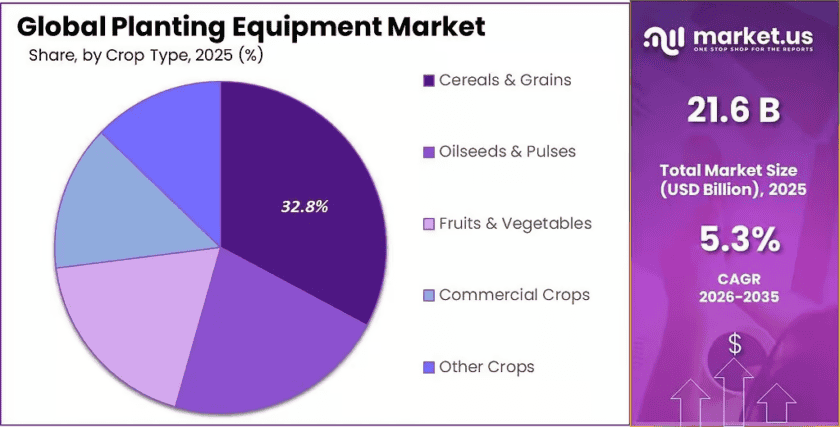
- Cereals & Grains accounted for more than 32.80% of demand, while Europe led the regional market with 42.50% share and USD 9.16 billion in revenue during 2025.
Regional Analysis
Europe Leads with 42.50% Share and USD 9.16 Billion
In 2025, Europe held a dominant position in the Planting Equipment Market, capturing more than a 42.50% share and generating approximately USD 9.16 billion. The region benefits from highly mechanized farming, strong cereal cultivation, established agricultural machinery infrastructure, and continued investment in productivity-enhancing technologies.
European agricultural policy also supports modernization. The EU and its Member States have planned around €307 billion in public expenditure through approximately 2,500 interventions under the Common Agricultural Policy Strategic Plans for 2023–2027. These plans include measures supporting productivity improvements, technology adoption, sustainability, and farm competitiveness.
North America is positioned as a strong growth region, supported by large commercial farming operations and rapid precision-agriculture adoption. USDA estimated U.S. corn planting at 95.3 million acres and soybean planting at 85.4 million acres in 2026, creating significant demand for high-capacity planters and precision seeding machinery.
Market Dynamics
Driver – Growing Adoption of Precision Planting Technology
Precision agriculture is becoming an important growth driver for planting equipment. Farmers are increasingly using GPS guidance, automatic steering, electronic seed meters, row shutoffs, and variable-rate planting to improve seed placement and field efficiency. USDA reported that guidance and autosteering systems were used by 52% of midsize crop farms and 70% of large-scale crop farms in 2023. Yield monitors, yield maps, and soil maps were used by 68% of large-scale crop farms. Higher adoption encourages producers to upgrade conventional planters with digitally controlled systems capable of improving operating efficiency and reducing unnecessary passes across fields.
Trend – Automation and Data-Connected Planting Systems
Automation is reshaping planting equipment as machinery becomes more connected to farm-management and precision-agriculture platforms. Electronic seed meters, automatic row control, sensors, GPS guidance, and data-driven planting maps allow operators to control planting rates and positioning more accurately. In 2026, USDA Agricultural Research Service began a project using production-scale precision agriculture data from growers across several states to assess improvements in agronomic and economic efficiency. The project runs from May 2026 through April 2027. Such government-backed research shows how equipment data is increasingly being converted into practical farm decisions, encouraging manufacturers to develop connected and software-enabled planting systems.
Restraint – Farm Income Pressure Limits Machinery Investment
High equipment costs and weaker farm earnings can delay planter replacement, particularly when producers face uncertain commodity prices and rising production expenses. USDA forecasts U.S. net farm income at USD 158.4 billion in 2026, representing a 2.6% nominal decline from 2025. After adjusting for inflation, net farm income is expected to fall 5.5%.
Planting machinery is normally a major capital investment, allowing growers to extend the working life of existing planters when profitability weakens. This can slow demand for completely new machines while increasing interest in retrofits, replacement components, electronic meters, sensors, and precision-control upgrades.
Opportunity – Conservation Agriculture Expands Specialized Planter Demand
Conservation farming creates an important opportunity for no-till and residue-handling planting equipment. USDA’s 2022 Census of Agriculture recorded approximately 105.2 million acres of U.S. cropland using no-till practices, representing a substantial operating base for conservation planters, drills, coulters, and accurate depth-control systems.
Government conservation funding can further support equipment-related technology adoption. USDA made up to USD 7.7 billion available for conservation activities in fiscal 2025, including as much as USD 5.7 billion for climate-smart practices. These programs create opportunities for machinery capable of planting into crop residue, limiting soil disturbance, conserving moisture, and improving field-input efficiency.
Emerging Trends
1. Precision Guidance Becomes Standard on Large Farms
GPS guidance and autosteering are moving deeper into commercial planting operations. USDA found that 70% of large-scale crop farms used guidance or autosteering systems in 2023, encouraging manufacturers to integrate navigation, row control, and digital planting functions directly into equipment.
2. No-Till Planting Equipment Gains Importance
No-till farming is creating demand for heavier row units, specialized seed drills, residue managers, and accurate depth systems. USDA’s 2022 Census recorded about 105.2 million acres of U.S. cropland managed using no-till practices.
3. Planting Machines Become More Data-Driven
Connected planting machinery is increasingly generating field-level data for agronomic decisions. USDA ARS launched a precision-agriculture project in 2026 using producer equipment data to evaluate yield stability and improve economic and agronomic efficiency across farming operations.
4. Labor Costs Strengthen Automation Demand
Rising agricultural wages are encouraging farms to improve machinery productivity. USDA ERS reported that nonsupervisory farm wages reached about USD 18.12 per hour in 2024, after increasing at an average real rate of 1.9% annually over the previous decade.
5. Specialized Precision Planting Research Expands
Planting technology is moving beyond basic seed delivery. A USDA ARS precision-orientation corn planting project started in September 2025 and runs through April 2027, testing equipment designed to control seed orientation and improve crop establishment.
Use Cases
1. Large-Scale Corn Planting
High-capacity planters are essential for completing corn planting during narrow seasonal windows. USDA estimated 95.3 million acres of U.S. corn were planted in 2026, supporting demand for wider planters, high-speed seed meters, and automated row control.
2. Soybean Row-Crop Operations
Precision and mechanical planters help soybean growers maintain uniform row spacing and planting depth across large areas. U.S. soybean planted acreage reached an estimated 85.4 million acres in 2026, increasing 5% from 2025, according to USDA NASS.
3. No-Till Crop Establishment
No-till planters allow seed placement directly through crop residue without full soil cultivation. Approximately 105.2 million U.S. cropland acres were managed under no-till practices in the 2022 Census, demonstrating a large application base for conservation planting machinery.
4. Precision Variable-Rate Seeding
Farmers can use digital planting maps and electronic meters to change seeding rates according to field conditions. USDA research is actively examining precision equipment data during 2026–2027 to understand how these technologies can improve farm-level agronomic and economic efficiency.
5. Vegetable and Specialty-Crop Planting
Specialized planters can improve seed placement while reducing manual labor in high-value crops. USDA-supported research into precision fluid planting has examined systems designed to plant approximately 10 acres per day while measuring seed depth, alignment, spacing, and labor-saving performance.
Frequently Asked Questions
What is the Planting Equipment Market size?
The global Planting Equipment Market was valued at approximately USD 21.6 billion in 2025. It is projected to reach around USD 36.3 billion by 2035, expanding at a 5.3% CAGR during 2026–2035.
Which equipment type dominates the Planting Equipment Market?
Planters held the dominant market position in 2025, capturing more than a 38.20% share. Their leadership comes from widespread use in row crops requiring controlled seed depth, spacing, fast field coverage, and increasingly precise electronic seed delivery.
Which planter type holds the largest market share?
Precision Planters dominated the planter type category with more than a 36.00% share in 2025. Increasing use of GPS guidance, electronic meters, variable-rate controls, and automatic row systems supports demand from commercial crop producers.
Which design segment leads the market?
Mechanical planting equipment accounted for more than a 37.70% share in 2025. Its straightforward construction, reliable seed-metering mechanism, easier maintenance, and ability to operate without complex electronics continue to support use across broad-acre farms.
Which power source dominates planting equipment?
Tractor-Mounted equipment captured more than a 48.00% market share in 2025. These systems benefit from compatibility with existing tractors while offering mobility, hydraulic power, flexibility, and support for planters, drills, and precision attachments.
Which crop category generates the highest demand?
Cereals & Grains dominated the crop category with more than a 32.80% share in 2025. Large cultivated areas of corn, wheat, barley, and other grains require fast, consistent seeding and extensive use of planters and drills.
Which region dominates the Planting Equipment Market?
Europe led the global market in 2025, accounting for more than 42.50% of revenue and approximately USD 9.16 billion. Highly mechanized farming, extensive cereal production, established machinery fleets, and technology investment support its leading position.
What is driving growth in the Planting Equipment Market?
Growth is being supported by precision agriculture, automation, conservation farming, large cultivated areas, and labor-saving requirements. USDA found autosteering and guidance technology adoption had reached 70% of large-scale crop farms in 2023, demonstrating increasing digitalization.
Conclusion
The Planting Equipment Market is gradually moving from conventional machinery toward accurate, connected, and increasingly automated planting systems. Valued at USD 21.6 billion in 2025, the market is projected to reach USD 36.3 billion by 2035, supported by a 5.3% CAGR. Precision planters, tractor-mounted machinery, and equipment designed for conservation agriculture are becoming increasingly important.
Large planted areas, labor costs, narrow planting windows, and demand for better seed placement continue to encourage technology upgrades. Government support for precision and conservation agriculture should further create opportunities for efficient, data-enabled, and low-disturbance planting equipment.
Discuss your needs with our analyst
Please share your requirements with more details so our analyst can check if they can solve your problem(s)