Overview
New York, NY – Sep 29, 2026 – The global Modular Substation Market is expanding as utilities, renewable-energy developers, data centers, industrial facilities, and transport networks seek faster and more flexible ways to add electrical capacity. The market is projected to increase from USD 23.2 billion in 2025 to approximately USD 41.3 billion by 2035, growing at a 5.9% CAGR during 2026–2035.
Modular substations integrate transformers, switchgear, protection, control, and auxiliary systems into prefabricated units assembled largely in controlled factory environments. This approach can simplify field installation and is increasingly relevant as electricity networks face rising demand.
The IEA estimates that around USD 400 billion is currently invested in grids worldwide each year, while annual spending needs to rise by roughly 50% by 2030. More than 2,500 GW of renewable generation, storage, and large-load projects are presently waiting in grid connection queues worldwide.
Electricity demand is adding further pressure. U.S. electricity demand grew about 1.7% annually between 2020 and 2025, compared with only 0.1% annually during 2005–2019, according to the U.S. Energy Information Administration. These trends are strengthening demand for compact, rapidly deployable substations across new and existing networks.
Key Takeaways
- The global Modular Substation Market is expected to increase from USD 23.2 billion in 2025 to around USD 41.3 billion by 2035, growing at a 5.9% CAGR.
- Skid/Trailer-Mounted Modular Substations held the dominant position by type in 2025, capturing more than a 38.00% share.
- Air-Insulated Modular Substations dominated the insulation category with more than a 57.30% share in 2025.
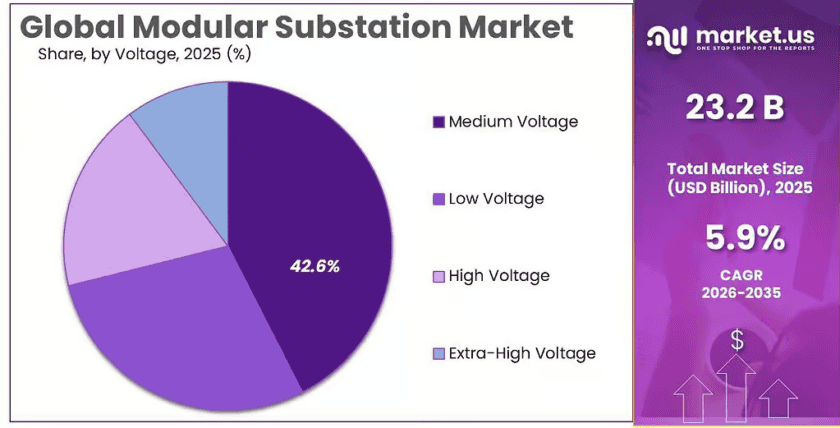
- Medium Voltage held the leading position by voltage, accounting for more than 42.56% of the market in 2025.
- Power Utilities represented the largest end-user segment, capturing more than a 40.00% share in 2025.
- Asia Pacific dominated the global market with more than a 44.00% share, generating approximately USD 10.19 billion in 2025.
Regional Analysis
Asia Pacific Leads with 44.00% Share and USD 10.19 Billion Market Value
In 2025, Asia Pacific held a dominant Modular Substation Market position, capturing more than a 44.00% share and generating approximately USD 10.19 billion in revenue. Growing electricity consumption, industrial development, renewable generation, urban expansion, and grid modernization are supporting demand for prefabricated substations across the region.
Southeast Asia illustrates the scale of future network requirements. Electricity consumption across ASEAN has increased about ninefold since 1990 and is projected to grow by approximately 3%–4% annually through 2040. The IEA estimates that the region will require more than USD 300 billion for grid expansion and modernization between 2025 and 2040.
North America is developing strongly as utilities respond to rising load, data-center expansion, manufacturing, and transmission investment. U.S. electricity demand grew around 1.7% annually between 2020 and 2025, and EIA identifies data centers as an important contributor to recent demand growth.
Globally, more than 2,500 GW of generation, storage, and large-load projects remain in grid queues. This creates a strong need for new substations, transformers, connection infrastructure, and quicker construction methods.
Market Dynamics
Driver – Grid Expansion and Rising Electricity Demand
Grid modernization is a major growth driver for modular substations. The IEA estimates global grid investment at around USD 400 billion annually, but says annual investment must increase by approximately 50% by 2030 to keep pace with electricity demand. More than 2,500 GW of renewable, storage, and large-load projects are currently waiting for grid connections. In the U.S., electricity demand grew about 1.7% annually between 2020 and 2025, compared with only 0.1% during 2005–2019. Factory-integrated substations can help utilities expand distribution and transmission capacity while reducing the amount of construction required at individual project sites.
Trend – Prefabrication and Faster Grid Deployment
Utilities are increasingly looking for standardized electrical systems that can be manufactured away from the final installation site and deployed when required. This trend is supported by a growing mismatch between grid-development schedules and new electricity loads. The IEA states that new grid infrastructure can require around 5–15 years to plan and complete, while data centers can be developed in just 1–3 years and EV charging infrastructure in about 1–2 years. Modular substations help address this timing pressure by combining switchgear, transformers, controls, protection, and auxiliary systems into repeatable packages that can reduce complex work at the final site.
Restraint – Transformer and Grid Equipment Supply Constraints
Equipment availability remains a major restraint for modular-substation deployment. Although prefabrication can simplify field work, substations still depend on transformers, switchgear, cables, protection equipment, and other specialized components. The IEA reports that investment in grids is currently about USD 400 billion per year, but expansion is being constrained partly by tight transformer and cable supply chains. The agency also reports that prices for important grid components have nearly doubled over the past five years. These pressures can raise project costs, extend procurement periods, and reduce the scheduling advantages that modular construction is intended to provide.
Opportunity – Renewable, Data Center and Large-Load Connections
Rapid growth in renewable generation, battery storage, data centers, and industrial electrification is creating a major opportunity for modular substations. More than 2,500 GW of renewable, storage, and large-load projects are waiting in grid queues globally. In the United States, electricity demand increased around 1.7% annually between 2020 and 2025, with data centers contributing importantly to growth. At the global level, electricity-sector investment was expected to reach around USD 1.5 trillion in 2025. Modular substations can serve these projects through standardized power blocks, renewable interconnections, temporary capacity additions, and rapidly deployable utility infrastructure.
Emerging Trends
1. Faster Connection of New Power Capacity
More than 2,500 GW of renewable generation, energy storage, and large electricity loads are currently waiting in grid queues worldwide, increasing interest in prefabricated substations that can simplify electrical interconnections and reduce field construction requirements.
2. Grid Spending Is Moving Higher
Global grid investment currently stands at about USD 400 billion annually, but the IEA estimates annual spending must increase approximately 50% by 2030, creating stronger demand for transformers, switchgear, modular substations, digital controls, and network equipment.
3. Data Centers Are Creating New Loads
U.S. electricity demand increased around 1.7% annually from 2020 to 2025, versus only 0.1% annually between 2005 and 2019. EIA identifies data-center electricity use as an important factor behind the recent acceleration.
4. Grid Projects Need Shorter Installation Cycles
New grid infrastructure can require around 5–15 years to develop, compared with approximately 1–3 years for data centers. This timing mismatch is encouraging developers to consider repeatable, factory-integrated electrical infrastructure wherever project requirements permit.
5. Southeast Asia Grid Expansion
ASEAN electricity consumption has increased approximately ninefold since 1990 and could grow 3%–4% annually through 2040. More than USD 300 billion in grid investment may be needed between 2025 and 2040.
Use Cases
1. Utility Distribution Expansion
Medium-voltage modular substations can support utilities adding new distribution capacity. Global grid spending is already around USD 400 billion annually, while investment must rise roughly 50% by 2030, indicating a substantial future pipeline for network equipment.
2. Renewable Energy Interconnection
Solar, wind, and storage projects require substations to transform voltage, switch circuits, and connect generation to transmission networks. More than 2,500 GW of renewable, storage, and large-load projects are currently waiting for grid connections worldwide.
3. Data Center Power Infrastructure
Data centers need high-capacity and highly reliable electricity connections. EIA reports U.S. electricity demand grew about 1.7% annually during 2020–2025, while data-center consumption is contributing materially to the increase, supporting additional substation requirements.
4. Grid Resilience and Emergency Replacement
Modular and transportable substations can provide temporary or replacement capacity when existing infrastructure is damaged or upgraded. A DOE project in Arizona, for example, included installation of 6 new 69-kV transmission breakers alongside switches and protection relays.
5. Industrial and Regional Electrification
Industrial areas and fast-growing electricity systems require new power-distribution infrastructure. ASEAN electricity demand is projected to grow about 3%–4% annually through 2040, with more than USD 300 billion required for network expansion and modernization.
Frequently Asked Questions on Modular Substation and Modular Substation Market
What is a modular substation?
A modular substation is a prefabricated electrical system combining equipment such as transformers, switchgear, protection panels, controls, and auxiliary systems. Its factory-integrated design reduces the amount of assembly and construction required at the final operating site.
How large is the Modular Substation Market?
The global Modular Substation Market was valued at approximately USD 23.2 billion in 2025 and is projected to reach around USD 41.3 billion by 2035, expanding at a 5.9% CAGR.
Which type dominates the Modular Substation Market?
Skid/Trailer-Mounted Modular Substations held the leading market position in 2025, accounting for more than 38.00%. Their transportable format makes them useful for temporary capacity, industrial projects, utilities, renewable installations, and emergency applications.
Which insulation type has the largest market share?
Air-Insulated Modular Substations dominated the insulation category in 2025 with more than a 57.30% share. These systems remain widely used where sufficient site space exists and conventional air-insulated electrical equipment is suitable.
Which voltage segment leads the market?
Medium Voltage held the largest Modular Substation Market share in 2025 at more than 42.56%, supported by widespread use across utility distribution systems, renewable projects, commercial facilities, industrial sites, and rapidly expanding electrical loads.
Which end-user segment dominates modular substations?
Power Utilities represented the dominant end-user segment in 2025, accounting for more than 40.00% of the market. Utilities use modular substations for network expansion, replacement projects, renewable interconnection, resilience upgrades, and distribution-capacity additions.
Which region leads the Modular Substation Market?
Asia Pacific held the leading position in 2025, accounting for more than 44.00% of global revenue and approximately USD 10.19 billion, supported by expanding electricity networks, industrialization, renewable development, and urban infrastructure.
Why is demand for modular substations increasing?
Demand is rising because power networks require faster expansion. The IEA reports more than 2,500 GW of renewable, storage, and large-load projects waiting in grid queues, while annual grid investment needs substantial further expansion.
What limits Modular Substation Market growth?
Important constraints include long equipment lead times, transformer availability, permitting, utility approvals, skilled labor, and rising costs. IEA data indicate prices of important grid components have nearly doubled during the past five years.
What opportunities will support future market growth?
Growth opportunities include renewable interconnections, data centers, battery-storage sites, mobile substations, industrial electrification, and grid-resilience projects. Global electricity-sector investment reached an estimated USD 1.5 trillion in 2025, supporting broader power-infrastructure development.
Conclusion
The Modular Substation Market is positioned for steady expansion as utilities and industries seek flexible solutions for grid modernization, renewable connections, data centers, and rising electricity demand. The market is projected to grow from USD 23.2 billion in 2025 to USD 41.3 billion by 2035, at a 5.9% CAGR.
Asia Pacific remains the largest region, while medium-voltage and skid-mounted systems hold strong positions. With global grid investment currently around USD 400 billion annually, increasing network requirements are expected to support further adoption of prefabricated, transportable, digitally controlled, and rapidly deployable substation infrastructure.
Discuss your needs with our analyst
Please share your requirements with more details so our analyst can check if they can solve your problem(s)