Overview
New York, NY – Sep 29, 2026 – The global Corn Wet-Milling Market is expanding as food, beverage, feed, pharmaceutical, chemical, and biofuel industries increase their use of corn-derived starches, sweeteners, corn oil, gluten feed, and fermentation ingredients. The market is projected to grow from USD 73.2 billion in 2025 to approximately USD 119.7 billion by 2035, registering a 5.0% CAGR during 2026–2035.
Corn wet milling separates kernels into starch, germ, fiber, and protein streams, enabling manufacturers to generate several high-value products from one agricultural raw material. USDA states that wet millers convert corn into HFCS, glucose, dextrose, starch, corn oil, beverage alcohol, industrial alcohol, and fuel ethanol.
Raw-material availability remains strong. USDA reported record U.S. corn production of 17.0 billion bushels in 2025, up 14% from 2024, with an average yield of 186.5 bushels per acre.
Wet-milling co-products also support feed markets. In January 2026, U.S. wet mills produced 251,479 tons of corn gluten feed and 193,748 tons of wet corn gluten feed, demonstrating the industry’s ability to generate value beyond starch and sweeteners.
Key Takeaways
- The global Corn Wet-Milling Market is projected to grow from USD 73.2 billion in 2025 to USD 119.7 billion by 2035, expanding at a 5.0% CAGR.
- Milling Equipment held the dominant equipment position in 2025, capturing more than a 30.00% share.
- Starches represented the largest end-product segment with more than a 48.70% share in 2025.
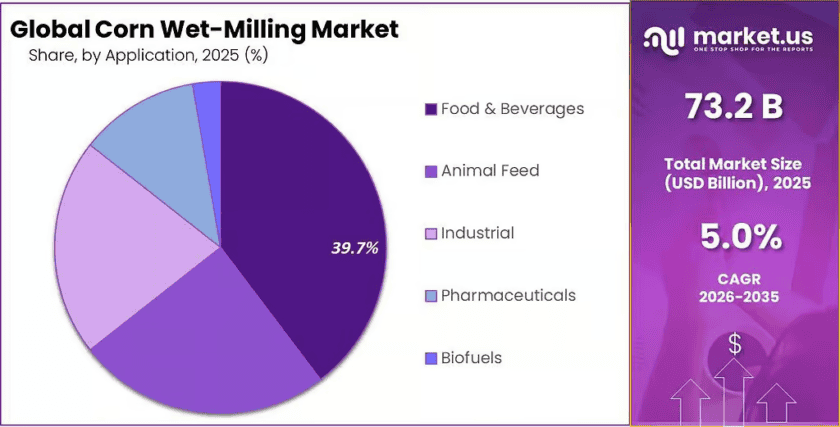
- Food & Beverages led the application category, accounting for more than a 39.00% share.
- Food Grade products dominated by grade, capturing more than a 62.00% share in 2025.
- North America held the leading regional position with a 38.00% share, representing approximately USD 27.82 billion in 2025.
Regional Analysis
North America Leads with 38.00% Share and USD 27.82 Billion
In 2025, North America held a dominant Corn Wet-Milling Market position, capturing 38.00% of global revenue and generating approximately USD 27.82 billion. The region benefits from abundant corn supplies, established milling infrastructure, large food and beverage industries, livestock production, fermentation capacity, and demand for starches and sweeteners.
Feedstock availability remains particularly strong in the United States. USDA estimated 2025 corn production at a record 17.0 billion bushels, with 91.3 million acres harvested and an average yield of 186.5 bushels per acre. Production increased 14% compared with the previous season.
Corn also accounts for more than 95% of U.S. feed-grain production and use, while food, seed, and industrial applications represent close to 60% of domestic corn use.
Asia Pacific continues to build processing capacity as demand rises for starch, sweeteners, animal feed, fermentation inputs, and food ingredients. Greater downstream food processing and industrial applications are encouraging investment in separation, centrifugation, filtration, drying, and starch-modification equipment.
Market Dynamics
Driver – Record Corn Availability Supports Higher Processing Capacity
Large corn supplies provide wet millers with a strong raw-material base for starch, sweetener, oil, feed, and fermentation production. USDA estimated U.S. corn output at a record 17.0 billion bushels in 2025, representing a 14% increase from 2024. Average yields reached a record 186.5 bushels per acre, while harvested area increased to 91.3 million acres. Corn represents more than 95% of U.S. feed-grain production and use, while food, seed, and industrial applications account for close to 60% of domestic corn utilization. These volumes support sustained throughput for wet-milling plants and downstream ingredient manufacturing.
Trend – Greater Valorization of Co-Products
Wet millers are increasingly focused on extracting value from every fraction of the corn kernel rather than relying on a single product stream. In January 2026, USDA reported U.S. wet-mill production of 251,479 tons of corn gluten feed and 193,748 tons of wet corn gluten feed. The same process can produce starch, corn oil, glucose, dextrose, high-fructose corn syrup, ethanol, and feed ingredients. USDA notes that food, seed, and industrial applications collectively account for nearly 60% of domestic corn use. This integrated approach helps processors improve value recovery per bushel and diversify end-market exposure.
Restraint – Water and Effluent Management Requirements
Corn wet milling requires significant water use across steeping, starch washing, separation, refining, and cleaning operations. EPA identifies modified starch washing, steepwater evaporation condensation, and syrup refining among the principal wastewater streams generated by corn wet-milling plants. Regulated parameters include BOD5, total suspended solids, and pH. EPA has also noted that modified-starch wastewater can represent one of the largest organic-load sources within wet mills. Consequently, processors must invest in wastewater treatment, water recovery, evaporation, filtration, and process optimization. These requirements can increase capital costs and operating complexity, particularly for older plants undergoing capacity expansion.
Opportunity – Expanding Starch and Sweetener Applications
Corn wet milling benefits from the broad range of industries that use starches and corn-derived sweeteners. USDA identifies HFCS, glucose, dextrose, starch, corn oil, beverage alcohol, industrial alcohol, and ethanol as key wet-milled products. HFCS-55 is used mainly in beverages, while HFCS-42 serves beverages, processed foods, cereals, bakery products, dairy foods, and confectionery. USDA continues to maintain current data on corn sweetener production, use, and trade, with its yearbook updated through September 2026. These diversified applications create opportunities for specialty starches, modified ingredients, fermentation feedstocks, and food-grade products.
Emerging Trends
1. Record Corn Supply Supports Processing
U.S. corn production reached a record 17.0 billion bushels in 2025, up 14% from 2024, while yield reached 186.5 bushels per acre. This larger feedstock base supports higher wet-milling throughput and dependable raw-material availability.
2. Greater Co-Product Recovery
Wet mills are increasing value recovery from protein and fiber streams. USDA recorded 251,479 tons of corn gluten feed and 193,748 tons of wet corn gluten feed in January 2026, supporting animal-feed and integrated biorefinery applications.
3. Continued Demand for Corn Sweeteners
Corn wet milling supplies HFCS, glucose, and dextrose. USDA identifies HFCS-55 mainly with beverages, while HFCS-42 serves beverages, bakery products, dairy foods, confectionery, and processed foods, supporting diversified demand across food manufacturing.
4. Water Recovery Becomes More Important
EPA identifies starch washing, steepwater evaporation, and syrup refining among major wet-milling wastewater sources. Growing attention to BOD5, suspended solids, and pH is encouraging mills to adopt better filtration, recycling, evaporation, and wastewater-treatment systems.
5. Integrated Food and Industrial Production
USDA reports that food, seed, and industrial uses represent close to 60% of domestic corn consumption. Wet mills increasingly serve both food and non-food markets through starch, sweeteners, oils, industrial alcohols, ethanol, and feed ingredients.
Use Cases
1. Starch Production
Wet milling separates starch from germ, gluten, and fiber for use in food, paper, adhesives, fermentation, and industrial applications. Starches held more than a 48.70% market share in 2025, making them the leading end-product category.
2. Corn Sweetener Manufacturing
Corn starch is converted into glucose, dextrose, and high-fructose corn syrup. USDA states that HFCS-55 is mainly used in beverages, while HFCS-42 supports processed foods, bakery products, dairy products, cereals, and confectionery.
3. Animal Feed Production
Wet milling produces protein- and fiber-rich feed co-products. In January 2026, U.S. wet mills manufactured 251,479 tons of corn gluten feed and 193,748 tons of wet corn gluten feed, supporting livestock and feed-manufacturing applications.
4. Ethanol and Industrial Alcohol
USDA identifies fuel ethanol, beverage alcohol, and industrial alcohol among products manufactured through corn processing. In January 2026, total U.S. corn consumption for alcohol and other uses reached 505 million bushels, demonstrating substantial industrial demand.
5. Corn Oil Recovery
Corn germ separated during wet milling can be processed to recover corn oil, creating another commercial revenue stream. USDA identifies corn oil as a principal wet-milled corn product alongside starch, sweeteners, ethanol, and feed ingredients.
Frequently Asked Questions on Corn Wet-Milling and Corn Wet-Milling Market
What is corn wet milling?
Corn wet milling separates corn kernels into starch, germ, fiber, and protein fractions using steeping, grinding, screening, centrifugation, and washing. These streams are further processed into starches, sweeteners, corn oil, feed ingredients, and alcohol products.
How large is the Corn Wet-Milling Market?
The global Corn Wet-Milling Market was valued at approximately USD 73.2 billion in 2025 and is projected to reach around USD 119.7 billion by 2035, growing at a 5.0% CAGR.
Which equipment segment dominates the market?
Milling Equipment held the dominant equipment position in 2025, accounting for more than 30.00% of the market because grinding is essential for releasing starch, germ, fiber, and protein after corn steeping.
Which end product holds the largest share?
Starches dominated the Corn Wet-Milling Market by end product with more than a 48.70% share in 2025, supported by their wide use across food manufacturing, paper, adhesives, fermentation, pharmaceuticals, and industrial processing.
Which application dominates corn wet milling?
Food & Beverages held the largest application share at more than 39.00% in 2025. Starches, glucose, dextrose, and corn syrups are widely used in beverages, bakery foods, dairy products, confectionery, and processed foods.
Which grade leads the Corn Wet-Milling Market?
Food Grade products dominated the market with more than a 62.00% share in 2025, reflecting extensive use of corn-derived starches and sweeteners for thickening, stabilizing, sweetening, texture modification, and other food-processing functions.
Which region leads the Corn Wet-Milling Market?
North America held the dominant regional position in 2025 with a 38.00% share, representing approximately USD 27.82 billion, supported by abundant corn supplies, mature refining infrastructure, feed demand, and large food-processing industries.
Why is corn supply important to wet milling?
Corn is the primary feedstock for wet mills. U.S. production reached a record 17.0 billion bushels in 2025, while average yield reached 186.5 bushels per acre, providing processors with significant raw-material availability.
What are the main restraints for corn wet milling?
Major restraints include corn-price changes, high energy requirements, water use, and wastewater treatment. EPA regulates wet-milling effluent characteristics including BOD5, total suspended solids, and pH, requiring mills to maintain effective environmental controls.
What opportunities exist in corn wet milling?
Future opportunities include specialty starches, food-grade ingredients, sweeteners, fermentation feedstocks, corn oil, protein-rich feed, and bio-based materials. USDA confirms that wet milling already serves food, beverage, industrial, feed, alcohol, and energy applications.
Conclusion
The Corn Wet-Milling Market is positioned for steady expansion as processors serve food, beverage, feed, industrial, and fermentation applications. The market is projected to grow from USD 73.2 billion in 2025 to USD 119.7 billion by 2035, at a 5.0% CAGR. North America remains the largest regional market with a 38.00% share, while starches account for 48.70% of end-product demand. Record U.S. corn production of 17.0 billion bushels in 2025 further supports feedstock availability. Future growth is expected to focus on specialty starches, sweeteners, co-product recovery, water efficiency, feed ingredients, and integrated biorefinery operations.
Discuss your needs with our analyst
Please share your requirements with more details so our analyst can check if they can solve your problem(s)