Overview
New York, NY – Oct 05, 2026 –The Marine Variable Frequency Drive (VFD) Market is gaining importance as shipowners adopt energy-efficient motor control, vessel electrification, hybrid propulsion, and smarter onboard power systems. Marine VFDs regulate motor speed and torque according to actual operating demand, helping pumps, ventilation systems, HVAC equipment, compressors, thrusters, cranes, and propulsion auxiliaries operate more efficiently.
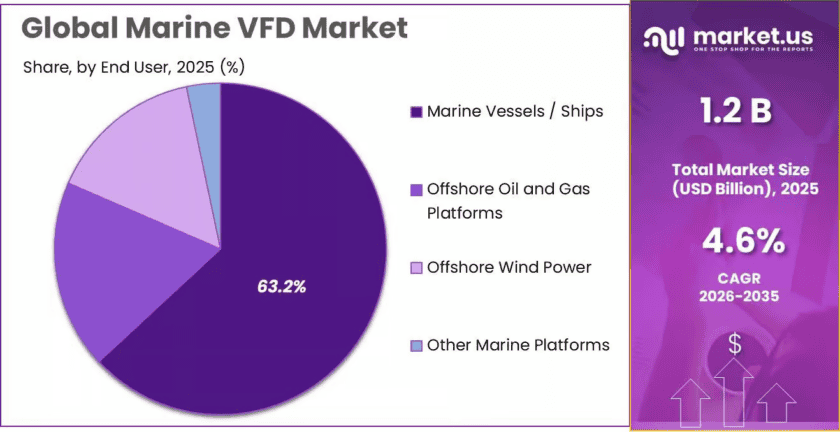
The Marine VFD Market is projected to reach USD 1.8 billion by 2035, rising from USD 1.2 billion in 2025 at a CAGR of 4.6%. In 2025, AC drives accounted for more than 72.00%, while low-voltage drives up to 1 kV represented over 68.00% of the market. Drives rated up to 500 kW captured more than 38.00%, and pumps accounted for over 29.00%. Marine vessels and ships represented more than 63.00% of end-user demand.
Demand is also supported by stricter shipping efficiency requirements. IMO targets at least a 40% decline in carbon intensity by 2030, encouraging vessel operators to reduce unnecessary electrical loads and improve onboard energy management.
Key Takeaways
- The global Marine VFD Market is expected to increase from USD 1.2 billion in 2025 to approximately USD 1.8 billion by 2035, expanding at a 4.6% CAGR.
- AC drives dominated with more than 72.00% share in 2025, supported by their widespread use in marine pumps, fans, compressors, HVAC systems, thrusters, and propulsion auxiliaries.
- Low-voltage drives up to 1 kV held more than 68.00% share, reflecting strong demand across standard auxiliary motors and electrical systems installed on commercial vessels.
- Marine VFD systems rated up to 500 kW captured more than 38.00% share in 2025, supported by their suitability for pumps, fans, compressors, and other auxiliary systems.
- Pumps accounted for more than 29.00% of Marine VFD applications, as variable-speed operation helps cooling, ballast, seawater, and circulation pumps adjust output according to operating conditions.
- Marine vessels and ships represented more than 63.00% of end-user demand in 2025, supported by increasing electrification and efficiency upgrades across commercial fleets.
- Asia Pacific led the market with more than 37.50% share and approximately USD 0.45 billion in revenue in 2025, supported by major shipbuilding activity in China, South Korea, and Japan.
Regional Analysis
Asia Pacific leads the Marine VFD Market with 37.50% share and USD 0.45 billion value.
In 2025, Asia Pacific held a dominant Marine VFD Market position, capturing more than 37.50% share and generating approximately USD 0.45 billion. The region benefits from a highly concentrated shipbuilding industry led by China, South Korea, and Japan, creating strong demand for drives used in pumps, thrusters, HVAC systems, ventilation equipment, propulsion auxiliaries, and deck machinery.
The report notes that China, South Korea, and Japan together produced about 91% of ships completed worldwide by gross tonnage in 2025, strengthening the region’s position as a major installation base for marine electrical equipment. Meanwhile, Europe is gaining importance as emission regulations encourage investments in efficient electric motors, hybrid propulsion, shore power, and onboard energy-management technology.
FuelEU Maritime has applied since January 1, 2025, initially requiring a 2% reduction in greenhouse-gas intensity compared with the 2020 reference level, increasing toward 80% by 2050. These rules are strengthening the business case for efficient onboard electrical systems.
Market Dynamics
Driver – Stronger Pressure to Improve Vessel Energy Efficiency
Improving vessel energy efficiency is a major driver for Marine VFD adoption. Electric pumps, fans, compressors, and HVAC equipment frequently operate below full design capacity, allowing variable-frequency drives to reduce motor speed when full output is unnecessary.
IMO’s 2023 strategy targets at least a 40% reduction in shipping carbon intensity by 2030 compared with 2008. It also calls for total shipping greenhouse-gas emissions to fall by at least 20%, while striving for 30%, by 2030. These requirements encourage shipowners to use efficient motor controls that lower onboard electricity demand, fuel consumption, and emissions.
Trend – Vessel Electrification and Hybrid Power Systems
Marine electrification is changing the role of VFDs from individual motor controllers into important parts of integrated vessel power systems. Hybrid propulsion, batteries, shaft generators, shore power, and intelligent energy-management platforms require precise electrical control.
The Market.us report notes that alternative-fuel vessels represented about 53% of global ship-orderbook tonnage by May 2025, compared with only about 8% of the active fleet by gross tonnage. This difference points to a long modernization cycle. As ships adopt new electrical architectures, VFDs increasingly support propulsion auxiliaries, pumps, thrusters, cooling systems, compressors, and power-management applications.
Restraint – High Retrofit Cost and Installation Downtime
Upfront retrofit expenditure remains an important restraint, especially for older ships. Installing VFDs may require new cabinets, harmonic filters, electrical protection, cabling, cooling arrangements, engineering studies, and classification approval. Vessel owners must also consider lost operating time while equipment is installed and commissioned.
The Market.us assessment associates retrofit capital expenditure with around -1.8 percentage points of forecast CAGR impact, while installation downtime carries an estimated -1.5 percentage-point impact. Certification costs and power-quality upgrades create additional pressure. These barriers can delay investment even when long-term fuel and energy savings make variable-speed control technically attractive.
Opportunity – VFD Retrofits and Energy-as-a-Service Models
A large existing vessel fleet creates an important opportunity for retrofit-based Marine VFD solutions. The global commercial fleet included around 112,500 vessels at the beginning of 2025, providing a broad installed base of pumps, ventilation systems, compressors, cooling equipment, and propulsion auxiliaries suitable for variable-speed operation.
Service-based models can further reduce adoption barriers by combining audits, equipment, installation, monitoring, maintenance, and measured efficiency outcomes under one contract. Regulatory pressure adds momentum. The EU ETS requires shipping companies to cover 70% of emissions reported for 2025 with allowances surrendered in 2026, strengthening the financial value of onboard efficiency improvements.
Emerging Trends
1. Hybrid-Electric Propulsion
Hybrid propulsion is increasing the need for flexible motor and power control. IMO aims for zero or near-zero greenhouse-gas technologies, fuels, and energy sources to supply at least 5%, while striving for 10%, of shipping energy by 2030, supporting greater vessel electrification.
2. Growing Use of Low-Voltage Drives
Low-voltage Marine VFDs are becoming central to auxiliary equipment because pumps, fans, HVAC systems, compressors, and deck machinery commonly use low-voltage motors. In 2025, drives rated up to 1 kV represented more than 68.00% of the Marine VFD Market.
3. Digital Energy Management
VFDs are increasingly connected to vessel automation and energy-management platforms that continuously adjust motor operation. The wider merchant fleet reached roughly 116,000 vessels at the beginning of 2026, creating a sizeable base where digital efficiency and condition-monitoring solutions can be deployed.
4. Decarbonization-Led Efficiency Upgrades
Shipowners are putting greater attention on technologies that reduce electricity and fuel consumption. IMO’s strategy targets greenhouse-gas reductions of at least 70%, while striving for 80%, by 2040, compared with 2008, making onboard motor-efficiency improvements increasingly important.
5. Shore-Power Integration
Marine electrical systems are being designed to work more closely with port-side electricity. FuelEU Maritime requires covered passenger and container ships to use shore-side power or another zero-emission technology at selected EU ports beginning in 2030, supporting more advanced vessel electrical controls.
Use Cases
1. Cooling and Seawater Pumps
Marine VFDs regulate cooling-water and seawater pumps according to actual engine and equipment demand instead of running continuously at maximum speed. Pumps represented more than 29.00% of Marine VFD applications in 2025, making pumping systems a major use case.
2. Propulsion and Thruster Systems
VFDs provide precise speed and torque control for propulsion motors and bow or stern thrusters. Marine vessels and ships accounted for more than 63.00% of end-user demand in 2025, supporting continued adoption across commercial shipping, passenger ships, and specialized vessels.
3. HVAC and Ventilation Systems
Variable-speed drives allow engine-room ventilation and HVAC fans to operate according to real cooling and airflow requirements. This supports IMO’s target of reducing international shipping carbon intensity by at least 40% by 2030, as lower auxiliary electrical loads can reduce overall fuel use.
4. Offshore Marine Platforms
VFDs can control pumps, compressors, cranes, drilling support equipment, ventilation, and other electric motors on offshore installations. EU maritime monitoring rules expanded from January 1, 2025 to cover certain offshore ships from 400 gross tonnage, increasing efficiency and emissions reporting attention.
5. Vessel Retrofit Programs
Existing ships can retrofit VFDs into fixed-speed pumps, fans, compressors, and cooling systems without replacing the entire vessel power architecture. With around 112,500 commercial vessels recorded at the start of 2025, the installed fleet creates substantial long-term retrofit potential.
Frequently Asked Questions on Marine VFD and Marine VFD Market
What is a Marine VFD?
A Marine Variable Frequency Drive is an electronic system that controls the speed and torque of electric motors installed on ships and offshore platforms. It helps pumps, fans, thrusters, compressors, and other equipment operate according to actual demand.
How large is the Marine VFD Market?
The global Marine VFD Market was valued at approximately USD 1.2 billion in 2025 and is projected to reach around USD 1.8 billion by 2035, expanding at a 4.6% CAGR.
Which drive type dominates the Marine VFD Market?
AC drives held the leading position in 2025, accounting for more than 72.00% of the Marine VFD Market. Their leadership comes from extensive use with AC motors in pumps, ventilation, compressors, HVAC, thrusters, and propulsion auxiliaries.
Which voltage segment leads the Marine VFD Market?
Low-voltage drives rated up to 1 kV captured more than 68.00% share in 2025. They are widely used because many onboard pumps, fans, compressors, HVAC systems, conveyors, and auxiliary machines operate using standard low-voltage motors.
Which application has the largest Marine VFD share?
Pumps were the leading Marine VFD application in 2025, accounting for more than 29.00% share. VFDs help cooling, ballast, circulation, and seawater pumps match motor output with changing vessel operating requirements.
Which end-user segment dominates the market?
Marine vessels and ships accounted for more than 63.00% of Marine VFD demand in 2025. Commercial vessels increasingly use variable-speed drives for pumps, HVAC, ventilation, compressors, thrusters, propulsion auxiliaries, and onboard electrical-energy management.
Which region leads the Marine VFD Market?
Asia Pacific led the Marine VFD Market in 2025 with more than 37.50% share and approximately USD 0.45 billion in revenue, supported by the large shipbuilding industries of China, South Korea, and Japan.
Why are Marine VFDs important for ship energy efficiency?
Marine VFDs allow electric motors to reduce speed when full output is unnecessary. This lowers auxiliary electricity demand and can support shipowners seeking to meet IMO’s targeted 40% carbon-intensity reduction by 2030 compared with 2008.
What is driving future demand for Marine VFDs?
Future demand is being supported by vessel electrification, hybrid propulsion, efficient auxiliary systems, alternative fuels, digital energy management, emissions regulations, and fleet retrofits. These developments increase the need for precise control of onboard electrical motors.
What are the major barriers to Marine VFD adoption?
The main barriers include retrofit cost, installation downtime, classification requirements, harmonic-control equipment, electrical-system upgrades, and integration with older vessel systems. These issues can extend project payback periods and slow upgrades in ageing fleets.
Conclusion
The Marine VFD Market is moving steadily toward wider adoption as shipowners focus on energy efficiency, electrification, emissions reduction, and smarter onboard power management. The market is projected to rise from USD 1.2 billion in 2025 to USD 1.8 billion by 2035 at a 4.6% CAGR. AC drives, low-voltage systems, pumps, and marine vessels remain major market segments, while Asia Pacific leads with more than 37.50% share. Growing hybrid propulsion, digital energy-management systems, efficiency regulations, and vessel retrofit programs are expected to expand VFD applications across commercial ships and offshore platforms during the coming decade.
Discuss your needs with our analyst
Please share your requirements with more details so our analyst can check if they can solve your problem(s)