Overview
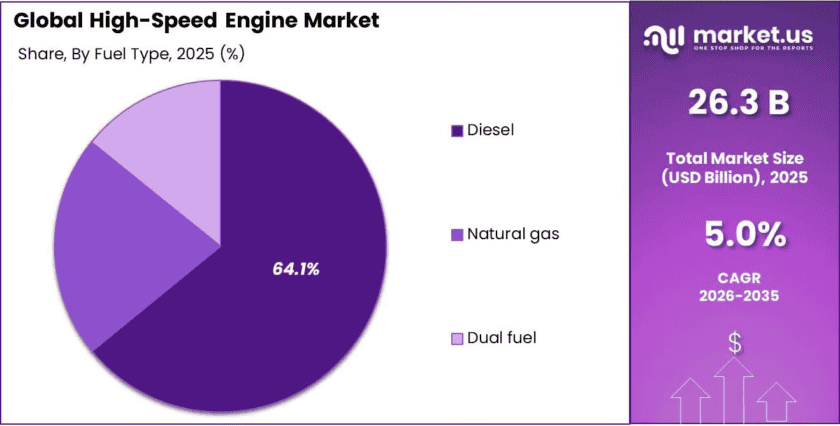
New York, NY – Oct 06, 2026 – The global High-Speed Engine Market is expanding as industries require compact, reliable, and fast-response engines for power generation, marine vessels, construction equipment, mining operations, rail systems, oil and gas facilities, and emergency power. The market was valued at USD 26.3 billion in 2025 and is projected to reach approximately USD 42.8 billion by 2035, growing at a 5.0% CAGR during 2026–2035.
High-speed engines provide a strong power-to-weight ratio and can respond rapidly to changing operating loads. Diesel remains widely used, while natural gas, dual-fuel technology, low-carbon fuels, and hybrid configurations are becoming increasingly important.
Power-sector expansion is supporting demand. U.S. utility-scale electricity generation reached approximately 4,429 billion kWh in 2025, while installed utility-scale capacity reached about 1.28 million MW.
Data centers are also creating new requirements for dependable backup generation. Lawrence Berkeley National Laboratory estimates that data centers could consume 11.8% of total U.S. electricity by 2030, with a possible range of 9.5% to 15.3%, strengthening the need for reliable standby and distributed power equipment.
Key Takeaways
- The global High-Speed Engine Market was valued at USD 26.3 billion in 2025 and is projected to reach approximately USD 42.8 billion by 2035, expanding at a 5.0% CAGR.
- By speed, 1,000–1,500 RPM engines dominated in 2025, capturing more than a 44.00% share.
- By power output, 0.56–1 MW engines held more than a 44.00% share during 2025.
- By fuel type, Diesel maintained the leading position with more than a 64.00% share.
- By end user, Marine applications accounted for more than a 30.00% share of the market.
- Asia-Pacific led the High-Speed Engine Market with more than a 39.00% share, generating approximately USD 10.2 billion in 2025.
- Reciprocating-engine CHP equipment is available from approximately 1 kW to 10 MW, while 75% of reciprocating-engine CHP systems are below 1 MW.
- Global shipping currently consumes around 350 million tonnes of fuel oil annually, increasing pressure for efficient, fuel-flexible, and lower-emission marine engines.
Regional Analysis
Asia-Pacific Leads with 39.00% Share and USD 10.2 Billion Revenue
In 2025, Asia-Pacific held a dominant position in the High-Speed Engine Market, capturing more than a 39.00% share and generating approximately USD 10.2 billion in revenue.
The regional market benefits from growing marine transportation, industrial facilities, construction activity, power-generation requirements, and expanding distributed-energy infrastructure. High-speed diesel and gas engines are widely suited to generator sets, ships, industrial plants, mines, and remote power applications.
Electricity demand supports further engine deployment. The IEA reported that China’s electricity demand increased 5.1% in 2025, while Southeast Asian demand grew by around 3%. Looking toward 2026–2030, electricity demand is forecast to grow annually by approximately 4.9% in China, 6.4% in India, and 5.3% in Southeast Asia.
Southeast Asia’s electricity demand is expected to more than double by 2050, while data centers already represent approximately 10% of Asia-Pacific data-center electricity demand, creating additional opportunities for reliable standby and distributed generation equipment.
Market Dynamics
Driver – Growth in Backup and Distributed Power Demand
Rising electricity use and data-center expansion are strengthening demand for high-speed engines in standby and distributed generation. U.S. electricity demand increased by around 1.7% annually between 2020 and 2025, compared with just 0.1% annually between 2005 and 2019, with data centers identified as an important growth driver.
Lawrence Berkeley National Laboratory estimates data centers could consume 11.8% of U.S. electricity by 2030. High-speed engines can start rapidly and provide dependable electricity during grid interruptions. This supports their use in data centers, hospitals, industrial facilities, telecommunications sites, commercial buildings, and other infrastructure requiring reliable backup power.
Trend – Shift Toward Cleaner and Fuel-Flexible Marine Engines
Marine engine technology is moving toward lower-emission fuels, hybrid systems, and improved efficiency. The International Maritime Organization reported in June 2025 that ships consume approximately 350 million tonnes of fuel oil each year. At the same time, marine represented more than 30.00% of High-Speed Engine Market demand in 2025.
This combination is encouraging engine manufacturers to develop dual-fuel systems, biofuel-compatible engines, methanol-ready designs, hybrid-electric propulsion, and improved electronic controls. Marine operators increasingly need engines capable of maintaining reliability while helping vessels respond to tightening environmental requirements and changing fuel availability.
Restraint – Increasing Emissions-Compliance Requirements
Stricter emissions rules increase the engineering and after-treatment requirements associated with high-speed diesel engines. EPA’s Tier 4 program regulates nonroad compression-ignition engines used in equipment such as generators and heavy machinery. Current ultra-low-sulfur diesel requirements limit sulfur content to a maximum of 15 parts per million.
Marine engines are also subject to EPA emission requirements, including Tier 3 and Tier 4 standards for relevant engine classes. Manufacturers may therefore require selective catalytic reduction, particulate filters, electronic injection, oxidation catalysts, and advanced controls. These systems can increase equipment cost, integration complexity, certification requirements, and maintenance needs for operators.
Opportunity – Distributed Generation and Combined Heat and Power
Distributed generation presents an important opportunity for high-speed engine suppliers. U.S. Department of Energy guidance states that reciprocating-engine CHP systems are available from approximately 1 kW to 10 MW, and several engines can be combined for capacities above 10 MW. Around 75% of reciprocating-engine CHP systems are smaller than 1 MW. This aligns closely with the High-Speed Engine Market, where 0.56–1 MW equipment captured more than a 44.00% share in 2025. Industrial facilities, hospitals, hotels, universities, food plants, and wastewater facilities can use engine-based CHP to generate electricity while recovering useful thermal energy.
Emerging Trends
1. Data-Center Backup Power
Data-center expansion is increasing demand for fast-starting standby generation. Lawrence Berkeley National Laboratory estimates U.S. data centers could represent 11.8% of electricity consumption by 2030, with potential demand ranging from 9.5% to 15.3%.
2. Cleaner Marine Propulsion
Marine operators are seeking lower-emission engines as environmental requirements strengthen. IMO reports that ships currently burn around 350 million tonnes of fuel oil annually, creating strong interest in dual-fuel, biofuel-compatible, hybrid, and alternative-fuel high-speed engine systems.
3. Growth of Sub-1 MW Distributed Generation
Smaller engine-generator systems are becoming important for decentralized electricity supply. DOE reports that approximately 75% of reciprocating-engine CHP installations are below 1 MW, closely matching industrial, institutional, and commercial requirements for flexible on-site power.
4. Advanced Emission-Control Systems
High-speed diesel engines increasingly incorporate advanced after-treatment technology. EPA requires ultra-low-sulfur diesel containing no more than 15 ppm sulfur, while Tier 4 requirements encourage greater use of electronic injection, particulate controls, and NOx-reduction technologies.
5. Hybrid Power Integration
Hybrid systems are increasingly combining engines with batteries and renewable generation. In 2025, wind and utility-scale solar already generated 17% of U.S. utility-scale electricity, increasing demand for flexible, dispatchable power equipment capable of supporting variable renewable output.
Use Cases
1. Data-Center Emergency Power
High-speed engines provide rapid backup electricity when utility power fails. This application is becoming more important as data-center demand rises, with U.S. facilities potentially consuming 11.8% of national electricity by 2030, according to Lawrence Berkeley National Laboratory.
2. Marine Propulsion
High-speed engines power ferries, workboats, offshore support vessels, patrol vessels, and other ships requiring compact power. Marine applications represented more than 30.00% of the High-Speed Engine Market in 2025, making them the largest end-user segment. (market.us)
3. Industrial Combined Heat and Power
Factories can use high-speed reciprocating engines to produce both electricity and useful heat. DOE states that CHP engines cover approximately 1 kW to 10 MW, while systems above 1 MW are particularly common in industrial and institutional facilities.
4. Construction and Mining Equipment
High-speed diesel engines are used in pumps, compressors, generators, construction machines, and extraction operations. U.S. construction and extraction occupations employed approximately 6.4 million people in May 2025, reflecting the large economic base served by heavy equipment.
5. Distributed and Standby Electricity Generation
High-speed engines support standby, emergency, peak-load, and decentralized power applications. U.S. utility-scale electricity generation reached approximately 4,429 billion kWh in 2025, while installed capacity totaled around 1.28 million MW, sustaining demand for flexible generation technologies.
Frequently Asked Questions on High-Speed Engine and High-Speed Engine Market
What is a high-speed engine?
A high-speed engine is a compact reciprocating engine designed to operate at relatively high rotational speeds. These engines are commonly used for power generation, marine propulsion, industrial machinery, mining, construction equipment, rail applications, and emergency power systems.
How large was the High-Speed Engine Market in 2025?
The global High-Speed Engine Market was valued at approximately USD 26.3 billion in 2025. It is projected to reach around USD 42.8 billion by 2035, expanding at a forecast 5.0% CAGR.
Which speed segment dominates the High-Speed Engine Market?
The 1,000–1,500 RPM segment held the leading position in 2025, capturing more than a 44.00% share. This speed range is widely suited to stationary generation and industrial applications requiring dependable long-duration operation.
Which power-output segment leads the market?
The 0.56–1 MW power-output category dominated the High-Speed Engine Market in 2025 with more than a 44.00% share, supported by demand from industrial facilities, commercial buildings, standby systems, distributed generation, and CHP installations.
Which fuel type dominates the High-Speed Engine Market?
Diesel held the dominant position in 2025 with more than a 64.00% share. Its strong position reflects rapid starting, high torque, dependable operation, established fueling infrastructure, and widespread adoption across marine and industrial applications.
Which end-use sector has the largest market share?
Marine applications accounted for more than a 30.00% share of the High-Speed Engine Market in 2025. High-speed engines are particularly suitable for vessels requiring compact dimensions, strong power density, rapid response, and reliable propulsion.
Which region leads the High-Speed Engine Market?
Asia-Pacific led the global market during 2025, accounting for more than a 39.00% share and approximately USD 10.2 billion in revenue, supported by marine activity, industrial expansion, infrastructure investment, and electricity demand.
Why are high-speed engines important for backup power?
High-speed engines can start quickly and respond rapidly to changing electrical loads. These characteristics make them suitable for emergency and standby systems supporting data centers, hospitals, telecommunications facilities, factories, commercial buildings, and other critical infrastructure.
How are environmental rules affecting high-speed diesel engines?
EPA Tier 4 requirements have encouraged cleaner combustion, electronic controls, and advanced exhaust treatment. Ultra-low-sulfur diesel used in regulated nonroad applications contains a maximum of 15 ppm sulfur, helping modern emission-control technologies operate effectively.
What are the future opportunities in the High-Speed Engine Market?
Future opportunities include data-center backup generation, hybrid marine propulsion, CHP, distributed energy, natural-gas engines, dual-fuel equipment, low-carbon fuels, digital monitoring, and engine retrofits. The market is forecast to reach USD 42.8 billion by 2035.
Conclusion
The High-Speed Engine Market is benefiting from growing demand for reliable, compact, and fast-response power systems. Valued at USD 26.3 billion in 2025, the market is projected to reach approximately USD 42.8 billion by 2035, expanding at a 5.0% CAGR. Diesel remains dominant with a 64.00% share, while marine applications account for more than 30.00%. Data-center growth, distributed power, CHP systems, marine fuel transitions, and industrial expansion are creating new opportunities. At the same time, tighter emission standards are encouraging cleaner combustion, hybrid configurations, digital controls, and fuel-flexible engine designs.
Discuss your needs with our analyst
Please share your requirements with more details so our analyst can check if they can solve your problem(s)