Overview
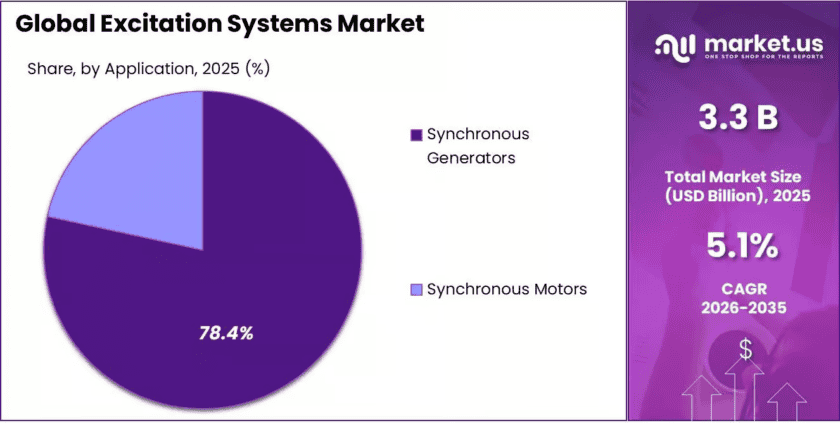
New York, NY – Oct 06, 2026 – The global Excitation Systems Market is expanding as utilities, power producers, and industrial facilities modernize synchronous generators and strengthen voltage-control capabilities. The market was valued at USD 3.3 billion in 2025 and is projected to reach approximately USD 5.4 billion by 2035, growing at a 5.1% CAGR during 2026–2035.
Excitation systems regulate the direct current supplied to synchronous-machine field windings. This enables generators to maintain terminal voltage, manage reactive power, and remain stable during changing grid conditions. They are widely used in gas, steam, hydroelectric, nuclear, and industrial generating facilities.
Demand is strengthening as electricity networks handle larger and more variable power flows. U.S. utility-scale electricity generation reached approximately 4.43 trillion kWh in 2025, while installed utility-scale generating capacity reached about 1.28 million MW.
Renewable integration is also creating stronger requirements for voltage stability and generator response. Wind and utility-scale solar together supplied 17% of U.S. electricity generation in 2025, compared with less than 1% in 2005. These changes are supporting demand for digital voltage regulators, brushless excitation equipment, synchronous condensers, and generator modernization.
Key Takeaways
- The global Excitation Systems Market was valued at USD 3.3 billion in 2025 and is projected to reach approximately USD 5.4 billion by 2035, expanding at a 5.1% CAGR.
- By type, Brushless Excitation Systems dominated in 2025, capturing more than a 64.56% share.
- By controller type, Digital Controllers held more than a 61.45% share of the global market during 2025.
- By application, Synchronous Generators represented the largest segment, accounting for more than a 78.45% share in 2025.
- Asia-Pacific led the global market with more than a 38.54% share, representing approximately USD 1.2 billion in revenue during 2025.
- Growth is supported by generator modernization, renewable integration, grid reliability investment, digital voltage regulation, and increasing electricity consumption.
- DOE’s grid modernization activity provides an additional demand environment, including approximately USD 1.9 billion of federal SPARK funding announced in 2026.
Regional Analysis
Asia-Pacific Leads with 38.54% Share and USD 1.2 Billion Revenue
In 2025, Asia-Pacific held a dominant position in the Excitation Systems Market, capturing more than a 38.54% share and generating approximately USD 1.2 billion in revenue. The region has large fleets of thermal, hydroelectric, nuclear, and industrial synchronous generators requiring reliable excitation and automatic voltage regulation.
Growing electricity requirements also support equipment modernization. China’s electricity demand exceeded 9,500 TWh in 2025, increasing approximately 5.1% from the previous year. China represented about 58% of the increase in global electricity demand that year.
Southeast Asia is another important growth area. Electricity demand in the region increased approximately 3% in 2025, while annual energy investment reached more than USD 100 billion, around 30% higher than previously reported levels. Expanding grids and power-generation capacity create opportunities for digital and brushless excitation systems.
Market Dynamics
Driver – Increasing Need for Grid Stability
Increasing electricity generation and changing power mixes are driving demand for excitation equipment. The United States generated about 4.43 trillion kWh of utility-scale electricity in 2025 and had approximately 1.28 million MW of installed utility-scale generating capacity. Excitation systems help synchronous generators maintain voltage and reactive-power output when loads change.
This role is becoming more important as renewable penetration increases. Wind and utility-scale solar supplied 17% of U.S. electricity generation in 2025, compared with less than 1% in 2005. Utilities are therefore placing greater emphasis on generator controls, voltage regulation, and grid-support capabilities.
Trend – Shift Toward Digital Excitation Controls
Digital excitation is becoming a major industry trend because utilities need faster voltage regulation, diagnostics, monitoring, and integration with plant-control systems. Digital controllers already represented more than 61.45% of the Excitation Systems Market in 2025. Grid reliability standards are also becoming more data-driven.
NERC’s updated technical requirements state that excitation controls are among the components requiring model validation for synchronous generators, with a maximum validation cycle of 10 years under MOD-026-2 technical rationale. Digital platforms make parameter verification, testing, disturbance analysis, and maintenance easier, supporting their growing use in generator modernization projects.
Restraint – Aging Plants and Retrofit Complexity
Retrofitting excitation equipment at older power plants can be difficult because utilities must coordinate generator controls, protective relays, turbines, transformers, and plant-control systems. Modernization can also require planned outages and extensive testing. U.S. electricity infrastructure includes many long-lived generating assets; EIA notes that most existing U.S. nuclear and hydropower plants were originally built before 1990.
Operators therefore need to balance modernization benefits against outage schedules and remaining plant life. NERC requirements covering voltage regulating controls and generating-unit protection also increase the need for careful coordination, engineering studies, documentation, and model validation during excitation-system upgrades.
Opportunity – Grid Modernization and Generator Upgrades
Large grid-modernization programs create opportunities for excitation-system suppliers. The U.S. Department of Energy administers a USD 10.5 billion Grid Resilience and Innovation Partnerships program, with more than USD 6 billion announced through its first two funding rounds. DOE also announced approximately USD 1.9 billion in federal SPARK investment for projects intended to strengthen electricity infrastructure. Selected projects are expected to make more than 23 GW of additional electricity capacity available. As transmission networks carry more electricity, utilities can invest in generator excitation modernization, digital automatic voltage regulators, synchronous condensers, and improved reactive-power capabilities.
Emerging Trends
1. Digital Automatic Voltage Regulators
Digital control is replacing older analog equipment because it offers improved monitoring and diagnostics. Digital controllers already accounted for more than 61.45% of the Excitation Systems Market in 2025, supporting continued investment in automated generator-voltage management.
2. Growing Renewable Integration
Wind and utility-scale solar generated about 760,000 GWh of U.S. electricity during 2025 and represented 17% of utility-scale generation. Higher variable-generation penetration is increasing interest in synchronous generators and excitation controls that support voltage stability.
3. Hydropower Generator Modernization
Hydropower remains an important application for excitation systems. DOE reported that the U.S. hydropower fleet reached 2,258 plants and 80.55 GW of generating capacity by 2025, supporting continued refurbishment opportunities for generator controls.
4. Greater Focus on Dynamic Models
Generator-model accuracy is becoming more important for grid planning. NERC’s MOD-026-2 technical rationale sets a maximum model-validation cycle of 10 years and specifically includes synchronous-generator excitation controls among equipment requiring validation.
5. Grid Infrastructure Investment
Excitation suppliers can benefit indirectly from wider power-system modernization. DOE’s SPARK initiative involves approximately USD 1.9 billion in federal funding and targets projects capable of unlocking more than 23 GW of additional grid capacity.
Use Cases
1. Hydroelectric Generators
Excitation systems regulate hydro-generator field current and terminal voltage. U.S. hydropower represented approximately 5.6% of utility-scale electricity generation in 2025, while DOE counted 2,258 hydroelectric plants, supporting a significant installed base for excitation equipment.
2. Nuclear Power Stations
Nuclear plants depend on large synchronous generators requiring stable excitation and voltage control. Nuclear energy supplied about 18% of U.S. utility-scale electricity generation in 2025, maintaining an important application base for high-reliability generator-control systems.
3. Natural Gas Power Plants
Gas turbines and combined-cycle stations use synchronous generators supported by excitation controls. Natural gas generated approximately 41% of U.S. utility-scale electricity in 2025, making gas-fired generation an important operating environment for modern excitation systems.
4. Synchronous Condensers and Voltage Support
Synchronous machines can provide reactive power and voltage support as inverter-based generation grows. Wind and utility-scale solar already represented 17% of U.S. generation in 2025, increasing the value of equipment capable of stabilizing changing grid conditions.
5. Generator Refurbishment
Excitation systems can be modernized during generator-life-extension projects. DOE reported 80.55 GW of U.S. hydropower capacity across 2,258 plants in 2025, illustrating the large existing equipment base where digital regulators and modern controls can be deployed.
Frequently Asked Questions on Excitation Systems and Excitation Systems Market
What is an excitation system?
An excitation system supplies and controls direct current for a synchronous machine’s field winding. It helps maintain generator terminal voltage, regulate reactive power, and support stable operation when electrical load or grid conditions change.
How large was the Excitation Systems Market in 2025?
The global Excitation Systems Market was valued at approximately USD 3.3 billion in 2025 and is projected to reach USD 5.4 billion by 2035, representing a forecast 5.1% CAGR.
Which excitation-system type dominates the market?
Brushless excitation systems led the global market in 2025, accounting for more than a 64.56% share. These systems are widely used because they reduce dependence on brushes and support reliable operation of large synchronous generators.
Which controller type leads the Excitation Systems Market?
Digital controllers held the leading market position during 2025, capturing more than a 61.45% share. Their growth is supported by automated voltage regulation, improved diagnostics, easier monitoring, and integration with modern power-plant control systems.
Which application dominates the Excitation Systems Market?
Synchronous generators were the leading application in 2025, accounting for more than a 78.45% share. These machines require excitation to establish magnetic fields, regulate voltage, control reactive power, and maintain stable grid operation.
Which region leads the Excitation Systems Market?
Asia-Pacific led the market during 2025 with more than a 38.54% share, representing approximately USD 1.2 billion. Large power-generation fleets and increasing electricity demand support regional excitation-system requirements.
Why are excitation systems important for power plants?
Excitation systems control generator voltage and reactive-power output. They allow synchronous generators to respond to changing loads and system disturbances, helping utilities maintain reliable electricity supply and stable voltage across transmission and generation networks.
How is renewable growth affecting excitation-system demand?
Renewable integration increases the need for voltage support as electricity networks become more dynamic. Wind and utility-scale solar supplied 17% of U.S. electricity in 2025, increasing attention on grid stability and synchronous-machine controls.
Where are excitation systems commonly used?
Excitation systems are mainly used with synchronous generators in hydroelectric, gas, coal, nuclear, and industrial generating plants. They are also used with synchronous motors and synchronous condensers requiring controlled magnetic fields and reactive-power management.
What are the future opportunities in the Excitation Systems Market?
Future opportunities include digital excitation retrofits, hydropower modernization, synchronous condensers, automated voltage regulation, and grid upgrades. The global market is projected to increase from USD 3.3 billion to approximately USD 5.4 billion by 2035.
Conclusion
The Excitation Systems Market is moving toward digital, reliable, and faster-response generator controls as electricity networks become more complex. The market, valued at USD 3.3 billion in 2025, is projected to reach approximately USD 5.4 billion by 2035, growing at a 5.1% CAGR. Brushless systems, digital controllers, and synchronous-generator applications continue to lead the industry.
Rising electricity demand, renewable integration, hydropower refurbishment, and government grid investment are creating additional modernization opportunities. Excitation systems will remain important for voltage regulation, reactive-power management, generator reliability, and stable operation of increasingly interconnected power systems.
Discuss your needs with our analyst
Please share your requirements with more details so our analyst can check if they can solve your problem(s)