Overview
New York, NY – Sep 30, 2026 – The global Canned Motor Pumps Market is expanding as chemical, refining, energy, refrigeration, and other process industries place greater importance on leak-free fluid handling. The market was valued at USD 3.1 billion in 2025 and is projected to reach approximately USD 6.3 billion by 2035, growing at a 7.6% CAGR during 2026–2035.
Canned motor pumps combine the pump and electric motor within a sealed pressure boundary. This construction removes the conventional rotating shaft seal and helps reduce leakage when handling hazardous, toxic, volatile, corrosive, or high-value fluids. The design is particularly useful in chemical processing, petroleum refining, refrigeration, LNG, power generation, and specialty manufacturing.
Leak control remains an important industrial requirement. The U.S. Environmental Protection Agency identifies pumps, valves, and connectors as major potential sources of volatile organic compound and hazardous air pollutant emissions in chemical plants and petroleum refineries.
Industrial activity provides a strong operating base. U.S. refinery atmospheric crude-distillation units processed an average 16.731 million barrels per day in 2025, while operable utilization reached 92.0%, supporting continued demand for dependable process pumping equipment.
Key Takeaways
- The global Canned Motor Pumps Market was valued at USD 3.1 billion in 2025 and is expected to reach approximately USD 6.3 billion by 2035, expanding at a 7.6% CAGR.
- Standard Basic Pumps held the dominant position in 2025, capturing more than a 42.00% share.
- Single-Stage Pumps led the pump-design segment with more than a 68.00% share, supported by their simple configuration and suitability for common industrial circulation and transfer duties.
- Induction Motors accounted for more than a 63.20% share because of their established reliability in continuous industrial operations.
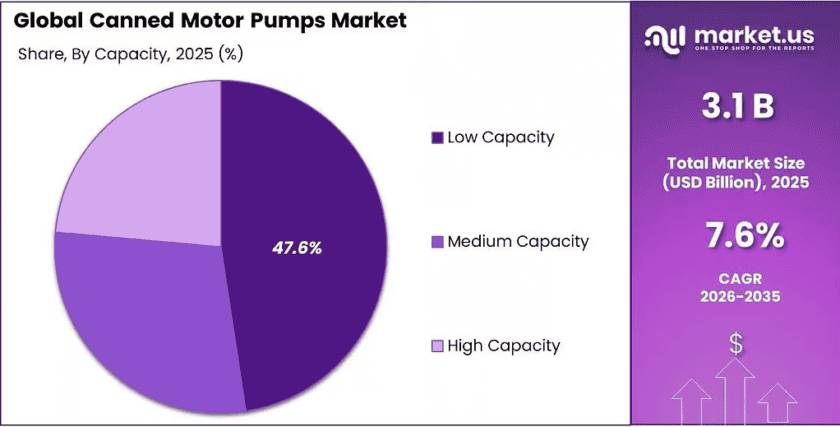
- Low Capacity Pumps dominated the capacity segment with more than a 47.00% share in 2025.
- The Chemical sector held more than a 39.60% share, reflecting strong demand for sealless equipment in hazardous and corrosive fluid applications.
- Asia-Pacific led the global market with a 31.50% share, representing approximately USD 0.97 billion in 2025.
Regional Analysis
Asia-Pacific Leads with 31.50% Share and USD 0.97 Billion
In 2025, Asia-Pacific held a dominant Canned Motor Pumps Market position, capturing more than a 31.50% share and generating approximately USD 0.97 billion. The region benefits from extensive chemical manufacturing, petroleum refining, refrigeration, LNG infrastructure, semiconductor production, and other continuous-process industries requiring reliable handling of hazardous liquids.
Energy infrastructure remains an important demand base. The International Energy Agency reported that global LNG production increased by almost 7%, or 38 billion cubic metres, in 2025. More than 90 billion cubic metres per year of additional LNG liquefaction capacity also reached final investment decisions during the year, supporting future requirements for specialized fluid-transfer equipment.
North America also provides a mature industrial market. U.S. refinery operable atmospheric distillation capacity stood at approximately 18.2 million barrels per calendar day on January 1, 2026, while 2025 refinery utilization averaged 92.0%. This high operating intensity supports demand for reliable pumps in refining, chemical processing, cooling, transfer, and auxiliary operations.
Market Dynamics
Driver – Strong Need for Zero-Leakage Fluid Handling
Leak prevention remains a major driver for canned motor pump adoption. EPA identifies pumps, valves, and connectors as important sources of volatile organic compounds and volatile hazardous air pollutants at petroleum refineries and chemical plants. Canned motor pumps remove the external rotating shaft seal by enclosing the motor and pump assembly within the process-pressure boundary. This construction can reduce potential leak paths when transferring toxic, flammable, corrosive, or valuable liquids. Demand is therefore supported by industries where containment, worker safety, environmental compliance, and product purity are important. Chemical processing already represented 39.60% of market demand in 2025.
Trend – Higher Focus on Pump and Motor Energy Efficiency
Energy efficiency is becoming more important in industrial pumping systems because pumps often operate continuously. The U.S. Department of Energy states that substantial energy and cost savings can be achieved through improved pump-system management, efficient equipment selection, variable-flow control, and proper system sizing. DOE also maintains federal efficiency and testing requirements for covered commercial pumps under 10 CFR Part 431. Canned motor pump manufacturers are consequently focusing on improved motor designs, hydraulic optimization, monitoring, and operating-point control. Induction motors remain dominant, accounting for 63.20% of market share in 2025, although higher-efficiency motor technologies are gaining attention.
Restraint – Higher Initial Cost and Specialized Maintenance
Canned motor pumps can carry higher upfront costs because the motor and pump are integrated into a sealed pressure system that requires specialized construction, materials, insulation, bearings, and monitoring arrangements. Maintenance can also require trained personnel because technicians cannot access conventional external seals or motor components as easily as with standard pumps. Cost sensitivity becomes particularly important when conventional pumps can safely perform the same service. DOE emphasizes life-cycle assessment, proper pump selection, effective maintenance, and matching pumps to system requirements as important ways to control pumping costs. As a result, buyers may reserve canned designs mainly for hazardous or technically demanding applications.
Opportunity – LNG, Hydrogen, and Low-Emission Chemical Infrastructure
New LNG and hydrogen-related infrastructure creates an important long-term opportunity for sealless pumps. The IEA reported that more than 90 bcm per year of LNG liquefaction capacity reached final investment decisions in 2025, with over 80 bcm per year located in the United States. The IEA also reports that announced hydrogen pipeline projects exceed 40,000 km by 2035, although only about 9% is currently operational or backed by committed investment. Expansion of ammonia, hydrogen carriers, LNG, refrigerants, and specialty chemical facilities can create demand for pumps capable of safely transferring volatile and environmentally sensitive liquids under demanding operating conditions.
Emerging Trends
1. Sealless Pumping Gains Importance
EPA identifies pumps, valves, and connectors as important industrial leakage sources. Canned motor systems eliminate conventional shaft seals, making sealless equipment increasingly attractive where operators need stronger containment of hazardous, volatile, or toxic process liquids.
2. Energy-Efficient Pump Systems Expand
DOE promotes efficient pumps, variable-flow control, proper sizing, and optimized system operation to reduce industrial energy use. This is encouraging canned motor pump suppliers to improve hydraulic efficiency and motor performance while adding more accurate operating controls.
3. LNG Infrastructure Creates New Pump Duties
Global LNG production increased by almost 7%, or 38 bcm, in 2025. More than 90 bcm per year of new liquefaction capacity also reached investment approval, creating future opportunities for specialized pumps handling cryogenic and volatile fluids.
4. Hydrogen Infrastructure Moves Toward Scale
Announced hydrogen pipeline projects exceed 40,000 km by 2035, according to the IEA. Expansion of hydrogen and ammonia supply chains can increase demand for tightly contained pumping systems used around chemical conversion, storage, cooling, and transfer facilities.
5. Condition Monitoring Becomes More Important
Industrial operators are focusing more closely on pump-system performance and preventive maintenance. DOE recommends regular system assessment and effective maintenance to improve reliability and energy use, supporting wider adoption of sensors, motor monitoring, temperature measurement, and predictive-maintenance tools.
Use Cases
1. Chemical Processing
Chemical plants use canned motor pumps for corrosive, toxic, flammable, and valuable liquids where leakage must be minimized. The chemical sector represented 39.60% of market demand in 2025, making it the largest end-user category.
2. Petroleum Refining
Canned pumps can handle process fluids in refinery circulation, transfer, cooling, and specialty services. U.S. atmospheric crude-distillation units processed an average 16.731 million barrels per day during 2025, demonstrating the scale of continuous pumping operations within refining facilities.
3. LNG and Refrigeration
Sealless designs are suited to volatile refrigerants and selected cryogenic services where fluid containment is critical. Global LNG output increased by nearly 38 bcm during 2025, while new liquefaction investments are expanding future fluid-handling requirements.
4. Nuclear Power Systems
Canned motor pumps can operate in specialized nuclear coolant applications. The U.S. NRC states that AP1000 reactor coolant pumps use canned-motor designs with rotating components contained inside the reactor coolant pressure boundary, eliminating conventional shaft seals.
5. Ammonia and Hydrogen Processing
Ammonia and methanol together account for roughly half of global hydrogen consumption, according to the IEA. These chemical processes require reliable fluid transfer, creating specialized applications for enclosed pumping systems that minimize leakage around hazardous process streams.
Frequently Asked Questions on Canned Motor Pumps Market
What is the Canned Motor Pumps Market size?
The global Canned Motor Pumps Market was valued at approximately USD 3.1 billion in 2025 and is projected to reach around USD 6.3 billion by 2035, expanding at a 7.6% CAGR.
What is a canned motor pump?
A canned motor pump is a sealless centrifugal pumping system in which the motor and pump operate within a common pressure boundary. Removing a conventional shaft seal helps reduce leakage when handling hazardous or volatile liquids.
Which pump type dominates the market?
Standard Basic Pumps held the largest market position in 2025, accounting for more than a 42.00% share. Their relatively straightforward sealless configuration suits many chemical circulation, transfer, refrigeration, and continuous industrial applications.
Which pump design has the largest share?
Single-Stage Pumps dominated the design category in 2025, capturing more than a 68.00% share. They are widely selected for applications requiring moderate pressure and straightforward liquid-transfer duties without the complexity of several impeller stages.
Which motor type dominates Canned Motor Pumps?
Induction Motors held more than a 63.20% market share in 2025. Their established industrial reliability, mature manufacturing base, continuous-duty capability, and familiarity among maintenance teams support widespread integration into canned motor pumping systems.
Which capacity segment leads the market?
Low Capacity Canned Motor Pumps accounted for more than a 47.00% share in 2025. They are commonly used for specialized transfer, circulation, dosing-support, cooling, and auxiliary applications requiring controlled flow and dependable containment.
Which end-user sector dominates the market?
The Chemical sector led the Canned Motor Pumps Market with more than a 39.60% share in 2025 because chemical facilities frequently handle corrosive, toxic, flammable, volatile, and high-value liquids requiring strict leakage control.
Which region dominates the Canned Motor Pumps Market?
Asia-Pacific led the global market in 2025 with more than a 31.50% share, representing approximately USD 0.97 billion. Chemical production, refining, LNG infrastructure, refrigeration, and industrial manufacturing support regional pump demand.
Why are canned motor pumps used for hazardous liquids?
Their sealless construction removes the conventional external shaft seal, reducing a common potential leakage point. This feature is useful for hazardous, toxic, flammable, corrosive, or volatile fluids where environmental containment and worker protection are priorities.
What is driving future demand for canned motor pumps?
Future demand is supported by chemical processing, energy efficiency, LNG infrastructure, hydrogen development, and tougher leakage control. More than 90 bcm per year of LNG liquefaction capacity reached investment decisions globally during 2025.
Conclusion
The Canned Motor Pumps Market is moving toward safer, more efficient, and increasingly monitored fluid-handling systems. Valued at USD 3.1 billion in 2025, the market is projected to reach USD 6.3 billion by 2035, expanding at a 7.6% CAGR. Asia-Pacific leads with a 31.50% share and USD 0.97 billion in revenue.
Chemical processing remains the largest application, while LNG, hydrogen, refining, refrigeration, and power generation are creating additional opportunities. Growing attention to leakage prevention, energy efficiency, process safety, and predictive maintenance should continue supporting adoption of sealless canned motor pumping technology across demanding industrial applications.
Discuss your needs with our analyst
Please share your requirements with more details so our analyst can check if they can solve your problem(s)