Overview
New York, NY – Oct 07, 2026 – The global Rapid Test Market is expanding as food manufacturers, laboratories, regulators, pharmaceutical companies, and other industrial users demand faster methods for identifying pathogens, allergens, pesticide residues, species substitution, and other safety risks. The market was valued at USD 34.3 Billion in 2025 and is projected to reach USD 78.6 Billion by 2035, expanding at an 8.7% CAGR during 2026–2035. Pathogen testing led with a 47.56% share, while PCR-based technology accounted for 40.21%.
Rapid methods are gaining importance because they can shorten the time between sample collection and corrective action. USDA-FSIS maintains official methods for major foodborne pathogens, antimicrobial residues, meat-species identification, and other food-safety parameters. Its laboratory guidebook includes a real-time PCR method for species identification in meat and poultry products, demonstrating increasing regulatory acceptance of molecular testing.
Public-health pressure also remains strong. CDC reported that 62 multistate enteric outbreaks confirmed during 2024 caused 2,605 illnesses, 861 hospitalizations, and 36 deaths. These risks are encouraging continued investment in rapid PCR, immunoassay, lateral-flow, chromatography, spectroscopy, and automated screening technologies.
Key Takeaways
- The Rapid Test Market was valued at USD 34.3 Billion in 2025 and is projected to reach USD 78.6 Billion by 2035, expanding at an 8.7% CAGR.
- Pathogens held the leading position in 2025 with more than a 47.56% share, reflecting strong demand for faster detection of Salmonella, Listeria, E. coli, and other microorganisms.
- PCR-based technology dominated with more than a 40.21% share, supported by its high specificity and ability to detect small quantities of microbial or species-specific genetic material.
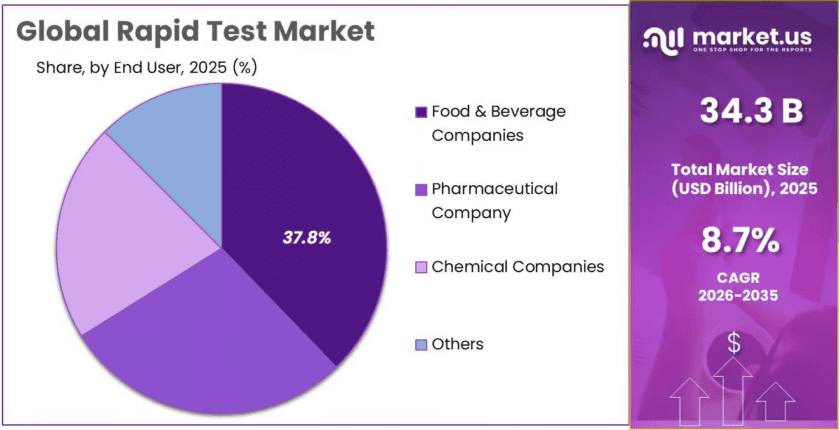
- Food & Beverage Companies accounted for more than a 37.89% share, showing the importance of rapid testing in sanitation verification, ingredient screening, and finished-product safety.
- Asia-Pacific led the global market with more than a 38.34% share in 2025, supported by large food-processing industries and increasing regulatory surveillance.
- CDC reported 29 foodborne outbreaks among the solved multistate outbreaks investigated for 2024, causing 1,533 illnesses and 519 hospitalizations.
Regional Analysis
Asia-Pacific held the dominant position in the Rapid Test Market in 2025, accounting for more than a 38.34% share. Growth is supported by large food-processing industries, expanding international food trade, stronger laboratory infrastructure, and increasing focus on pathogens, pesticide residues, allergens, and food authenticity. PCR, immunoassays, and rapid screening systems are becoming particularly useful where manufacturers require quicker release decisions and stronger supplier verification.
North America remains an important testing market because foodborne disease surveillance and regulatory sampling continue at substantial scale. CDC reported 62 confirmed multistate enteric outbreaks during 2024, resulting in 2,605 illnesses, 861 hospitalizations, and 36 deaths. Contaminated food was responsible for 29 solved outbreaks involving 1,533 illnesses. The FDA also operates microbiological surveillance programmes that collect targeted food samples and publish testing outcomes, supporting continued adoption of faster laboratory methods.
Market Dynamics
Driver – Rising Foodborne Disease Surveillance Increases Testing Demand
Foodborne illness remains a major driver for rapid testing because manufacturers and regulators need faster contamination decisions. CDC confirmed 62 multistate enteric outbreaks during 2024, causing 2,605 illnesses, 861 hospitalizations, and 36 deaths. Among solved outbreaks, contaminated foods caused 1,533 illnesses and 519 hospitalizations. FDA also states that foodborne diseases have historically affected around 48 million Americans annually.
These risks encourage food companies to screen raw materials, environmental surfaces, finished products, and production lines more frequently. Faster PCR, immunoassay, and other rapid methods can help manufacturers respond earlier and limit contaminated products from moving further through distribution.
Trend – PCR and Molecular Methods Move Deeper Into Routine Testing
Rapid molecular testing is moving from specialized laboratories into more routine food-safety workflows. USDA-FSIS maintains an official Real-Time PCR Method for Species Identification in Meat and Poultry Products, effective from September 30, 2024, alongside whole-genome sequencing and pathogen-identification procedures. Its Microbiology Laboratory Guidebook was updated in March 2025 and covers pathogens, toxins, antimicrobial residues, and species verification.
This regulatory use strengthens confidence in DNA-based rapid methods. Food companies are increasingly interested in automated sample preparation, multiplex PCR, faster enrichment procedures, and digital reporting because these approaches can reduce response times while providing greater specificity than conventional visual or biochemical screening.
Restraint – Rapid Results Still Require Confirmation and Skilled Laboratories
Rapid testing reduces analysis time, but it does not completely remove the need for conventional laboratory procedures. FDA explains that some foods contain compounds that interfere with biochemical or molecular shortcuts, while culture enrichment may still be required before sufficient microbial material is available. Positive rapid-test results can also require confirmation using another analytical method.
This creates additional cost for laboratories and food manufacturers because they must maintain trained staff, validated equipment, reference methods, quality-control systems, and confirmatory testing capacity. FDA’s LAAF programme further emphasizes uniform laboratory standards and accreditation, meaning rapid technologies must demonstrate reliability rather than simply provide faster results.
Opportunity – Accredited and Digitally Connected Testing Creates New Growth
A major opportunity is developing around accredited laboratories, automated analysis, and digitally connected food-safety systems. FDA’s Laboratory Accreditation for Analyses of Foods programme requires LAAF-accredited laboratories in specific regulatory circumstances, including certain import testing and identified food-safety problems. This creates room for laboratories offering validated rapid methods, automated PCR, integrated data platforms, and faster reporting.
FDA’s New Era of Smarter Food Safety strategy is built around 4 core elements, including technology-enabled traceability and smarter tools for prevention and outbreak response. Rapid-test providers that combine analytical hardware with software, sample tracking, cloud reporting, and traceability systems can therefore move beyond individual test kits toward broader preventive food-safety services.
Emerging Trends
1. PCR-Based Testing Expands
PCR is becoming more established in regulatory testing. USDA-FSIS lists a real-time PCR procedure for meat and poultry species identification, while PCR-based technology held a 40.21% market share in 2025, supporting broader adoption of faster molecular screening.
2. Listeria Surveillance Becomes Broader
From January 2025, USDA-FSIS expanded ready-to-eat sampling beyond Listeria monocytogenes to include additional Listeria species. This broader surveillance approach gives processors more information about sanitation conditions and strengthens demand for rapid environmental and product testing.
3. Laboratory Accreditation Gains Importance
FDA’s LAAF programme is strengthening formal standards for food laboratories. Accredited laboratories may be required for specific import and regulatory circumstances, creating demand for validated rapid methods that offer reliable results, traceable documentation, standardized procedures, and stronger quality assurance.
4. Digital Food-Safety Systems Grow
FDA’s smarter food-safety framework is organized around 4 core elements, including technology-enabled traceability and smarter prevention tools. Rapid testing is increasingly being connected with digital records, predictive analytics, automated sample tracking, and faster communication of contamination results.
5. Multiparameter Testing Gains Attention
Testing laboratories increasingly need to handle pathogens, allergens, residues, species identification, and chemical hazards through coordinated workflows. USDA laboratory programmes include microbiological methods, antimicrobial-residue detection, species identification, food composition, additives, nutrients, pesticides, and veterinary-drug residue analysis.
Use Cases
1. Pathogen Detection
Rapid tests help detect Salmonella, Listeria, E. coli, and other foodborne microorganisms before products are released. CDC reported 29 solved foodborne multistate outbreaks for 2024, responsible for 1,533 illnesses, showing why early pathogen detection remains important.
2. Meat Species Identification
PCR enables processors and regulators to verify whether meat products contain the species declared on their labels. USDA-FSIS maintains an official real-time PCR method for meat and poultry species identification, supporting authenticity checks and mislabeling investigations.
3. Ready-to-Eat Food Monitoring
Rapid tests are used for environmental surfaces and finished ready-to-eat foods where Listeria contamination is a major concern. USDA-FSIS introduced broader Listeria species testing from January 2025, strengthening sanitation monitoring and follow-up sampling requirements.
4. Allergen and Chemical Verification
Food laboratories use rapid and analytical testing to verify allergens, additives, pesticide residues, veterinary drugs, and product composition. USDA’s Chemistry Laboratory Guidebook includes dedicated methods covering these areas, supporting regulatory surveillance and quality-control decisions across processed foods.
5. Import Food Compliance
Rapid testing can support decisions on imported foods detained or questioned at borders. FDA’s LAAF framework requires accredited laboratory testing in specified import-related situations, creating an important use case for reliable and standardized rapid analytical methods.
Frequently Asked Questions on Rapid Test
What is rapid testing?
Rapid testing uses molecular, immunological, chemical, or instrumental methods to identify pathogens, allergens, species, residues, or other targets faster than many conventional laboratory workflows, allowing manufacturers and regulators to make earlier safety and quality decisions.
How large is the Rapid Test Market?
The global Rapid Test Market was valued at USD 34.3 Billion in 2025 and is projected to reach approximately USD 78.6 Billion by 2035, expanding at an 8.7% CAGR during 2026–2035.
Which test type dominates the market?
Pathogen testing held the leading position in 2025 with more than a 47.56% share. Demand is supported by routine screening for organisms such as Salmonella, Listeria, and E. coli across food manufacturing environments.
Which technology dominates the Rapid Test Market?
PCR-based technology dominated in 2025 with more than a 40.21% share. PCR provides highly specific DNA-based identification and is used for pathogens, meat species, and other molecular targets within regulatory and commercial laboratory workflows.
Which end user leads the market?
Food & Beverage Companies accounted for more than a 37.89% share in 2025. Manufacturers use rapid testing for pathogen screening, sanitation verification, raw-material assessment, allergen controls, species confirmation, and finished-product release decisions.
Which region leads the Rapid Test Market?
Asia-Pacific held the leading regional position in 2025 with more than a 38.34% share. Large food-processing industries, expanding regulatory oversight, growing laboratory capacity, and international food trade support regional testing requirements.
Why is pathogen testing important?
Foodborne contamination can cause severe public-health effects. CDC reported that 62 confirmed multistate outbreaks during 2024 caused 2,605 illnesses, 861 hospitalizations, and 36 deaths, demonstrating the need for faster detection and intervention.
Can rapid tests completely replace laboratory culture?
Not always. FDA explains that culture or enrichment may still be necessary because some food matrices interfere with rapid methods, and positive screening results can require confirmation before regulatory or legal decisions are made.
How does regulation support rapid testing?
Regulators increasingly recognize modern analytical technologies. USDA-FSIS maintains PCR and whole-genome sequencing methods, while FDA’s LAAF programme establishes accreditation requirements for laboratories conducting certain regulatory food analyses, supporting validated and reliable testing practices.
What will support future market growth?
Future growth is expected to come from multiplex PCR, automated sample preparation, portable screening tools, accredited laboratories, digital reporting, and traceability integration. These technologies can help food companies shorten response times while improving preventive food-safety programmes.
Conclusion
The Rapid Test Market is moving toward faster, more specific, and digitally connected analytical systems as food manufacturers and regulators strengthen contamination prevention. The market is projected to expand from USD 34.3 Billion in 2025 to USD 78.6 Billion by 2035, supported by an 8.7% CAGR. PCR, pathogen testing, automation, and accredited laboratory services are expected to remain important growth areas.
Government surveillance also supports demand, with CDC recording 2,605 illnesses across 62 multistate outbreaks investigated for 2024. Although confirmation requirements and laboratory complexity remain barriers, rapid technologies are becoming increasingly important for preventive food-safety management.
Discuss your needs with our analyst
Please share your requirements with more details so our analyst can check if they can solve your problem(s)