Overview
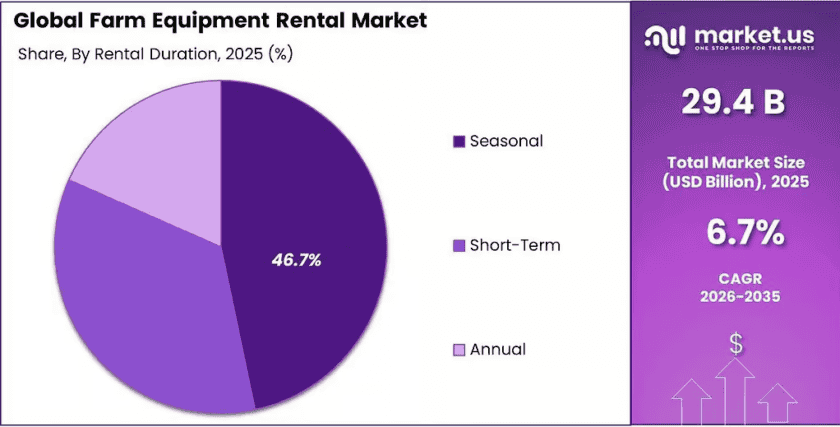
New York, NY – Sep 29, 2026 – The global Farm Equipment Rental Market is expanding as farmers seek access to tractors, harvesters, sprayers, planters, balers, and precision equipment without carrying the full cost of machinery ownership. The market is projected to grow from USD 29.4 billion in 2025 to around USD 56.2 billion by 2035, registering a 6.7% CAGR during 2026–2035.
Rental and custom-hire models are particularly useful where machinery is required only during planting, crop-care, and harvesting periods. They allow equipment costs to be spread across several users while improving machinery utilization.
The economic case is strengthening as farm expenses rise. USDA forecasts U.S. farm production expenses at USD 492.8 billion in 2026, up 4.5% from 2025, while inflation-adjusted net farm income is expected to decline 5.5%.
Smaller farms provide a broad customer base for equipment-access services. USDA reports that small family farms represented 86% of all U.S. farms in 2024, operated 40% of agricultural land, and produced 17% of total agricultural production value. FAO also identifies machinery hire as an important route for smallholders to access mechanization without purchasing complete equipment fleets.
Key Takeaways
- The global Farm Equipment Rental Market is expected to rise from USD 29.4 billion in 2025 to USD 56.2 billion by 2035, growing at a 6.7% CAGR.
- Tractors held the dominant equipment-type position in 2025, capturing more than a 38.50% share.
- Equipment rated at 71–130 HP accounted for more than a 31.30% share, leading the power-output category.
- Four-Wheel Drive equipment dominated by drive type with more than a 55.10% share in 2025.
- Small Farms represented the largest farm-size segment, holding more than a 42.30% market share.
- Seasonal Rental led by rental duration with more than a 46.00% share, reflecting concentrated machinery demand during planting and harvesting periods.
- Asia Pacific held the dominant regional position with more than a 35.60% share, generating approximately USD 10.46 billion in 2025.
Regional Analysis
Asia Pacific Leads with 35.60% Share and USD 10.46 Billion
In 2025, Asia Pacific held a dominant Farm Equipment Rental Market position, capturing more than a 35.60% share and generating approximately USD 10.46 billion. The regional market benefits from a large agricultural base, increasing mechanization, fragmented farm structures, growing contractor networks, and the need to obtain modern machinery without making large upfront investments.
Farm-equipment rental is particularly relevant where smallholders cannot economically own every tractor, planter, sprayer, or harvester required during a production cycle. FAO notes that hire services are widely used for land preparation, planting, spraying, threshing, shelling, transportation, irrigation, and post-harvest operations. Many users are smallholder farmers cultivating less than 1 hectare.
North America also represents an important rental opportunity because agriculture is highly mechanized and machinery ownership requires significant capital. USDA reports that 86% of U.S. farms were small family farms in 2024, while large-scale family farms represented only 5% of farms but generated 50% of production value.
Seasonality further supports rental demand. By May 25, 2025, U.S. farmers had already planted 87% of corn acreage and 76% of soybean acreage, demonstrating how large machinery requirements can become concentrated within short field-work windows.
Market Dynamics
Driver – Rising Farm Costs Support Capex-Light Equipment Access
Growing production costs are strengthening the economic appeal of machinery rental. USDA forecasts total U.S. farm production expenses at USD 492.8 billion in 2026, an increase of USD 21.2 billion or 4.5% from 2025. At the same time, net farm income is forecast at USD 158.4 billion, down 2.6% nominally and 5.5% after inflation.
Under these conditions, farmers may prefer renting tractors, harvesters, planters, and specialized machinery rather than committing capital to equipment that may be used only briefly each year. Rental also reduces storage, depreciation, financing, and ownership exposure.
Trend – Mechanization-as-a-Service Is Becoming More Structured
Farm mechanization is increasingly being delivered as a service rather than through individual machinery ownership. FAO identifies hire services as established businesses providing land preparation, planting, spraying, harvesting, transportation, irrigation, and post-harvest work. Small-scale rental enterprises can serve farmers with limited access to capital while allowing machinery owners to improve asset utilization.
FAO has developed a mechanization training series containing 6 courses, covering hire-service business models, equipment selection, local-market assessment, maintenance, and related topics. This growing focus on organized service provision supports contractor platforms, dealer rentals, cooperatives, and digital equipment-booking models.
Restraint – Farm Income Pressure Can Limit Rental Spending
Rental reduces ownership costs, but farmers still need sufficient operating cash to pay for equipment during critical production periods. USDA expects U.S. inflation-adjusted net farm income to fall 5.5% in 2026, while production expenses are forecast to rise 4.5% to USD 492.8 billion.
Smaller farms can be particularly sensitive to cash-flow pressure because farm income often represents only part of household earnings. USDA reports that small family farms account for 86% of U.S. farms, but only 17% of agricultural production value. Low commodity margins or poor weather can therefore cause farmers to delay non-essential rented machinery.
Opportunity – Small Farms Create a Large Addressable Customer Base
Small farms represent a major opportunity because many require modern equipment but cannot economically own every specialized machine. USDA reports that small family farms accounted for 86% of all U.S. farms in 2024 and operated around 40% of U.S. agricultural land.
FAO similarly highlights mechanization hire services as a practical way to improve smallholder access to farm power and equipment. Rental providers can address this need through tractors, planters, sprayers, harvesters, irrigation pumps, precision implements, and operator-inclusive services. Digital booking and equipment-sharing systems can further improve machine utilization and expand access across dispersed farming communities.
Emerging Trends
1. Seasonal Equipment Rental
Seasonal hiring is becoming important because major farm operations occur within narrow periods. By May 25, 2025, U.S. corn planting had reached 87%, while soybean planting reached 76%, creating concentrated demand for tractors and planters.
2. Rental for Small Family Farms
Small farms provide a large rental customer base. USDA reports that small family farms represented 86% of U.S. farms in 2024, operated 40% of farmland, and generated 17% of agricultural production value.
3. Digital Mechanization Services
Digital tools are increasingly being linked with farm-equipment hire businesses. FAO highlights ICT as part of modern mechanization-service development, helping providers manage equipment availability, customer demand, scheduling, business planning, and machinery access for smallholders.
4. Wider Range of Rental Services
Equipment hire is expanding beyond tillage and harvesting. FAO identifies services for planting, spraying, water pumping, transportation, drying, cleaning, grading, milling, and storage, allowing rental businesses to serve several stages of agricultural production and post-harvest activity.
5. Mechanization Businesses for Rural Entrepreneurs
FAO’s mechanization learning programme now includes 6 dedicated courses covering hire-service development and equipment management. The framework supports farmers, cooperatives, and rural youth interested in building machinery-service businesses rather than depending only on equipment ownership.
Use Cases
1. Tractor Rental for Land Preparation
Tractors are rented for plowing, tillage, seedbed preparation, hauling, and cultivation. FAO identifies land preparation as one of the most common mechanization hire services, especially for smallholders that cannot justify purchasing and maintaining their own tractor.
2. Planter Rental During Short Planting Windows
Planter rentals help growers increase field capacity during narrow crop-establishment periods. In the United States, 87% of corn and 76% of soybeans had already been planted by May 25, 2025, highlighting highly concentrated machinery demand.
3. Harvest Equipment Rental
Combines and harvesting equipment are expensive assets that may be required for only a limited number of weeks each year. FAO specifically identifies harvesting and threshing among the most widely provided agricultural mechanization hire services.
4. Equipment Access for Small Farms
Rental enables small farms to use mechanized equipment without purchasing a full machinery fleet. Small family farms represented 86% of U.S. farms and operated about 40% of agricultural land in 2024, according to USDA.
5. Post-Harvest Machinery Services
Rental businesses can extend beyond field equipment into drying, winnowing, cleaning, grading, storage, chopping, milling, grinding, and pressing. FAO identifies these activities as potential hire services, allowing machinery owners to generate revenue beyond planting and harvesting periods.
Frequently Asked Questions on Farm Equipment Rental and Farm Equipment Rental Market
What is farm equipment rental?
Farm equipment rental allows growers to use tractors, harvesters, planters, sprayers, balers, and other agricultural machinery for agreed periods without purchasing the equipment, helping farmers match machinery access more closely with seasonal operating needs.
How large is the Farm Equipment Rental Market?
The global Farm Equipment Rental Market was valued at approximately USD 29.4 billion in 2025 and is projected to reach around USD 56.2 billion by 2035, growing at a 6.7% CAGR.
Which equipment type dominates the market?
Tractors held the dominant equipment-type position in 2025, accounting for more than a 38.50% share. Their versatility supports land preparation, planting, spraying, transport, mowing, material handling, and numerous other agricultural activities.
Which power-output category leads the market?
The 71–130 HP category captured more than a 31.30% share in 2025. Equipment within this range can support a broad combination of tillage, planting, spraying, hauling, and general field operations.
Which drive type dominates farm equipment rental?
Four-Wheel Drive equipment held more than a 55.10% share in 2025. Four-wheel-drive machinery offers improved traction and pulling capability for demanding jobs such as tillage, planting, hauling, and working under challenging field conditions.
Which farm-size category has the largest market share?
Small Farms held more than a 42.30% share of the Farm Equipment Rental Market in 2025. Rental gives smaller operators access to machinery without requiring the full capital, maintenance, depreciation, and storage costs of ownership.
Which rental duration dominates the market?
Seasonal Rental led the market with more than a 46.00% share in 2025 because equipment demand often peaks during planting and harvesting, allowing farmers to obtain extra machinery only when operational workloads are highest.
Which region leads the Farm Equipment Rental Market?
Asia Pacific dominated the global market in 2025, capturing more than a 35.60% share and generating approximately USD 10.46 billion, supported by its large agricultural sector and rising mechanization requirements.
Why do farmers rent equipment rather than buy it?
Rental can reduce upfront investment and avoid ownership costs for machinery used only seasonally. USDA forecasts U.S. farm production expenses at USD 492.8 billion in 2026, encouraging farmers to consider more flexible capital-management approaches.
What are the future opportunities in farm equipment rental?
Future opportunities include digital booking, precision-equipment rental, operator-inclusive services, cooperative machinery pools, specialized harvest equipment, and smallholder mechanization. FAO specifically supports hire-service business models to expand sustainable access to agricultural machinery.
Conclusion
The Farm Equipment Rental Market is positioned for steady expansion as farmers seek flexible access to modern machinery while controlling capital expenditure. The market is projected to rise from USD 29.4 billion in 2025 to USD 56.2 billion by 2035, growing at a 6.7% CAGR.
Tractors, four-wheel-drive machines, small farms, and seasonal rentals remain important market categories. Rising farm production costs and concentrated planting and harvesting periods strengthen the case for rental services. With 86% of U.S. farms classified as small family farms, equipment-sharing and mechanization services have a broad potential customer base.
Discuss your needs with our analyst
Please share your requirements with more details so our analyst can check if they can solve your problem(s)