Overview
New York, NY – Oct 08, 2026 – The global Sucrose Esters Market is expanding as food, beverage, personal care, pharmaceutical, and specialty chemical manufacturers increase their use of multifunctional emulsifiers and stabilizers. The market was valued at USD 98.3 billion in 2025 and is projected to reach approximately USD 162.5 billion by 2035, growing at a 5.2% CAGR from 2026 to 2035.
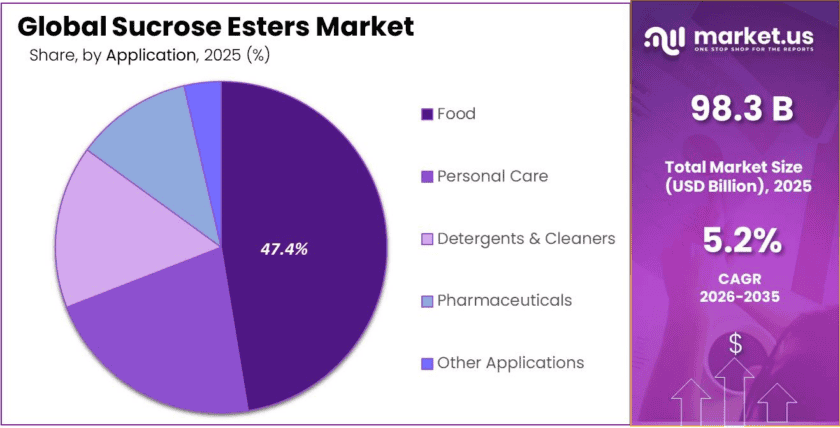
Sucrose esters are non-ionic surfactants produced by combining sucrose with food-grade fatty acids. They are commonly used to stabilize oil-and-water mixtures, improve texture, disperse fats, and support product consistency. In 2025, Powder held 60.23% of the market, while Food accounted for 47.45% of application demand.
FAO/WHO recognizes sucrose esters of fatty acids as INS 473 and classifies them as food emulsifiers. JECFA specifications require commercial material to contain at least 80% sucrose esters, while free sucrose must remain below 5%.
Codex provisions updated through 2025 permit sucrose esters in many food categories, supporting demand across dairy, bakery, confectionery, beverages, frozen desserts, and processed foods.
Key Takeaways
- The global Sucrose Esters Market was valued at USD 98.3 billion in 2025 and is projected to reach USD 162.5 billion by 2035, expanding at a 5.2% CAGR.
- Powder dominated the form category in 2025 with more than a 60.23% share.
- Food represented the largest application, capturing more than a 47.45% share.
- Asia-Pacific held the leading regional position with more than a 43.22% share, generating around USD 42.4 billion in 2025.
- Regulatory acceptance across multiple food categories continues to support demand for sucrose esters as emulsifiers, stabilizers, and texture-enhancing ingredients.
- Growing processed-food production, advanced formulations, and specialty personal-care applications are supporting long-term market development.
Regional Analysis
Asia-Pacific Leads with 43.22% Share and USD 42.4 Billion
Asia-Pacific dominated the Sucrose Esters Market in 2025, capturing more than a 43.22% share and generating approximately USD 42.4 billion. The region benefits from large food-processing, chemical, bakery, dairy, confectionery, personal-care, and beverage industries across China, Japan, South Korea, and Southeast Asia.
China’s industrial activity provides a strong supporting base. Official statistics show that refined sugar production reached 16.21 million tonnes in 2025, increasing 9.0% from 2024. The country also produced 41.51 million tonnes of ethylene, while chemical fibre output increased 4.9%, reflecting strong downstream chemical-manufacturing capability.
Regional food manufacturing also supports demand for functional ingredients used in emulsified and processed products. Sucrose esters are widely suited to dairy formulations, bakery products, confectionery, beverages, and specialty applications, helping Asia-Pacific maintain its leading position.
Market Dynamics
Driver – Growing Processed Food Applications Support Emulsifier Demand
Processed-food production remains a major driver for sucrose esters because manufacturers require stable emulsions, controlled texture, and consistent product quality. Codex Alimentarius, updated through the 48th Session in 2025, permits sucrose esters in numerous food categories. Maximum levels include 20,000 mg/kg in beverage whiteners, 10,000 mg/kg in milk and cream powders, and 10,000 mg/kg in cream analogues.
These broad permitted uses support demand across dairy, bakery, beverage, and confectionery manufacturing. As companies develop longer-lasting and more stable processed foods, sucrose esters remain useful because they combine emulsifying, stabilizing, and texture-management functions.
Trend – Powder Grades Gain Preference in Industrial Processing
Powdered sucrose esters are gaining wider preference because they are easier to transport, store, weigh, and incorporate into dry ingredient systems. This aligns with the market structure, where Powder held a 60.23% share in 2025. International specifications also support standardized industrial production.
FAO/JECFA requires sucrose ester products to contain at least 80% ester content, with free sucrose limited to 5% and sulfated ash capped at 2%. These specifications encourage producers to develop consistent powder grades for bakery mixes, dairy powders, confectionery, and dry beverage formulations.
Restraint – Regulatory Exposure Limits Uncontrolled Food Use
Regulatory review remains an important restraint because sucrose esters must meet strict purity and exposure requirements. JECFA established a group acceptable daily intake of 0–30 mg/kg body weight per day. In its 2020 evaluation, the committee estimated that high dietary exposure among children aged 3–9 years could reach 113 mg/kg body weight per day, nearly 4 times the group ADI under conservative assumptions.
The European Commission has also requested additional technical and toxicological data for E473. Such regulatory scrutiny increases testing, documentation, reformulation, and compliance requirements for manufacturers targeting food and infant-nutrition applications.
Opportunity – Broader Food Categories Create Formulation Opportunities
Sucrose esters have substantial opportunity across food categories because Codex permits their use at varying levels depending on application. Current provisions allow up to 12,000 mg/kg in chewing gum, 10,000 mg/kg in fine bakery wares, 5,000 mg/kg in edible ices, and 3,000 mg/kg in ordinary bakery products.
This broad regulatory scope gives formulators flexibility to use sucrose esters in texture improvement, emulsion stability, fat dispersion, and shelf-life management. Suppliers that offer application-specific ester compositions and technical support can target premium bakery, confectionery, dairy, beverage, and functional-food formulations.
Emerging Trends
1. Higher-Purity Grades Gain Attention
FAO/JECFA requires sucrose esters to contain at least 80% ester content, while free sucrose must remain below 5%. These specifications are encouraging manufacturers to improve purification and consistency for demanding food and specialty formulations.
2. Bakery Applications Continue Expanding
Codex provisions updated through 2025 permit sucrose esters at up to 10,000 mg/kg in fine bakery wares and mixes. This supports greater use for crumb softness, fat dispersion, aeration, and consistent industrial bakery processing.
3. Beverage Formulations Become More Specialized
Sucrose esters are permitted at up to 20,000 mg/kg in beverage whiteners, while water-based flavoured drinks allow up to 200 mg/kg. These different limits encourage customized emulsifier grades for specific beverage systems.
4. Dairy and Cream Alternatives Support Demand
Codex allows sucrose esters at up to 10,000 mg/kg in cream analogues and milk or cream powders. Growing formulation activity in dairy alternatives supports demand for emulsifiers that stabilize fat and water phases.
5. Regulatory Documentation Is Becoming More Important
JECFA’s group ADI remains 0–30 mg/kg body weight per day, while regulatory authorities continue reviewing exposure information. Manufacturers are therefore investing more attention in dosage control, specifications, safety documentation, and application-specific compliance.
Use Cases
1. Bakery Products
Sucrose esters improve fat dispersion, dough stability, and finished-product texture in bakery manufacturing. Codex allows up to 10,000 mg/kg in fine bakery wares and mixes, providing manufacturers with flexibility for cakes, pastries, and related products.
2. Beverage Whiteners
Sucrose esters help stabilize fat-containing beverage whiteners by maintaining uniform oil-and-water dispersion. Codex permits sucrose ester group additives at levels up to 20,000 mg/kg in beverage whiteners, supporting extensive formulation flexibility.
3. Dairy and Cream Products
Manufacturers use sucrose esters to stabilize fat and improve texture in dairy-related formulations. Codex provisions allow up to 10,000 mg/kg in cream analogues and milk or cream powders, depending on product category.
4. Frozen Desserts
Sucrose esters can improve emulsion stability and texture in ice cream, sherbet, and related frozen desserts. Codex permits sucrose ester group additives at up to 5,000 mg/kg in edible ices, supporting industrial frozen-food applications.
5. Confectionery and Chewing Gum
Sucrose esters help manage texture and fat distribution in confectionery applications. Codex provisions permit up to 12,000 mg/kg in chewing gum, while other confectionery categories can allow higher use levels depending on the product specification.
Frequently Asked Questions on Sucrose Esters
What are sucrose esters?
Sucrose esters are non-ionic surfactants made by reacting sucrose with food-grade fatty acids. They are mainly used as emulsifiers, stabilizers, and texture-enhancing ingredients in food, beverage, personal-care, and specialty formulations.
How large is the Sucrose Esters Market?
The global Sucrose Esters Market was valued at USD 98.3 billion in 2025 and is expected to reach approximately USD 162.5 billion by 2035, growing at a 5.2% CAGR.
Which region dominates the Sucrose Esters Market?
Asia-Pacific held the dominant regional position in 2025 with more than a 43.22% share, representing approximately USD 42.4 billion, supported by strong food-processing, chemical, and consumer-product manufacturing.
Which form leads the Sucrose Esters Market?
Powder was the leading form in 2025, capturing more than a 60.23% share. Powder grades are widely preferred because they are convenient to store, transport, measure, and incorporate into dry formulations.
Which application dominates the market?
Food represented the leading application segment in 2025, accounting for more than a 47.45% share. Demand comes from bakery, dairy, confectionery, beverages, desserts, and other processed-food formulations.
Are sucrose esters permitted in food?
Yes. FAO/WHO identifies sucrose esters of fatty acids as INS 473. Codex permits their use in numerous food categories at defined maximum levels depending on the type of product.
What purity requirements apply to sucrose esters?
FAO/JECFA specifications require sucrose esters to contain at least 80% ester content, while free sucrose must remain below 5% and sulfated ash must not exceed 2%.
What factors are supporting future market growth?
Future growth is supported by processed-food manufacturing, dairy alternatives, bakery products, beverages, confectionery, and specialty formulations. Regulatory acceptance across multiple food categories also creates room for new application-specific ester grades.
Conclusion
The Sucrose Esters Market is positioned for steady expansion as manufacturers increasingly require stable emulsions, improved texture, and reliable ingredient performance. The market was valued at USD 98.3 billion in 2025 and is projected to reach USD 162.5 billion by 2035, advancing at a 5.2% CAGR. Powder remains the leading form with a 60.23% share, while Food accounts for 47.45% of application demand.
Asia-Pacific leads with 43.22%. Regulatory acceptance across bakery, dairy, beverages, and confectionery should continue supporting product innovation, while tighter safety and purity requirements will encourage higher-quality, application-specific sucrose ester formulations.
Discuss your needs with our analyst
Please share your requirements with more details so our analyst can check if they can solve your problem(s)