Overview
New York, NY – Oct 05, 2026 – The Center Pivot Irrigation Systems Market is expanding as farms seek more controlled, automated, and water-efficient methods to irrigate large crop areas. Center pivots rotate around a fixed point and distribute water through sprinklers mounted along a long pipeline, making them suitable for cereals, oilseeds, pulses, forage crops, and other broad-acre farming operations.
The global Center Pivot Irrigation Systems Market is expected to increase from USD 3.8 billion in 2025 to around USD 12.1 billion by 2035, growing at a 12.3% CAGR from 2026 to 2035.
Water availability is strengthening the need for efficient irrigation. FAO reports that agriculture accounts for approximately 72% of global freshwater withdrawals, while 1.2 billion people live in agricultural areas facing severe water constraints.
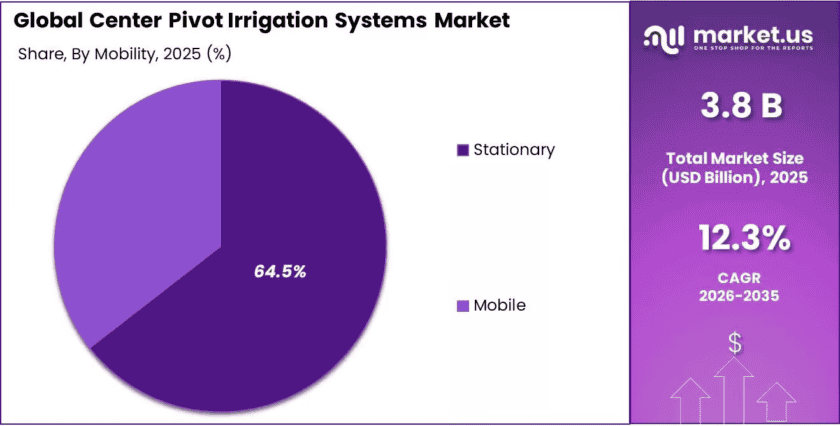
In 2025, Span components held more than 29.78% of the market, Cereals accounted for 47.45%, and Stationary systems captured 64.56%. North America led globally with 32.34% share and USD 1.2 billion revenue.
Key Takeaways
- The global Center Pivot Irrigation Systems Market was valued at USD 3.8 billion in 2025 and is projected to reach approximately USD 12.1 billion by 2035, registering a 12.3% CAGR.
- Span components captured more than 29.78% share in 2025, supported by their essential role in carrying pipelines, sprinklers, electrical systems, and structural loads across large fields.
- Cereals held more than 47.45% of the market, reflecting widespread center-pivot use across corn, wheat, sorghum, barley, and other large-acreage crops.
- Stationary center pivots dominated with more than 64.56% share in 2025, as fixed systems provide consistent irrigation across fields used repeatedly for commercial crop production.
- North America led with more than 32.34% share and approximately USD 1.2 billion in revenue during 2025, supported by large-scale mechanized farming and extensive pressurized irrigation infrastructure.
- USDA reported 53.1 million irrigated acres across 212,714 U.S. farms in 2023, highlighting the large installed base supporting irrigation equipment demand.
Regional Analysis
North America Leads with 32.34% Share and USD 1.2 Billion Revenue
In 2025, North America held a dominant Center Pivot Irrigation Systems Market position, capturing more than 32.34% share and generating approximately USD 1.2 billion in revenue.
The region benefits from large commercial farms, highly mechanized crop production, significant groundwater use, and a well-developed irrigation equipment base. According to USDA, the United States had 212,714 irrigating farms covering 53.1 million acres in 2023, with around 81 million acre-feet of water applied.
USDA also reported that groundwater supplied 54% of irrigation water applied to acres in the open. Sprinkler-irrigated acreage exceeded gravity-irrigated acreage by 12.6 million acres, illustrating the importance of pressurized technologies such as center pivots.
The shift is particularly clear in Western states. USDA ERS reported that pressurized irrigation represented about 75% of irrigated acres in 2023, compared with 69% in 2013.
Market Dynamics
Driver – Rising Need for Water-Efficient Irrigation
Water scarcity and the need to produce more food with limited resources are major drivers for center pivot irrigation. FAO reports that agriculture consumes around 72% of global freshwater withdrawals, while approximately 1.2 billion people live in agricultural areas facing severe water constraints.
Agriculture may also need to produce 50% more food, feed, and fibre by 2050 compared with 2012. Center pivots allow farmers to control irrigation timing, pressure, and application depth across large fields. USDA data show that pressurized irrigation represented 75% of Western U.S. irrigated acreage in 2023, highlighting the long-term shift toward more controlled water-delivery systems.
Trend – Variable-Rate and Sensor-Based Irrigation
Smart center pivots are increasingly combining variable-rate irrigation, soil-moisture sensors, crop-temperature monitoring, weather data, and remote controls. USDA-ARS has developed systems that use infrared thermometers and soil-moisture sensors to create irrigation prescriptions for individual field zones.
USDA research found that variable-rate irrigation could save up to 30% of irrigation water without reducing crop yield compared with uniform-rate irrigation. Another five-crop-year study recorded irrigation-water reductions of 22% in corn and 11% in soybean. These results are encouraging precision technologies that allow center pivots to apply different amounts of water across the same field.
Restraint – High Capital and Energy Requirements
High installation costs remain a major restraint, particularly for smaller farms. A center pivot requires towers, spans, sprinkler packages, pumps, pipelines, electrical systems, controls, water access, and ongoing maintenance. Energy costs can also rise when farmers pump groundwater from deeper wells.
USDA’s 2023 survey found that the average U.S. irrigation well was approximately 241 feet deep, while groundwater supplied 54% of irrigation water applied to open-field acreage. Farmers must therefore evaluate equipment investment together with pumping energy and water availability. These financial barriers can slow replacement of older irrigation systems even when modern pivots offer improved control and water-use efficiency.
Opportunity – Precision Irrigation and Water-Saving Retrofits
Modernizing existing pivots with low-pressure sprinklers, variable-rate controls, telemetry, soil sensors, weather monitoring, and automated pump management creates a strong growth opportunity. USGS notes that traditional high-pressure spray irrigation can lose up to 35% of water through evaporation and wind, while lower-pressure configurations can reduce these losses.
USDA-ARS research found that variable-rate irrigation reduced water use by 22% in corn and 11% in soybean without a significant yield difference in its study. These technologies allow existing center pivots to become smarter without requiring complete replacement, opening opportunities in both new installations and retrofit markets.
Emerging Trends
1. Variable-Rate Irrigation
Variable-rate irrigation allows different field zones to receive different amounts of water. USDA-ARS research found that VRI saved up to 30% of irrigation water without a yield difference, strengthening interest in precision-controlled center pivots.
2. Low-Pressure Sprinklers
Low-pressure sprinkler packages are replacing high-pressure water application in many fields. USGS reports that traditional high-pressure systems can lose up to 35% of applied water through evaporation and wind, creating demand for lower-pressure alternatives.
3. Soil-Moisture Sensor Integration
Center pivots are increasingly connected to field sensors. USDA-ARS systems combine soil-moisture readings, crop temperatures, and weather information to calculate irrigation requirements, while studies recorded water reductions of 22% in corn and 11% in soybean.
4. Expansion of Pressurized Irrigation
Pressurized irrigation continues to replace traditional gravity methods. Across the Western United States, pressure-based systems represented roughly 75% of irrigated acreage in 2023, up from approximately 69% in 2013, according to USDA ERS.
5. Larger Cereal Irrigation Base
Cereals are an important center-pivot application. USDA estimated 95.2 million U.S. corn acres and 45.5 million wheat acres planted in 2025, creating a large crop base where mechanized irrigation can support production.
Use Cases
1. Corn Irrigation
Center pivots are widely suited to corn because fields are often large and require consistent moisture through key growth stages. USDA estimated 95.2 million corn acres planted in 2025, creating substantial potential for automated sprinkler irrigation.
2. Wheat Irrigation
Wheat growers can use center pivots to manage water during establishment, vegetative development, and grain filling. USDA reported approximately 45.5 million acres of wheat planted in 2025, including 33.3 million acres of winter wheat.
3. Variable-Rate Corn and Soybean Irrigation
Precision center pivots can apply less water in wetter zones and more water where soils dry faster. USDA-ARS trials found VRI reduced irrigation water by 22% in corn and 11% in soybean without significant yield loss.
4. Large Commercial Fields
A typical center-pivot unit can extend approximately 1,250–1,300 feet and irrigate around 130 acres, according to USGS. This makes the technology practical for large commercial farms seeking automated, repeatable irrigation coverage.
5. Groundwater-Dependent Farming
Center pivots are widely useful where irrigation depends on wells. USDA reported that groundwater supplied approximately 54% of irrigation water applied to open-field acreage in 2023, making efficient pump and sprinkler management important for groundwater-dependent producers.
Frequently Asked Questions on Center Pivot Irrigation Systems
What is a Center Pivot Irrigation System?
A center pivot is a mechanized sprinkler system that rotates around a fixed central point. Water moves through a long elevated pipeline supported by wheeled towers, allowing crops across large circular fields to receive controlled irrigation.
How large is the Center Pivot Irrigation Systems Market?
The market was valued at approximately USD 3.8 billion in 2025 and is forecast to reach around USD 12.1 billion by 2035, growing at a 12.3% CAGR.
Which component leads the Center Pivot Irrigation Systems Market?
Span components led the market in 2025, capturing more than 29.78% share. Spans support the irrigation pipeline, sprinklers, electrical equipment, and structural load between towers across large agricultural fields.
Which crop segment dominates the market?
Cereals held the leading market position in 2025 with more than 47.45% share. Corn, wheat, sorghum, barley, and similar crops are commonly grown across broad fields suited to mechanized center-pivot irrigation.
Which mobility type dominates Center Pivot Irrigation Systems?
Stationary systems dominated in 2025 with more than 64.56% market share. Fixed pivots are suitable for farms that repeatedly irrigate the same large fields and need permanent connections to pumps, controls, and water infrastructure.
Which region leads the Center Pivot Irrigation Systems Market?
North America led the global market in 2025, accounting for more than 32.34% share and approximately USD 1.2 billion in revenue, supported by large farms and extensive mechanized irrigation infrastructure.
Why are center pivots important for water management?
Center pivots allow farmers to control when, where, and how much irrigation water is applied. Low-pressure sprinklers and variable-rate controls can further reduce losses and improve water management across fields with different soils or crop conditions.
What is variable-rate irrigation?
Variable-rate irrigation changes water application within different parts of a field rather than applying one uniform amount everywhere. USDA research found VRI could save up to 30% of irrigation water without reducing yield.
What crops commonly use center pivots?
Center pivots are commonly used for corn, wheat, soybean, sorghum, barley, alfalfa, forage crops, oilseeds, and pulses. They are particularly useful where crops are grown across large, relatively uniform commercial farming areas.
What factors may limit center-pivot adoption?
High upfront equipment costs, pump energy expenses, limited water access, maintenance needs, field shape, terrain, groundwater decline, and technical management requirements may limit adoption, particularly among smaller farms or operations with fragmented land.
Conclusion
The Center Pivot Irrigation Systems Market is positioned for strong growth as agriculture requires more efficient, automated, and precise water management. The market is projected to rise from USD 3.8 billion in 2025 to USD 12.1 billion by 2035 at a 12.3% CAGR.
Span components, cereals, and stationary systems remain major segments, while North America leads with 32.34% share and USD 1.2 billion revenue. Water scarcity, precision agriculture, low-pressure sprinklers, variable-rate irrigation, sensors, and automated controls are expected to strengthen center-pivot adoption across large commercial farms.
Discuss your needs with our analyst
Please share your requirements with more details so our analyst can check if they can solve your problem(s)