Overview
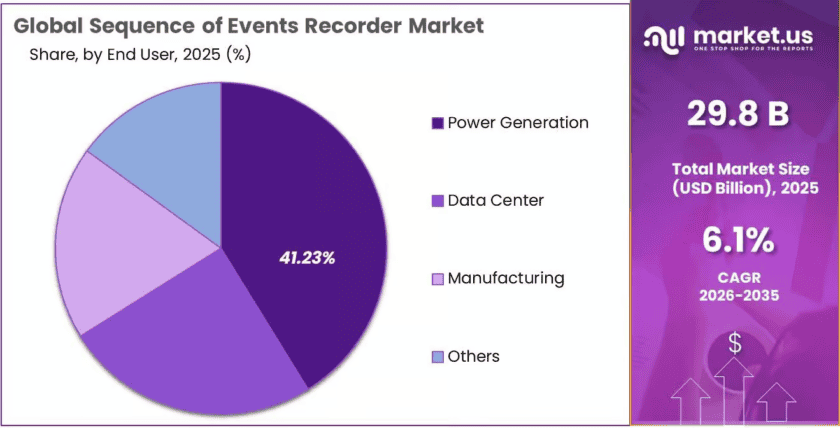
New York, NY – Oct 07, 2026 – The global Sequence of Events Recorder Market is expanding as electric utilities, power plants, manufacturing facilities, and data centers strengthen real-time monitoring and fault-analysis systems. The market was valued at USD 29.8 Billion in 2025 and is projected to reach USD 54.0 Billion by 2035, growing at a 6.1% CAGR during 2026–2035. Rack-mounted systems led with a 72.34% share, while power generation accounted for 41.23% of end-user demand.
Sequence of Events Recorders capture breaker operations, relay trips, equipment alarms, and other digital changes in chronological order, helping engineers identify the first event that triggered an outage or process failure. NERC’s PRC-002-5 standard requires sequence-of-events data for selected Bulk Electric System buses and specifies synchronized device-clock accuracy within ±2 milliseconds of Coordinated Universal Time.
Grid expansion is creating additional monitoring requirements. In September 2026, the U.S. Department of Energy selected 31 projects across 26 states involving USD 5.25 billion of total grid investment, including USD 1.9 billion in federal funding. The projects are expected to improve more than 22,500 miles of transmission infrastructure and unlock over 23 GW of electricity capacity.
Key Takeaways
- The Sequence of Events Recorder Market was valued at USD 29.8 Billion in 2025 and is projected to reach USD 54.0 Billion by 2035, expanding at a 6.1% CAGR.
- Rack Mounted systems dominated the market with more than a 72.34% share in 2025 because utilities and industrial plants require centralized, high-density monitoring systems.
- Power Generation held more than a 41.23% share, supported by the need to record breaker operations, relay trips, alarms, and equipment faults.
- North America led with more than a 37.34% share and approximately USD 11.6 Billion in revenue during 2025.
- NERC PRC-002-5 requires synchronized SER equipment to maintain device-clock accuracy within ±2 milliseconds of UTC.
- U.S. utility-scale electricity generation reached approximately 4.43 trillion kWh in 2025, increasing the scale of assets requiring protection and disturbance monitoring.
Regional Analysis
North America held the dominant position in the Sequence of Events Recorder Market in 2025, capturing more than a 37.34% share and generating approximately USD 11.6 Billion. Strong utility infrastructure, digital substations, power-generation assets, data centers, and mandatory reliability standards support regional demand. NERC PRC-002-5 specifically requires SER data for circuit-breaker positions at selected Bulk Electric System locations and also requires time synchronization within ±2 milliseconds of UTC.
Government grid investment is reinforcing this position. In September 2026, DOE announced USD 1.9 billion in federal support for 31 grid-improvement projects across 26 states, alongside USD 3.35 billion in recipient cost sharing. The projects are expected to rebuild or reconductor more than 1,500 miles of transmission lines and deploy grid-enhancing technologies across nearly 21,000 miles.
Asia-Pacific is also emerging as an important growth area as electricity consumption, renewable generation, industrial automation, and digital substations expand. The IEA expects global electricity demand to rise at an average 3.6% annually from 2026 to 2030, increasing requirements for reliable grid monitoring and event analysis.
Market Dynamics
Driver – Grid Modernization Increases Need for Accurate Disturbance Records
Grid modernization is a major driver for Sequence of Events Recorders because utilities need precise data to investigate faults and maintain reliability. DOE’s Grid Resilience and Innovation Partnerships programme announced USD 7.6 billion for 105 selected projects across all 50 states and the District of Columbia through its first two funding rounds.
NERC PRC-002-5 also requires transmission and generator owners to maintain SER data for specified circuit breakers and synchronize monitoring systems within ±2 milliseconds of UTC. These requirements encourage utilities to upgrade substations, timing systems, protective relays, event recorders, and digital monitoring infrastructure.
Trend – Renewable Integration Drives Higher-Resolution Event Monitoring
Rapid growth in variable renewable generation is increasing the need for detailed disturbance data. EIA reported that wind and utility-scale solar together generated 760,000 GWh of U.S. electricity in 2025, representing 17% of utility-scale generation. Utility-scale solar alone reached 296,000 GWh, increasing 34% from 2024.
NERC’s PRC-028-1 disturbance-monitoring standard for inverter-based resources became effective on April 1, 2025, requiring adequate data to evaluate ride-through performance and validate resource models. These changes are encouraging utilities to combine SERs with digital relays, fault recorders, synchronized clocks, and disturbance-analysis platforms.
Restraint – Legacy Integration and Precise Time Synchronization Add Complexity
Modern Sequence of Events Recorder deployments can be difficult in older substations because utilities must integrate new equipment with legacy relays, communication networks, control systems, and timing infrastructure. NERC PRC-002-5 requires synchronized SER and disturbance data with device-clock accuracy within ±2 milliseconds of UTC.
It also requires relevant data to remain retrievable for 10 calendar days and normally be supplied within 30 calendar days when requested. Meeting these requirements can require new GPS or network clocks, communications hardware, engineering work, cybersecurity controls, and testing. As a result, brownfield projects can face higher costs and longer commissioning periods than new digital substations.
Opportunity – Data Centers Create New Critical-Power Monitoring Demand
Rapid data-center expansion creates a major opportunity for SER suppliers because these facilities depend on complex electrical networks containing utility feeds, transformers, UPS systems, switchgear, generators, batteries, and transfer switches.
Lawrence Berkeley National Laboratory estimated in June 2026 that data centers could account for around 11.8% of total U.S. electricity consumption by 2030, with scenarios ranging from 9.5% to 15.3%. EIA also expects U.S. electricity sales to increase almost 2% in 2026, driven partly by data-center development. Precise event sequencing can help operators locate the first electrical failure and reduce troubleshooting time.
Emerging Trends
1. Millisecond-Level Time Synchronization
NERC PRC-002-5 requires SER and other disturbance-monitoring devices to maintain clock accuracy within ±2 milliseconds of UTC. This is encouraging wider deployment of GPS, precision-time-protocol systems, and synchronized substation monitoring platforms.
2. Inverter-Based Resource Monitoring
NERC PRC-028-1 became effective on April 1, 2025, establishing disturbance-monitoring requirements for inverter-based resources. Growing solar, wind, and battery deployment is increasing demand for high-resolution event recording and model-validation data.
3. Digital Transmission Investment
DOE selected 31 grid projects across 26 states in September 2026 with USD 5.25 billion of combined investment. These projects increase opportunities for digital monitoring, substation automation, synchronized event recording, and advanced protection technologies.
4. Data Center Power Monitoring
U.S. data centers could consume around 11.8% of national electricity by 2030, according to Lawrence Berkeley National Laboratory. Growing critical-power loads are increasing demand for event recorders that monitor switchgear, UPS systems, generators, and transfer equipment.
5. Standardized Digital Event Data
NERC PRC-002-5 requires SER records to be supplied in ASCII CSV format, while fault and dynamic disturbance files can use standardized COMTRADE formats. Standardized data improves cross-platform analysis and post-event investigations.
Use Cases
1. Power Generation Fault Investigation
Power plants use SERs to identify the exact order of relay trips, breaker changes, alarms, and equipment shutdowns. U.S. utility-scale generators produced about 4.43 trillion kWh in 2025, illustrating the large infrastructure base requiring reliable monitoring.
2. Transmission Substation Monitoring
SERs record breaker open-and-close positions at critical transmission buses. NERC PRC-002-5 requires SER data for designated Bulk Electric System locations and calls for monitored buses to be reassessed at least once every 5 calendar years.
3. Renewable Plant Disturbance Analysis
Wind, solar, and battery sites use synchronized event data to understand inverter trips and ride-through performance. U.S. wind and utility-scale solar generation reached 760,000 GWh in 2025, strengthening the need for disturbance analysis.
4. Data Center Power Reliability
Data centers use event recorders to determine whether a power interruption originated from the utility, UPS system, generator, transfer switch, or internal distribution equipment. Data centers could reach 11.8% of U.S. electricity consumption by 2030.
5. Chemical and Process-Safety Monitoring
Industrial plants use SER systems to reconstruct shutdowns, valve actions, interlocks, and equipment trips. OSHA’s Process Safety Management standard covers 137 highly hazardous chemicals and certain flammable-gas or liquid processes at 10,000 pounds or more.
Frequently Asked Questions on Sequence of Events Recorder
What is a Sequence of Events Recorder?
A Sequence of Events Recorder is an electronic monitoring system that time-stamps changes in breakers, relays, alarms, switches, and other digital inputs, allowing engineers to reconstruct the exact chronological order of events during a fault or shutdown.
How large is the Sequence of Events Recorder Market?
The global market was valued at USD 29.8 Billion in 2025 and is projected to reach approximately USD 54.0 Billion by 2035, growing at a 6.1% CAGR during 2026–2035.
Which mount type dominates the market?
Rack Mounted systems held more than a 72.34% share in 2025. Their centralized architecture suits substations, control rooms, power plants, and industrial sites requiring many event-monitoring channels in one equipment cabinet.
Which end user leads the Sequence of Events Recorder Market?
Power Generation held more than a 41.23% share in 2025. Generating facilities use SER systems to analyze breaker operations, protection-system responses, equipment alarms, and shutdown sequences following electrical or mechanical disturbances.
Which region dominates the market?
North America led the market in 2025 with more than a 37.34% share, representing approximately USD 11.6 Billion. Grid-modernization investment and NERC reliability requirements continue to support regional monitoring demand.
Why is accurate time synchronization important?
Accurate timestamps allow engineers to identify which protective device or component operated first during a disturbance. NERC PRC-002-5 requires applicable SER and disturbance-monitoring equipment to maintain device-clock accuracy within ±2 milliseconds of UTC.
How are SER systems used in substations?
Substation SER systems monitor breaker positions, relay trips, alarms, reclosing actions, and equipment states. NERC requires SER data for selected Bulk Electric System buses and specific circuit breakers directly connected to those monitored locations.
Are renewable energy projects increasing SER demand?
Yes. Renewable-heavy grids require more detailed disturbance information because inverter-based resources respond differently from traditional generators. NERC’s PRC-028-1 monitoring requirements for inverter-based resources became effective on April 1, 2025.
Why are data centers becoming an important application?
Data centers contain highly interconnected electrical systems and cannot tolerate long outages. Lawrence Berkeley National Laboratory estimates they could account for 11.8% of U.S. electricity use by 2030, increasing demand for precise power-event diagnostics.
What will support future Sequence of Events Recorder growth?
Future growth is expected from digital substations, renewable integration, data centers, grid expansion, synchronized monitoring, cybersecurity upgrades, and advanced analytics. DOE’s 2026 SPARK selections alone involve USD 5.25 billion in planned grid investments.
Conclusion
The Sequence of Events Recorder Market is becoming more important as power networks, renewable plants, data centers, and industrial facilities demand faster fault diagnosis and stronger reliability. The market is projected to increase from USD 29.8 Billion in 2025 to USD 54.0 Billion by 2035, representing a 6.1% CAGR.
NERC’s ±2-millisecond time-synchronization requirement demonstrates the growing need for highly accurate event data. With DOE supporting USD 5.25 billion of grid projects across 26 states, future opportunities are expected in digital substations, renewable integration, critical-power monitoring, data centers, and automated disturbance analytics.
Discuss your needs with our analyst
Please share your requirements with more details so our analyst can check if they can solve your problem(s)