Overview
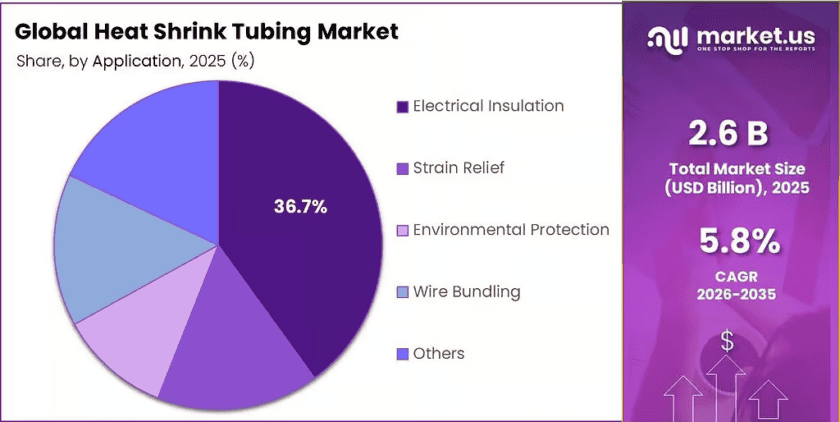
New York, NY – Sep 15, 2026 – The global Heat Shrink Tubing Market is gaining importance as automotive, electrical, electronics, renewable-energy, aerospace, telecommunications, and industrial systems use increasingly complex wiring networks. The market was valued at USD 23.6 billion in 2025 and is projected to reach approximately USD 44.1 billion by 2035, expanding at a 6.4% CAGR. Polyolefin tubing accounted for 42.3% of the market, while the 2:1 shrink ratio segment captured 40.5%. Electrical insulation remained the leading application with 36.7%, while electrical and electronics represented 35.4% of end-use demand. Asia Pacific led regional consumption with a 38.7% share.
Heat shrink tubing contracts when heated, creating a close-fitting protective layer around cables, connectors, joints, terminals, and electronic components. It provides electrical insulation, strain relief, moisture protection, abrasion resistance, and identification. Demand is expanding alongside electrification. Global electric-car sales reached approximately 21 million units in 2025, representing about 1 in 4 new cars sold. Nearly 22 million electric cars were manufactured worldwide during the year, increasing more than 25% from 2024. These developments increase requirements for reliable wire harnesses, battery connections, charging systems, and protected electrical assemblies.
Key Takeaways
- The global Heat Shrink Tubing Market reached USD 23.6 billion in 2025 and is projected to approach USD 44.1 billion by 2035, advancing at a 6.4% CAGR.
- Polyolefin remained the leading material type with approximately 42.3% of global market demand.
- The 2:1 shrink ratio segment led product usage with a substantial 40.5% share, supported by its versatility across standard electrical applications.
- Electrical insulation represented the largest application segment, accounting for approximately 36.7% of market demand.
- Electrical and electronics remained the leading end-use industry with a 35.4% market share.
- Asia Pacific dominated global consumption in 2025 with approximately 38.7% of the market.
- Global electric-car sales exceeded 20 million units in 2025, creating a larger installed base of high-voltage wiring and electrical assemblies requiring insulation and protection.
Regional Analysis
Asia Pacific held the dominant position in the Heat Shrink Tubing Market in 2025, accounting for approximately 38.7% of global consumption. Its position is supported by a large automotive, electronics, electrical-equipment, battery, semiconductor, and telecommunications manufacturing base. China alone sold more than 13 million electric cars during 2025 and represented nearly 75% of global electric-car production. Approximately 16 million electric cars were manufactured in China during the year, creating significant requirements for battery wiring, connectors, sensors, charging circuits, and protected cable assemblies.
North America also presents a strong demand environment as investment rises across renewable power, electricity networks, semiconductors, data infrastructure, and transportation. U.S. power developers added 53 GW of new generating capacity in 2025 and planned a record 86 GW for 2026, with solar representing 51% and battery storage 28% of planned additions. These installations require extensive electrical connections, control wiring, cable joints, and weather-resistant insulation, supporting continued heat shrink tubing consumption.
Market Dynamics
Driver – Rapid Electrification Across Automotive and Electrical Systems
Rising electrification is a major growth driver for the Heat Shrink Tubing Market because modern vehicles require increasingly complex power cables, battery connections, sensors, chargers, and electronic control systems. Global electric-car sales increased more than 20% in 2025 to approximately 21 million units, meaning around 25% of all new cars sold were electric. Electric heavy-truck sales also tripled to more than 200,000 units. Nearly 22 million electric cars were produced globally, increasing more than 25% year over year. This expanding vehicle base increases the need for tubing that provides electrical insulation, strain relief, abrasion protection, sealing, and cable identification in high-voltage and low-voltage wiring assemblies.
Trend – Renewable Power and Grid Expansion Increase Cable Protection Needs
Expansion of solar, battery storage, transmission, and grid infrastructure is increasing requirements for durable electrical insulation and environmental protection. U.S. electricity developers added 53 GW of utility-scale capacity during 2025, the highest level since 2002. For 2026, planned additions reached a record 86 GW, with solar accounting for 51%, battery storage 28%, and wind 14%. Separately, DOE’s Project RELIEF plans to install advanced conductors across 250 miles of transmission lines and another 150 miles of optical ground wire. Such projects require reliable connectors, splices, terminals, and protected wiring, supporting broader adoption of weather-resistant and high-performance heat shrink products.
Restraint – Material Regulation Raises Pressure on Specialty Tubing
Regulatory scrutiny surrounding fluorinated materials could create formulation and compliance challenges for specialty heat shrink tubing manufacturers. Fluoropolymer tubing is valued in demanding applications because of its thermal and chemical resistance, but European authorities continue to assess broader restrictions on PFAS substances. In March 2026, ECHA’s scientific committees supported EU-wide PFAS restrictions while recommending targeted derogations for important industrial uses. The European Commission reported that 11 REACH restrictions covering hundreds of hazardous substances had been adopted since 2022, with another 6 reaching final evaluation stages. Manufacturers may therefore face additional testing, documentation, material-substitution, and product-development costs where fluorinated tubing is currently specified.
Opportunity – Semiconductor, Broadband and Advanced Infrastructure Investment
Large technology and infrastructure projects offer significant future opportunities for heat shrink tubing suppliers. In January 2026, a U.S.–Taiwan agreement outlined at least USD 250 billion in new direct investment from Taiwanese semiconductor and technology companies for advanced manufacturing, energy, and artificial-intelligence infrastructure in the United States. Meanwhile, NTIA had approved 50 of 56 state and territory BEAD final proposals by February 2026, moving broadband infrastructure projects closer to construction. Semiconductor facilities, telecom networks, data infrastructure, and broadband equipment contain extensive power, control, fiber, and communication cabling. This creates opportunities for tubing engineered for insulation, sealing, cable organization, identification, chemical protection, and long service life.
Emerging Trends
1. EV Wiring Systems Become More Complex
Global electric-car sales reached approximately 21 million units in 2025, representing 25% of new car sales. Higher-voltage battery packs, charging circuits, sensors, and electronic controls are increasing demand for heat shrink tubing capable of providing insulation, sealing, and strain relief.
2. Renewable Energy Creates New Cable Protection Demand
U.S. developers plan to add a record 86 GW of utility-scale generating capacity in 2026. Solar represents 51% and battery storage 28%, creating growing requirements for protected cable joints, terminals, connectors, control wiring, and outdoor electrical assemblies.
3. Fluoropolymer Alternatives Gain Attention
ECHA supported broader PFAS restrictions in March 2026, although targeted industrial derogations were recommended. Regulatory changes are encouraging tubing suppliers to explore alternative polymers where possible while maintaining the heat, chemical, electrical, and environmental performance required by demanding industrial applications.
4. Electronics Manufacturing Supports High-Specification Tubing
U.S.–Taiwan agreements announced in 2026 include at least USD 250 billion of direct semiconductor and technology investment. Expanding advanced manufacturing facilities will require large electrical, automation, power-distribution, networking, and instrumentation systems, creating opportunities for specialized heat shrink insulation products.
5. Aerospace Wiring Requirements Continue Expanding
The FAA forecasts the U.S. commercial aircraft fleet to increase from 6,949 aircraft in 2025 to 10,677 by 2046. Fleet growth supports long-term requirements for lightweight, flame-resistant, abrasion-resistant, and high-temperature tubing used across aircraft wiring and electronic systems.
Use Cases
1. Automotive Wire Harness Protection
Heat shrink tubing protects automotive cables, connectors, battery terminals, and wire harnesses from heat, vibration, moisture, and abrasion. Global EV production reached nearly 22 million vehicles in 2025, increasing more than 25%, expanding the volume of electrical connections requiring protection.
2. Solar and Battery Energy Systems
Solar farms and battery-storage systems use heat shrink tubing around cable terminations, connectors, sensors, and control circuits. The United States added 27.2 GW of utility-scale solar during 2025 and plans substantial additional solar and battery capacity through 2026.
3. Electrical Transmission and Substations
Utilities use heat shrink materials for cable joints, terminations, conductor insulation, and environmental sealing. DOE’s Project RELIEF covers 250 miles of upgraded transmission lines and 150 miles of optical ground wire, illustrating the expanding scale of modern grid infrastructure.
4. Aircraft Electrical Systems
Aircraft contain extensive wiring for avionics, lighting, flight controls, communications, sensors, and passenger systems. FAA data place the U.S. commercial fleet at 6,949 aircraft in 2025, creating a large installed base requiring reliable wiring maintenance and protection.
5. Broadband and Telecommunications Networks
Heat shrink tubing protects power connections, cable transitions, fiber-related components, and outdoor telecom equipment from mechanical and environmental damage. By February 2026, NTIA had approved 50 of 56 BEAD final proposals, supporting continued expansion of U.S. broadband infrastructure.
Frequently Asked Questions on Heat Shrink Tubing and Heat Shrink Tubing Market
1. What is heat shrink tubing?
Heat shrink tubing is a polymer sleeve that contracts when exposed to controlled heat. It fits tightly around wires, cables, joints, and connectors, providing electrical insulation, strain relief, abrasion resistance, environmental sealing, and organized cable management.
2. How large is the Heat Shrink Tubing Market?
The global Heat Shrink Tubing Market was valued at approximately USD 23.6 billion in 2025 and is expected to reach around USD 44.1 billion by 2035, advancing at an estimated 6.4% CAGR.
3. Which material dominates the Heat Shrink Tubing Market?
Polyolefin held the leading material position with approximately 42.3% market share in 2025. Its broad adoption reflects a useful balance of electrical insulation, flexibility, durability, processing ease, and suitability across automotive, electronic, telecommunications, and industrial applications.
4. Which shrink ratio is most commonly used?
The 2:1 shrink ratio accounted for approximately 40.5% of market demand. It is widely selected for standard wire insulation, cable organization, strain relief, and connector protection because it can accommodate a useful range of component diameters.
5. What is the largest heat shrink tubing application?
Electrical insulation remained the largest application in 2025 with approximately 36.7% market share. Heat shrink tubing helps isolate conductive parts while reducing risks associated with abrasion, moisture exposure, vibration, accidental contact, and damaged cable coverings.
6. Which end-use sector consumes the most heat shrink tubing?
Electrical and electronics represented the leading end-use sector with approximately 35.4% share. Demand comes from wiring assemblies, electrical equipment, connectors, power systems, control panels, electronics production, communication hardware, and other applications requiring compact insulation.
7. Which region leads the Heat Shrink Tubing Market?
Asia Pacific dominated global consumption with approximately 38.7% share in 2025. Its position is supported by high-volume electronics manufacturing, automotive production, electric vehicles, batteries, electrical equipment, semiconductor activity, and substantial industrial manufacturing capacity.
8. Why are electric vehicles important for heat shrink tubing demand?
Electric vehicles contain extensive high- and low-voltage wiring, battery connections, sensors, chargers, and electronic controls. With approximately 21 million electric cars sold globally in 2025, these applications provide an expanding demand base for protective tubing.
9. What could restrain market growth?
Raw-material requirements, qualification costs, strict performance standards, and environmental regulations can limit adoption of certain products. Proposed PFAS restrictions are particularly relevant to specialty fluorinated materials, encouraging manufacturers to evaluate alternatives while maintaining required thermal and chemical performance.
10. Where are the strongest future opportunities?
Growth opportunities are emerging in EVs, renewable power, batteries, grid modernization, aerospace, semiconductors, broadband, and industrial automation. U.S. developers alone plan 86 GW of new utility-scale generating capacity during 2026, supporting additional electrical infrastructure requirements.
Conclusion
The Heat Shrink Tubing Market is positioned for steady expansion as electrification increases across transportation, power, electronics, telecommunications, and industrial systems. The market is expected to rise from USD 23.6 billion in 2025 to approximately USD 44.1 billion by 2035, registering a 6.4% CAGR. Polyolefin leads with 42.3%, while electrical insulation accounts for 36.7% of demand. Asia Pacific remains the leading region with a 38.7% share. Future opportunities will increasingly come from EV wiring, renewable-energy connections, battery systems, semiconductor plants, broadband infrastructure, and grid modernization, while material regulation and high-performance requirements will encourage continued innovation in safer, durable tubing technologies.
Discuss your needs with our analyst
Please share your requirements with more details so our analyst can check if they can solve your problem(s)