Overview
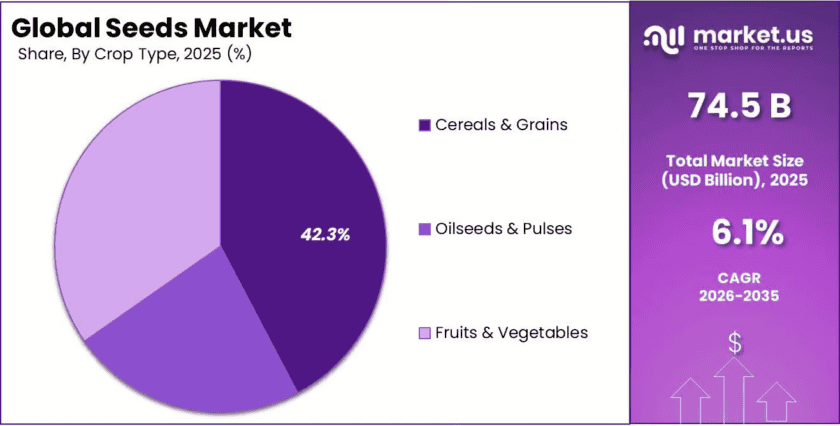
New York, NY – Oct 07, 2026 – The global Seeds Market continues to expand as growers seek higher-yielding, climate-resilient, pest-resistant, and locally adapted crop varieties. The market was valued at USD 74.5 Billion in 2025 and is projected to reach USD 134.4 Billion by 2035, growing at a 6.1% CAGR during 2026–2035. Conventional seeds held a 54.21% share, while herbicide-tolerant seeds represented 59.90% of the trait segment. Cereals & Grains accounted for 52.12% of demand.
Large planting areas continue to create consistent seed requirements. USDA estimated that U.S. farmers planted 95.2 million acres of corn and 83.4 million acres of soybeans in 2025. About 94% of corn acreage was planted with biotech varieties, while 96% of soybean acreage used herbicide-resistant seeds.
Seed innovation is increasingly important because future agricultural output is expected to depend more on yield improvements than land expansion. OECD-FAO projects global cereal production to reach 3.2 billion tonnes by 2034, while average cereal yields are expected to reach 4.2 tonnes per hectare. This outlook supports continued investment in breeding, biotechnology, seed treatment, genetic conservation, and climate-adapted varieties.
Key Takeaways
- The Seeds Market was valued at USD 74.5 Billion in 2025 and is projected to reach USD 134.4 Billion by 2035, growing at a 6.1% CAGR.
- Conventional Seeds dominated the type segment with more than a 54.21% share in 2025.
- Herbicide-Tolerant Seeds held more than a 59.90% share, supported by large-scale commercial farming and weed-management requirements.
- Cereals & Grains represented more than a 52.12% share, reflecting extensive corn, wheat, rice, and other grain cultivation.
- Asia-Pacific led the global Seeds Market with more than a 41.23% share in 2025.
- USDA reported 95.2 million acres of corn and 83.4 million acres of soybeans planted in the United States in 2025.
Regional Analysis
Asia-Pacific held the dominant Seeds Market position in 2025, capturing more than a 41.23% share. Large cereal-producing areas, expanding food requirements, active plant-breeding programmes, and demand for varieties with higher productivity support the region. OECD-FAO projects Asia’s cereal production to increase around 0.9% annually through 2034. The region is also expected to contribute a major share of future agricultural growth.
The wider Asia-Pacific region is projected to account for about 54% of additional global agricultural output through 2034. Meanwhile, global cereal production is forecast to reach 3.2 billion tonnes, driven mainly by improving yields rather than large increases in cultivated land. North America also remains technologically advanced, with USDA reporting that more than 90% of U.S. corn, upland cotton, and soybean acres used genetically engineered varieties in 2025. These conditions support continued demand for advanced conventional, hybrid, herbicide-tolerant, insect-resistant, and stacked-trait seeds.
Market Dynamics
Driver – Rising Crop Production Requires Productive Seed Varieties
Growing food and feed requirements are increasing pressure on farmers to produce more from existing agricultural land. OECD-FAO projects global cereal production to rise around 1.1% annually, reaching approximately 3.2 billion tonnes by 2034. Average cereal yields are expected to increase to 4.2 tonnes per hectare, making genetic improvement and high-quality seed important productivity tools.
In 2025, USDA recorded 95.2 million acres planted with corn and 83.4 million acres with soybeans in the United States alone. Large cultivation areas require regular seed supply, supporting demand for high-germination, disease-resistant, stress-tolerant, and high-yielding commercial varieties.
Trend – Biotechnology and Stacked Seed Traits Expand
Biotechnology remains a major seed-industry trend as farmers use genetic traits to simplify weed and pest management. USDA reported that 94% of U.S. corn acreage was planted with biotech varieties in 2025, while 96% of soybean acreage used herbicide-resistant varieties.
More than 90% of U.S. corn, cotton, and soybean acres now use at least one genetically engineered trait. Seed developers are increasingly combining herbicide tolerance and insect resistance into stacked products while also exploring drought, fungal, viral, nutritional, and other traits. This shift supports continued research in molecular breeding, gene editing, genomics, and trait integration.
Restraint – Limited Land and Climate Pressure Increase Seed Development Risk
Seed companies must develop varieties for increasingly difficult production environments. OECD-FAO expects global cereal harvested-area growth to slow to only 0.14% annually through 2034, adding about 16.2 million hectares over the decade. This means future production will rely more heavily on yield improvement rather than farmland expansion.
At the same time, climate variability, pests, drought, heat, and changing rainfall can reduce the performance of varieties developed for specific growing conditions. Breeding new commercial seeds requires several generations of selection, testing, multiplication, and regulatory evaluation. These long development cycles can raise costs while increasing the risk that environmental conditions change before varieties reach farmers.
Opportunity – Genetic Diversity Supports Climate-Resilient Seed Innovation
Plant genetic resources create a major long-term opportunity for seed developers seeking new traits for heat, drought, pests, diseases, nutrition, and yield stability. FAO reported that approximately 6 million plant germplasm accessions were preserved in 902 gene banks across 118 countries and 17 regional or international research centres by the end of 2024.
The International Treaty system had made around 2.6 million plant materials available by January 2025. Access to wider genetic diversity helps public and private breeders identify useful characteristics and develop varieties adapted to changing climates, creating opportunities in genomics, gene editing, hybrid breeding, digital phenotyping, and locally adapted commercial seeds.
Emerging Trends
1. Herbicide-Tolerant Seeds Remain Widely Adopted
Herbicide-resistant varieties continue to shape commercial seed demand. USDA reported that 96% of U.S. soybean acreage used herbicide-resistant seeds in 2025, while widespread adoption also continued in corn and cotton, supporting next-generation weed-management traits.
2. Stacked Biotechnology Traits Expand
Farmers increasingly use seeds combining several useful characteristics. USDA reports that more than 90% of U.S. corn, cotton, and soybean acreage now uses genetically engineered varieties, encouraging companies to combine insect resistance, herbicide tolerance, and other traits.
3. Yield Improvement Becomes More Important
Future crop growth will depend less on expanding farmland. OECD-FAO projects average global cereal yields to rise around 0.9% annually, reaching approximately 4.2 tonnes per hectare by 2034, increasing demand for improved genetics.
4. Seed Genetic Resources Gain Strategic Value
FAO reported around 6 million crop germplasm accessions stored in 902 gene banks by the end of 2024. These collections provide breeders with genetic material needed to develop varieties with improved resilience, productivity, and nutritional characteristics.
5. International Germplasm Exchange Supports Breeding
By January 2025, approximately 2.6 million plant materials had been made available through FAO’s Multilateral System. Since 2007, almost 7 million samples have moved internationally under more than 110,000 agreements, supporting crop research and breeding.
Use Cases
1. Cereal and Grain Production
Commercial seeds support corn, wheat, rice, and other staple crops. U.S. farmers planted 95.2 million acres of corn in 2025, illustrating the scale of annual seed requirements for large grain-production systems.
2. Soybean and Oilseed Farming
Seed technology supports high-volume oilseed farming through herbicide tolerance and improved productivity. USDA estimated 83.4 million acres of soybeans planted in 2025, with 96% of acreage using herbicide-resistant seed varieties.
3. Insect-Resistant Crop Production
Bt and other insect-resistant seeds help protect crops from damaging pests. USDA reports that genetically engineered traits are used across more than 90% of U.S. corn, cotton, and soybean acreage, demonstrating their commercial importance.
4. Climate-Resilient Crop Breeding
Gene banks provide genetic material for developing drought-, heat-, pest-, and disease-tolerant crops. FAO records about 6 million accessions held in long- or medium-term conservation facilities, creating a broad resource base for breeding programmes.
5. High-Yield Crop Intensification
Improved seeds help raise output where farmland expansion is limited. OECD-FAO forecasts global cereal production at 3.2 billion tonnes by 2034, with increasing yields expected to provide most of the additional production rather than major acreage expansion.
Frequently Asked Questions on Seeds
What is the Seeds Market?
The Seeds Market covers commercial planting materials supplied for cereals, grains, oilseeds, pulses, vegetables, and other crops. It includes conventional, hybrid, genetically modified, herbicide-tolerant, insect-resistant, and other improved seed varieties used in agricultural production.
How large is the global Seeds Market?
The global Seeds Market was valued at USD 74.5 Billion in 2025 and is projected to reach approximately USD 134.4 Billion by 2035, expanding at a 6.1% CAGR during 2026–2035.
Which seed type dominates the market?
Conventional seeds held the leading position in 2025 with more than a 54.21% share. Their broad use across grains, vegetables, pulses, and other crops supports demand in agricultural systems with different regulatory and production requirements.
Which seed trait holds the largest market share?
Herbicide-Tolerant seeds dominated with more than a 59.90% share in 2025. These varieties help farmers manage weeds efficiently and are widely used in major commercial crops, including soybean, corn, and cotton.
Which crop segment dominates the Seeds Market?
Cereals & Grains accounted for more than a 52.12% share in 2025. Large planting areas for corn, wheat, rice, and other staple crops create steady demand for commercial seed replacement and improved varieties.
Which region leads the global Seeds Market?
Asia-Pacific led the global Seeds Market in 2025 with more than a 41.23% share. Its position reflects extensive crop cultivation, large food requirements, active breeding programmes, and continued demand for higher-yielding varieties.
Why are genetically engineered seeds important?
Genetically engineered seeds can provide traits such as herbicide tolerance and insect resistance. USDA reported that more than 90% of U.S. corn, upland cotton, and soybean acreage used genetically engineered varieties in 2025.
Why are gene banks important to seed companies?
Gene banks preserve crop diversity that breeders can use to develop improved varieties. FAO reported approximately 6 million germplasm accessions conserved across 902 gene banks, supporting breeding for resilience, productivity, nutrition, and disease resistance.
What factors are driving future seed demand?
Population growth, food requirements, yield intensification, climate stress, crop diseases, biotechnology, and limited farmland expansion are supporting seed innovation. OECD-FAO projects global cereal output to reach approximately 3.2 billion tonnes by 2034.
What are the main challenges facing seed producers?
Seed producers face lengthy breeding cycles, climatic variability, regulatory requirements, genetic-resource access issues, pest evolution, and changing farmer economics. Limited opportunities for farmland expansion also increase pressure to deliver measurable yield improvements from each new variety.
Conclusion
The Seeds Market is entering a period where genetics, productivity, and resilience are becoming increasingly important. The industry is projected to grow from USD 74.5 Billion in 2025 to USD 134.4 Billion by 2035, representing a 6.1% CAGR.
Conventional seeds remain important, while biotechnology and herbicide-tolerant traits continue to shape commercial farming. With global cereal production expected to reach 3.2 billion tonnes by 2034, seed developers will play a central role in increasing yields from limited farmland. Climate-resilient breeding, germplasm conservation, biotechnology, digital breeding, and improved seed distribution are expected to create additional opportunities.
Discuss your needs with our analyst
Please share your requirements with more details so our analyst can check if they can solve your problem(s)