Overview
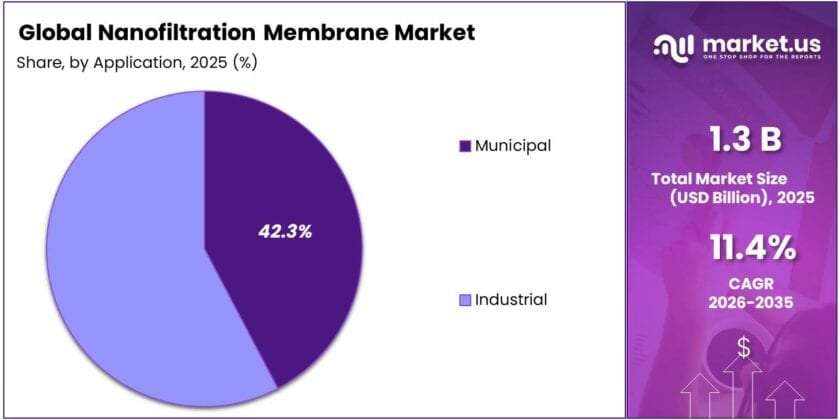
New York, NY – Sep 22, 2026 – The global Nanofiltration Membrane Market is moving into a stronger growth phase as utilities and industries increase spending on water reuse, drinking-water purification, brackish-water treatment, and selective contaminant removal. The market was valued at USD 1.3 billion in 2025 and is projected to reach about USD 3.9 billion by 2035, growing at an 11.4% CAGR. Polymeric membranes accounted for 78.5%, spiral-wound modules represented 55.6%, and industrial applications held 57.7%. Asia Pacific led regional demand with a 43.5% share.
Nanofiltration sits between ultrafiltration and reverse osmosis and is used to remove hardness, color, organic compounds, multivalent ions, and selected emerging contaminants. The U.S. EPA identifies nanofiltration as useful for removing hardness, synthetic organic chemicals, odor compounds, and some disinfection-by-product precursors. Water scarcity and reuse are strengthening the commercial case. The World Bank estimates potable and industrial water reuse could expand 8-fold to 430 million cubic meters per day by 2040, potentially unlocking USD 340 billion in investment.
Key Takeaways
- The global Nanofiltration Membrane Market reached USD 1.3 billion in 2025 and is expected to reach approximately USD 3.9 billion by 2035, registering an 11.4% CAGR.
- Polymeric membranes dominated the membrane-type category with 78.5% of total market share in 2025.
- Spiral-wound modules accounted for approximately 55.6% of market revenue due to compact construction and high membrane packing density.
- Industrial applications held the leading position with 57.7% of nanofiltration membrane demand.
- Asia Pacific remained the dominant regional market, accounting for approximately 43.5% of global consumption in 2025.
- The World Bank estimates municipal and industrial water reuse could reach 430 million m³ per day by 2040, supporting long-term membrane demand.
Regional Analysis
Asia Pacific Leads with 43.5% Share as Water Reuse Investment Expands
Asia Pacific dominated the Nanofiltration Membrane Market in 2025, accounting for approximately 43.5% of global consumption. Rapid industrial activity, large urban populations, wastewater treatment requirements, and growing pressure on freshwater resources are supporting membrane installations across municipal and industrial facilities.
Regional water infrastructure requirements remain significant. The Asian Development Bank estimated in its 2025 outlook that Asia and the Pacific needs around USD 4 trillion of investment in water, sanitation, and hygiene infrastructure through 2040. The region also accounts for approximately 41% of global flood events, increasing interest in resilient and diversified water supplies.
China provides a clear example of expanding reuse. Government data released in May 2026 showed that Chinese cities used more than 22 billion cubic meters of recycled water during 2025. The country has also implemented leakage-control programs in 50 key cities, sponge-city pilots in 60 cities, and more than 10,000 sponge-city projects nationwide. These developments create opportunities for nanofiltration in industrial reuse, water softening, wastewater polishing, and higher-quality reclaimed-water production.
Market Dynamics
Driver – Water Scarcity and Wastewater Reuse Increase Membrane Demand
Water scarcity and the push for reuse are major drivers for nanofiltration membranes. UN-Water reported that 42% of household wastewater was not safely treated in 2022, equal to about 113 billion cubic meters released with inadequate or no treatment. Industrial treatment also remains limited, with only 27% of reported industrial wastewater safely treated across 22 reporting countries. This creates demand for selective treatment technologies capable of recovering usable water while removing hardness, dissolved organics, and multivalent ions. The World Bank estimates potable and industrial reuse could reach 430 million cubic meters per day by 2040, strengthening the long-term project pipeline.
Trend – PFAS and Micropollutant Treatment Moves into Focus
Tighter drinking-water standards are pushing nanofiltration toward more selective contaminant removal. The U.S. EPA maintains federal limits of 4.0 parts per trillion for PFOA and PFOS, while its May 2026 proposal could provide eligible systems additional compliance time to 2031. EPA technical guidance specifically covers reverse osmosis and nanofiltration for PFAS removal. Europe also began applying drinking-water PFAS limits in January 2026, including 0.1 µg/L for Sum of PFAS and 0.5 µg/L for PFAS Total. These rules encourage tighter membranes, monitoring, pretreatment, and advanced residual-management solutions.
Restraint – Fouling and Concentrate Management Raise Lifecycle Costs
Fouling, scaling, and concentrate disposal remain important restraints for nanofiltration projects. EPA technical guidance notes that membrane systems require pretreatment and periodic cleaning, while higher recovery can raise dissolved-solids concentration, pressure requirements, and scaling risk. Reported RO/NF recovery rates for PFAS treatment range from 78% to 92%. This means facilities still generate concentrated residual streams that require safe handling. EPA identifies the volume of membrane residuals as a known barrier to wider membrane adoption, particularly when contaminants become concentrated in reject water. Cleaning chemicals, membrane replacement, energy consumption, and disposal can therefore weaken project economics where feedwater quality is difficult.
Opportunity – Public Funding Expands Water Reuse Infrastructure
Government-backed water-reuse programs create a strong opportunity for nanofiltration suppliers. In 2025, EPA reported that more than USD 7.8 billion had been made available for federal reuse-infrastructure investment since 2020, while USD 75 million supported advanced desalination and reuse research. In November 2025, EPA announced USD 6.5 billion of available WIFIA financing for water systems plus another USD 550 million for states. Europe is also promoting water efficiency, with its Water Resilience Strategy targeting at least a 10% improvement by 2030. These programs create opportunities for modular NF systems serving municipal treatment, industrial recycling, and advanced purification.
Emerging Trends
1. PFAS-Focused Membrane Treatment
Nanofiltration is gaining attention for emerging-contaminant treatment as drinking-water limits become stricter. U.S. EPA standards maintain PFOA and PFOS limits at 4.0 ppt, strengthening demand for advanced membrane systems where conventional treatment cannot consistently achieve required contaminant reductions.
2. Rapid Expansion of Water Reuse
Water reuse is becoming a mainstream supply strategy. The World Bank estimates potable and industrial reuse could expand 8-fold to 430 million m³ per day by 2040, creating opportunities for nanofiltration as a selective polishing and mineral-management step.
3. Higher-Recovery Membrane Systems
Membrane developers are working toward greater recovery while controlling scaling and fouling. EPA-reviewed RO/NF treatment studies reported water recovery ranging from 78% to 92%, showing the potential for high water recovery when pretreatment and operating conditions are properly managed.
4. Modular Spiral-Wound Configurations
Compact, modular designs are becoming important for industrial and municipal installations. Spiral-wound modules already account for 55.6% of the Nanofiltration Membrane Market, while EPA notes that drinking-water RO/NF systems commonly use spiral-wound membrane elements arranged within pressure vessels.
5. Asia Pacific Circular-Water Investment
Asia Pacific is placing more focus on circular water systems. Chinese cities reused more than 22 billion m³ of water in 2025, while ADB estimates the wider region requires approximately USD 4 trillion in WASH investment through 2040.
Use Cases
1. Drinking-Water Softening
Nanofiltration is used to reduce calcium, magnesium, color, odor compounds, and selected organic contaminants. EPA guidance states that NF efficiently targets hardness, while typical NF membrane separation occurs around 0.001–0.006 µm, allowing selective removal without complete desalination.
2. Industrial Wastewater Reuse
Industrial plants can use NF to recover process water while reducing dissolved contaminants. UN-Water found only 27% of reported industrial wastewater was safely treated among 22 countries, demonstrating substantial room for improved treatment and reuse infrastructure.
3. Brackish-Water Treatment
Nanofiltration can support partial desalination and hardness reduction for brackish groundwater. USGS reported 649 active U.S. desalination plants with treatment capacity of 402 million gallons per day, and more than 95% of U.S. desalination facilities were inland.
4. PFAS Removal
NF systems can separate PFAS and other dissolved contaminants from drinking water. EPA’s technical assessment evaluates RO/NF treatment and reports membrane-system recovery rates between 78% and 92%, depending on source water, system design, and treatment configuration.
5. Reclaimed-Water Production
Nanofiltration can act as an advanced polishing step where reclaimed water requires higher quality. Europe currently reuses around 1 billion m³ of treated urban wastewater annually, while the European Commission estimates roughly 6 times more could potentially be reused.
Frequently Asked Questions on Nanofiltration Membrane Market
What is a nanofiltration membrane?
A nanofiltration membrane is a pressure-driven separation technology positioned between ultrafiltration and reverse osmosis. It selectively removes hardness, multivalent ions, organic molecules, color, and certain contaminants while allowing some smaller monovalent ions to pass through treated water.
How large is the Nanofiltration Membrane Market?
The global Nanofiltration Membrane Market was valued at approximately USD 1.3 billion in 2025 and is forecast to reach nearly USD 3.9 billion by 2035, expanding at an estimated 11.4% CAGR.
Which membrane type dominates the market?
Polymeric nanofiltration membranes held the leading market position in 2025 with approximately 78.5% share. Their use is supported by flexible module designs, scalable production, chemical versatility, and suitability for municipal and industrial water-treatment systems.
Which application leads the Nanofiltration Membrane Market?
Industrial applications represented approximately 57.7% of nanofiltration membrane utilization in 2025. Industrial users apply membrane systems for process-water purification, wastewater recycling, hardness reduction, contaminant separation, and improved water efficiency across manufacturing operations.
Which region dominates the Nanofiltration Membrane Market?
Asia Pacific led the global market with approximately 43.5% share in 2025. Regional demand is supported by industrialization, urban water requirements, wastewater reuse, and large infrastructure needs across major manufacturing and population centers.
Why is water reuse important for future market growth?
Water reuse provides a reliable additional supply for industries and cities. The World Bank estimates potable and industrial reuse could increase 8-fold by 2040 to 430 million m³ per day, potentially unlocking USD 340 billion of investment.
What limits wider adoption of nanofiltration?
The main operating challenges include membrane fouling, scaling, pretreatment requirements, concentrate disposal, cleaning, and membrane replacement. EPA-reviewed membrane studies show recovery rates ranging from 78% to 92%, leaving a residual stream that still requires management.
Conclusion
The Nanofiltration Membrane Market is positioned for steady expansion as governments and industries focus on water reuse, contaminant removal, industrial recycling, and more efficient freshwater management. The market is projected to increase from USD 1.3 billion in 2025 to USD 3.9 billion by 2035, supported by an 11.4% CAGR. Polymeric membranes, spiral-wound modules, industrial treatment, and Asia Pacific currently form the leading market segments. At the same time, tighter PFAS rules and growing reuse investment are creating new requirements for selective treatment. Future development will increasingly focus on higher recovery, fouling resistance, lower operating pressure, modular equipment, and safer concentrate management.
Discuss your needs with our analyst
Please share your requirements with more details so our analyst can check if they can solve your problem(s)