Overview
New York, NY – Sep 09, 2026 – The global Power Distribution Unit Market is gaining importance as data centers, telecom networks, laboratories, commercial buildings, and industrial facilities require safer and more reliable electricity distribution. Power distribution units, or PDUs, deliver electricity to servers, networking equipment, computers, test systems, and other rack-mounted devices while helping operators monitor loads and improve power control.
- The market is projected to increase from USD 4.9 billion in 2025 to around USD 15.6 billion by 2035, expanding at a CAGR of 12.2%. Growth is being supported by cloud computing, artificial intelligence, high-density server racks, 5G networks, automation, and stronger attention to energy efficiency. U.S. Department of Energy data show that American data centers used about 176 TWh of electricity in 2023, equal to 4.4% of national electricity consumption, with usage projected to reach 325–580 TWh by 2028.CAGR of 12.2%
This rapid increase is encouraging demand for switched, monitored, three-phase, and intelligent PDUs that provide remote control, outlet-level visibility, overload alerts, and capacity planning. North America currently leads the market, while Asia Pacific is expected to expand quickly as digital infrastructure and data-center investment continue growing. These systems are becoming a core part of resilient, efficient, managed infrastructure worldwide today.
Key Takeaways
- The global Power Distribution Unit Market is projected to grow from USD 4.9 billion in 2025 to approximately USD 15.6 billion by 2035, registering a 12.2% CAGR.
- Switched PDUs led the type segment with more than a 22.0% share, supported by remote outlet control and easier equipment management.
- Three-phase PDUs accounted for more than 58.0% of the market as large data centers and high-density facilities required greater power-handling capacity.
- The 120–240 V category held more than a 55.0% share, reflecting its broad use across server racks, telecom equipment, and enterprise IT infrastructure.
- Data centers represented the leading application with more than a 49.0% share, driven by cloud, AI, colocation, and hyperscale computing expansion.
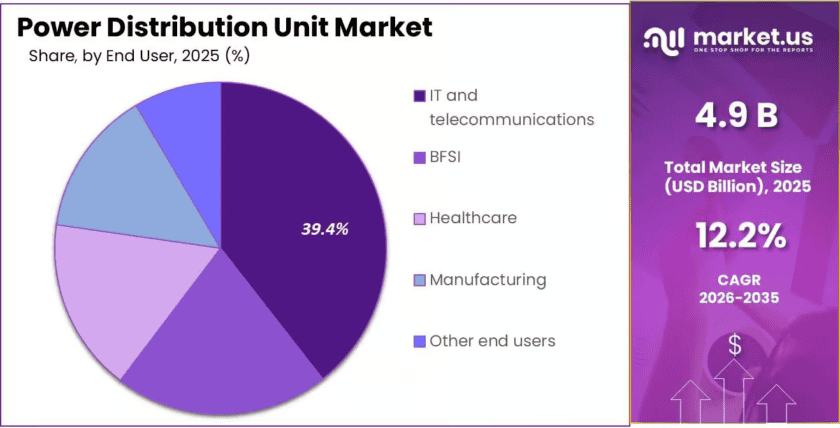
- IT and telecommunications dominated end-user demand with more than a 51.0% share, while North America led geographically with more than 35.0% of the global market.
Regional Analysis
In 2025, North America held a dominant market position, capturing more than a 35.0% share. Applying this share to the stated global value of USD 4.9 billion implies regional revenue of approximately USD 1.72 billion. The region benefits from extensive data-center, cloud, telecom, and AI infrastructure. EIA reported that data-center servers accounted for an estimated 7% of U.S. commercial-sector electricity consumption in 2025, showing the growing power requirements that support demand for intelligent and high-capacity PDUs.
Asia Pacific is the fastest-growing regional segment. The referenced report states that 5G covered around 70% of the region’s population in 2025, while mobile-broadband penetration reached 101 subscriptions per 100 inhabitants. China’s data-center electricity consumption is also expected to increase substantially through 2030, while Southeast Asian data-center power demand is expected to more than double. These developments are increasing requirements for rack-level power distribution across hyperscale facilities, telecom networks, edge sites, and enterprise computing environments.
Market Dynamics
Driver – Rapid Data-Center Power Growth
Rapid data-center power growth is the strongest demand driver for PDUs. The U.S. Department of Energy reported that data centers consumed about 176 TWh of electricity in 2023, representing 4.4% of total U.S. electricity use. Consumption could rise to 325–580 TWh by 2028 as AI, cloud computing, and high-performance computing expand. More electrical load means more racks, circuits, redundancy, and monitoring points. This increases demand for three-phase, switched, metered, and intelligent PDUs that can distribute power safely, track rack-level usage, warn operators about overloads, and support better capacity planning across hyperscale, colocation, enterprise, and edge computing facilities globally today.
Trend – Intelligent and Energy-Efficient PDUs
Intelligent and energy-efficient PDUs are becoming more important as operators seek better visibility into electricity use. ENERGY STAR states that electrical distribution system losses can account for around 10%–12% of total data-center energy consumption. It also notes that PDUs using high-efficiency transformers can be 2%–3% more efficient than units with generic lower-efficiency transformers. Smart PDUs can monitor current, outlet-level consumption, event logs, and remotely switch connected equipment. As data-center energy costs rise, buyers are moving beyond basic power strips toward connected systems that support efficiency benchmarking, PUE calculations, load balancing, fault alerts, predictive maintenance, and remote management worldwide today.
Restraint – Grid and Skilled-Labor Constraints
Grid delays and shortages of skilled electrical workers can slow PDU deployment even when data-center demand is strong. FERC has highlighted more than 2,000 GW of energy resources waiting in interconnection queues, with wait times exceeding five years. The U.S. Bureau of Labor Statistics also projects about 81,000 electrician openings each year over the coming decade. These constraints can delay data-center energization, equipment installation, testing, commissioning, and expansion work. For PDU suppliers, slower site activation may postpone orders, extend project schedules, raise service costs, and encourage customers to phase purchases instead of installing full planned capacity immediately.
Opportunity – AI and Federal Infrastructure Expansion
Federal support for AI and energy infrastructure creates a clear opportunity for advanced PDU suppliers. The U.S. Department of Energy identified 16 federal sites that could support rapid data-center and related power development, then selected four locations to move forward with private-sector project plans. DOE’s program targeted possible operations by the end of 2027. These projects can require large amounts of rack-level distribution, three-phase power, remote switching, metering, redundancy, and software-based monitoring. Vendors that offer intelligent PDUs, integrated sensors, cybersecurity features, and remote management can participate in new AI campuses while also serving retrofit demand at existing facilities.
Emerging Trends
1. Smart PDU Monitoring
Data-center operators are adopting intelligent PDUs with outlet-level measurement and remote control. ENERGY STAR says electrical distribution losses can represent 10%–12% of data-center energy use, making monitoring valuable for finding waste, balancing loads, and improving efficiency.
2. Higher-Efficiency Power Distribution
ENERGY STAR reports that PDUs with high-efficiency transformers can be 2%–3% more efficient than conventional units. This is encouraging operators to replace older equipment, reduce conversion losses, lower cooling requirements, and improve facility-level power usage effectiveness.
3. AI-Driven Power Density
U.S. data-center electricity use reached 176 TWh in 2023 and could rise to 325–580 TWh by 2028, according to DOE. AI workloads are pushing facilities toward higher-capacity, three-phase PDUs with stronger monitoring, protection, and thermal-management capabilities.
4. On-Site Power Integration
DOE says individual data-center sites may request up to 4.5 GW of power. This is increasing interest in microgrids, dedicated generation, storage, and grid-interactive controls, creating demand for PDUs that coordinate power across multiple energy sources.
5. Connected-Device Cybersecurity
Intelligent PDUs function as networked operational-technology assets. NIST’s Cybersecurity Framework 2.0 organizes cyber-risk management around 6 functions, encouraging PDU buyers to prioritize secure access, firmware management, device inventories, monitoring, incident response, and recovery alongside electrical performance.
Use Cases
1. Data Centers
PDUs distribute power to servers, storage, and network equipment while supporting monitoring and redundancy. DOE estimates U.S. data centers used 176 TWh in 2023, showing why reliable rack-level distribution is essential as computing loads continue to expand.
2. Telecommunications
PDUs support routers, switches, base-station equipment, network rooms, and edge computing sites. FCC data show about 95% of the U.S. population had access to at least one 5G-NR provider by June 2025, expanding powered communications infrastructure requirements nationwide.
3. Hospitals
Healthcare facilities use PDUs for server rooms, imaging systems, laboratory equipment, communications, and electronics. CMS’s April 2026 hospital quality dataset covered 4,609 hospitals, illustrating the installed base of facilities that depend on reliable electrical infrastructure nationwide.
4. Research Laboratories
PDUs organize and protect power for analytical instruments, computing clusters, testing systems, and controlled environments. NSF reported U.S. academic R&D spending of USD 117.7 billion in FY2024, supporting investment in laboratory equipment and electrical distribution infrastructure.
5. Industrial Facilities
Factories use PDUs to distribute electricity to automation, control cabinets, computing equipment, test stations, and network devices. EIA recorded 1,042,217 thousand MWh of U.S. industrial electricity sales in 2025, highlighting the scale of industrial operations.
Frequently Asked Questions on Power Distribution Unit and Power Distribution Unit Market
1. What is a Power Distribution Unit (PDU)?
A Power Distribution Unit is electrical equipment that distributes power to multiple devices from one source. In data centers, PDUs supply servers, storage, and networking hardware while advanced models also provide metering, remote switching, alarms, and outlet-level monitoring.
2. How is a PDU different from a normal power strip?
A basic PDU may resemble a power strip, but data-center PDUs are designed for higher loads, rack installation, reliability, and monitoring. Intelligent models can measure current, record events, issue alerts, and remotely switch individual outlets for better operational control.
3. What is driving the Power Distribution Unit Market?
Market growth is mainly driven by data-center expansion, AI computing, cloud services, telecom infrastructure, and higher rack power requirements. DOE reported U.S. data centers consumed about 176 TWh in 2023 and could reach 325–580 TWh by 2028.
4. How large is the Power Distribution Unit Market?
The referenced Market.us report values the global Power Distribution Unit Market at USD 4.9 billion in 2025 and projects approximately USD 15.6 billion by 2035, representing a 12.2% compound annual growth rate during the forecast period.
5. Which PDU type leads the market?
According to the referenced Market.us report, switched PDUs held the leading position in 2025 with more than a 22% share. Their remote outlet control helps operators restart equipment, manage loads, and reduce the need for physical intervention.
6. Which application is the largest for PDUs?
Data centers were the largest application in the referenced market analysis, accounting for more than a 49% share in 2025. Their large server populations, continuous uptime requirements, redundancy needs, and rising AI loads support strong PDU deployment.
7. Why are intelligent PDUs becoming popular?
Intelligent PDUs give operators detailed power visibility and remote control. ENERGY STAR notes that electrical distribution losses can represent about 10%–12% of data-center energy consumption, so monitoring, load balancing, and efficiency management can create meaningful operational savings.
8. Why are three-phase PDUs important?
Three-phase PDUs are useful where racks and facilities carry higher electrical loads because they distribute power across three phases and support more efficient capacity use. The referenced Market.us report shows three-phase units held more than 58% share in 2025.
9. Which region leads the Power Distribution Unit Market?
North America led the referenced market analysis with more than a 35% share in 2025, supported by major data-center, cloud, telecom, and AI infrastructure. Applying that share to the stated USD 4.9 billion global value implies roughly USD 1.72 billion.
10. What could restrain growth in the PDU market?
Grid interconnection delays, electrical labor shortages, component availability, and project timing can slow installations. FERC has cited more than 2,000 GW of resources waiting in interconnection queues, while BLS projects about 81,000 electrician openings annually.
Conclusion
The Power Distribution Unit Market is positioned for strong growth as data centers, AI computing, telecom networks, laboratories, healthcare facilities, and industrial sites require more reliable and measurable electricity distribution. Market.us projects the market to rise from USD 4.9 billion in 2025 to USD 15.6 billion by 2035 at a 12.2% CAGR. Government data also show rapid growth in data-center electricity demand, supporting greater use of intelligent, switched, efficient, and three-phase PDUs. Although grid delays, labor shortages, and component constraints can slow deployment, opportunities remain strong in smart monitoring, high-density computing, microgrids, federal AI infrastructure, and energy-efficiency retrofits worldwide today.
Discuss your needs with our analyst
Please share your requirements with more details so our analyst can check if they can solve your problem(s)