Overview
New York, NY – Oct 01, 2026 – The global Cotton Processing Market is expanding as textile manufacturers, ginning facilities, cottonseed processors, and exporters invest in automated equipment, fibre-quality control, contamination removal, and efficient material handling. The market was valued at USD 84.8 billion in 2025 and is projected to reach approximately USD 136.3 billion by 2035, growing at a 4.9% CAGR from 2026 to 2035.
Cotton processing covers ginning, drying, cleaning, lint separation, baling, cottonseed handling, carding, and preparation for spinning. USDA reported global cotton production of about 121.95 million 480-pound bales in 2025/26, up around 2% year over year, providing a large raw-material base for processing operations.
Demand from spinning mills remains equally important. USDA’s September 2026 outlook projects global cotton mill use at 122.9 million bales in 2026/27, representing a 1.5% increase and the highest level in six years.
Automation is also changing cotton ginning. USDA Agricultural Research Service-developed computerized process-control systems are already used in more than 80 installations, collectively processing above 2 million bales annually, highlighting the growing role of sensors and automated quality management.
Key Takeaways
- The global Cotton Processing Market was valued at USD 84.8 billion in 2025 and is projected to reach around USD 136.3 billion by 2035, expanding at a 4.9% CAGR.
- Lint held a dominant market position in 2025, capturing more than 68.00% share, reflecting its central role as the primary fibre supplied to spinning and textile manufacturing.
- Ginning Equipment accounted for more than 28.50% share, supported by its essential role in separating lint from cottonseed and cleaning raw cotton.
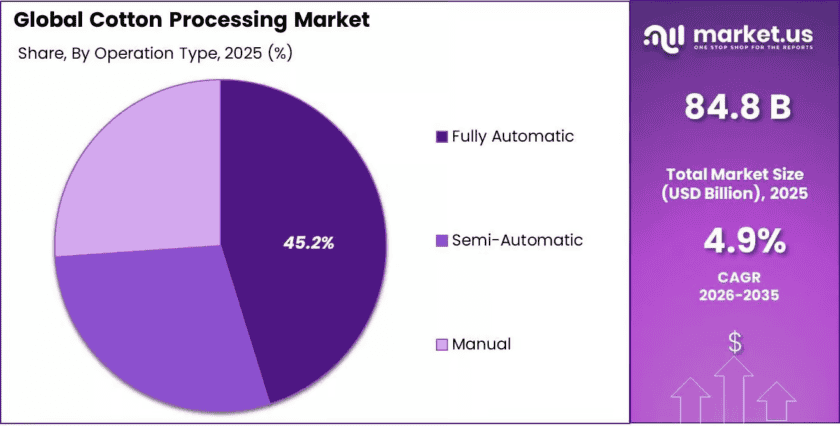
- Fully Automatic systems held more than 45.20% share as processors increasingly adopted automated handling, moisture control, cleaning, and baling technologies.
- Textile Manufacturing dominated the application segment with more than 59.00% share, supported by substantial global spinning and apparel demand.
- Direct Sales represented more than 64.50% share of the distribution channel segment as large processors commonly procure machinery directly from equipment manufacturers and system integrators.
- Asia Pacific led the market with more than 54.20% share, generating approximately USD 45.9 billion in 2025.
Regional Analysis
Asia Pacific Leads with 54.20% Share and USD 45.9 Billion Revenue
In 2025, Asia Pacific held a dominant Cotton Processing Market position, capturing more than 54.20% share and generating approximately USD 45.9 billion. The region benefits from extensive cotton cultivation, large spinning industries, textile manufacturing capacity, export-oriented apparel production, and significant investment in ginning and fibre-processing infrastructure.
The importance of Asian textile processing can also be seen in global mill-use patterns. USDA projects worldwide cotton mill use at 122.9 million bales in 2026/27, up 1.5% from the previous season. China alone is expected to represent around 34% of global cotton consumption, highlighting the scale of fibre-processing requirements in the region.
Global supply remains substantial. USDA reported worldwide cotton production of approximately 121.95 million bales in 2025/26, compared with 119.53 million bales in 2024/25, representing growth of around 2%.
These volumes require large-scale ginning, drying, cleaning, contamination removal, baling, fibre classification, storage, and downstream spinning infrastructure. Continued modernization of processing plants, together with rising textile consumption and tighter fibre-quality requirements, is supporting investment in automated equipment throughout the region.
Market Dynamics
Driver – Rising Global Cotton Mill Consumption
Growing textile demand continues to drive cotton processing activity. USDA projects global cotton mill use at 122.9 million bales in 2026/27, an increase of 1.8 million bales, or 1.5%, from the previous year and the highest level in six years. Higher spinning demand creates greater requirements for properly cleaned, dried, classified, and baled lint.
Cotton processors therefore remain closely linked with textile manufacturing capacity and fibre-quality requirements. In the United States, apparent retail cotton use reached about 8.3 billion pounds in 2025, equivalent to roughly 17.3 million 480-pound bales, demonstrating the continuing scale of downstream cotton-product consumption.
Trend – Increasing Automation in Cotton Ginning
Automation is becoming a major processing trend as operators seek consistent fibre quality and lower dependence on manual adjustments. USDA Agricultural Research Service developed computerized gin process-control technology that automatically measures cotton quality and selects suitable processing sequences.
More than 80 systems are reported to be operating, processing over 2 million bales annually. ARS estimates that computerized controls can increase returns by around USD 10 to USD 20 per bale, demonstrating the economic value of sensors, automatic valves, moisture monitoring, and data-driven process optimization. This trend supports increasing adoption of fully automatic ginning and handling systems across modern processing facilities.
Restraint – Weak Mill Demand and Cotton Dust Management
Processing investment can be limited when textile mill activity weakens. USDA estimated U.S. cotton mill use at only 1.6 million bales in 2025/26, its lowest level in more than 145 years, with synthetic-fibre competition and overseas spinning capacity affecting domestic demand. Workplace dust management also increases operating requirements.
OSHA limits lint-free respirable cotton dust in yarn manufacturing and cotton washing operations to 200 micrograms per cubic metre averaged over eight hours, with an action level of 100 micrograms per cubic metre. These requirements encourage dust extraction and monitoring but can increase compliance, maintenance, and equipment costs.
Opportunity – Automated Quality Control and By-Product Recovery
Cotton processors have an opportunity to generate more value through automation, higher fibre recovery, and improved cottonseed utilization. USDA ARS estimates computerized gin-control systems can improve returns by approximately USD 10–20 per bale, while existing systems already process more than 2 million bales annually.
Cottonseed also provides an important secondary revenue stream alongside lint. The supplied market source reports U.S. cottonseed production of about 4.13 million tons in 2025, with approximately half directed toward oil mills and the remainder serving feed, seed, export, and other uses. This supports investment in seed cleaning, conveying, crushing, storage, and value-added processing systems.
Emerging Trends
1. Automated Gin Process Control
Cotton gins are increasingly using sensors and computerized controls. USDA ARS reports more than 80 computerized process-control systems are already processing above 2 million bales annually, helping operators automatically adjust machine sequences according to fibre condition and quality.
2. Higher Global Mill Consumption
Global cotton processing is receiving support from stronger mill demand. USDA expects mill consumption to reach 122.9 million bales in 2026/27, rising 1.5% and marking the fourth consecutive annual increase in worldwide cotton mill use.
3. Greater Focus on Fibre Quality
Processing plants are placing greater attention on moisture, contamination, and lint quality. USDA ARS says computerized gin systems can improve processor and grower returns by around USD 10–20 per bale through better machine routing and quality preservation.
4. Cottonseed Value Recovery
Processors are increasingly treating cottonseed as an important co-product rather than waste. U.S. cottonseed production reached approximately 4.13 million tons in 2025, creating opportunities in livestock feed, oil extraction, planting seed, storage, and industrial processing.
5. Workplace Dust-Control Technology
Dust extraction and monitoring remain important in downstream cotton processing. OSHA sets an 8-hour limit of 200 µg/m³ for lint-free respirable cotton dust in yarn manufacturing and cotton washing, encouraging investment in ventilation and filtration systems.
Use Cases
1. Cotton Ginning
Ginning separates usable lint from cottonseed before fibre moves into textile manufacturing. Global cotton production reached approximately 121.95 million bales in 2025/26, creating substantial demand for gins, cleaners, dryers, conveyors, balers, and related processing systems.
2. Textile and Yarn Manufacturing
Processed lint is primarily supplied to spinning and textile mills. USDA projects global cotton mill use at 122.9 million bales in 2026/27, reflecting the large volume of fibre requiring cleaning, classing, blending, carding, and spinning preparation.
3. Cottonseed Oil Processing
Cotton ginning also produces cottonseed for secondary processing. Around 4.13 million tons of U.S. cottonseed were produced in 2025, creating a significant material stream for crushing, edible oil production, feed products, seed preparation, and industrial uses.
4. Fibre Quality Optimization
Automated systems are used to measure fibre conditions and optimize gin-machine settings. USDA ARS reports more than 80 control systems process over 2 million bales annually, with potential gains of roughly USD 10–20 per bale.
5. Cotton Waste Processing
Cotton waste can be sorted, blended, cleaned, recycled, and returned to fibre applications. OSHA specifically recognizes waste-processing activities including sorting, blending, cleaning, and willowing, while applying defined occupational controls to reduce worker exposure during such operations.
Frequently Asked Questions on Cotton Processing and Cotton Processing Market
What is the Cotton Processing Market size?
The global Cotton Processing Market was valued at USD 84.8 billion in 2025 and is expected to reach approximately USD 136.3 billion by 2035, expanding at a 4.9% CAGR between 2026 and 2035.
What is cotton processing?
Cotton processing includes drying, cleaning, ginning, lint separation, baling, classing, cottonseed handling, carding, and fibre preparation. These operations convert harvested seed cotton into usable lint, cottonseed, and other materials for textile and industrial applications.
Which product type dominated the market in 2025?
Lint held the largest share of the Cotton Processing Market in 2025, accounting for more than 68.00%. Its dominance is supported by extensive use in yarn spinning, fabrics, apparel, furnishings, and other textile applications.
Which equipment segment held the largest market share?
Ginning Equipment dominated the equipment category in 2025 with more than 28.50% share. These machines form the core of cotton processing because they separate lint from seed and prepare fibre for cleaning and baling.
Which operation type dominates cotton processing?
Fully Automatic systems held more than 45.20% market share in 2025. Automated equipment improves consistency, material flow, moisture management, quality monitoring, and processing speed while helping modern facilities reduce dependence on continuous manual machine adjustment.
Which application leads the Cotton Processing Market?
Textile Manufacturing accounted for more than 59.00% market share in 2025, making it the leading application. Cotton lint remains an important raw material for spinning, weaving, knitting, apparel, household textiles, and other fibre-based products.
Which region dominates the Cotton Processing Market?
Asia Pacific led the Cotton Processing Market in 2025 with more than 54.20% share, representing around USD 45.9 billion in revenue, supported by substantial cotton processing and textile manufacturing infrastructure.
How large is global cotton production?
USDA reported global cotton production at approximately 121.95 million 480-pound bales in 2025/26, about 2% higher than the previous marketing year, providing a substantial raw-material base for worldwide cotton processing facilities.
What are the main challenges in cotton processing?
Important challenges include volatile raw-cotton supply, fibre contamination, energy requirements, weak mill utilization, synthetic-fibre competition, and occupational dust. OSHA limits respirable cotton dust to 200 µg/m³ over eight hours in specified textile operations.
What is the future outlook for cotton processing?
The outlook is supported by automation and global textile demand. USDA forecasts worldwide mill use at 122.9 million bales in 2026/27, while the Cotton Processing Market is projected to reach USD 136.3 billion by 2035.
Conclusion
The Cotton Processing Market is entering a steady modernization phase as processors adopt automation, quality sensors, efficient ginning equipment, and improved cottonseed recovery systems. The market is forecast to grow from USD 84.8 billion in 2025 to USD 136.3 billion by 2035, registering a 4.9% CAGR. Asia Pacific leads with 54.20% share and USD 45.9 billion in revenue.
Global mill consumption is also projected to reach 122.9 million bales in 2026/27, supporting processing volumes. Future investment is expected to focus on automation, contamination control, fibre-quality preservation, dust management, energy efficiency, and greater value recovery from cottonseed and other processing by-products.
Discuss your needs with our analyst
Please share your requirements with more details so our analyst can check if they can solve your problem(s)