Report Overview
In 2025, the Global Nano Bubbles Market was valued at USD 240.4 million. Between 2026 and 2035, the market is projected to expand at a CAGR of 8.6%, reaching approximately USD 545.8 million by 2035. Asia Pacific maintained a leading position in the global market, accounting for more than 43% of the market share and generating revenue of USD 103.4 million.
The nano bubbles industry focuses on technologies and generators designed to introduce air, oxygen, ozone, nitrogen, and other gases into liquids for applications across water treatment, agriculture, aquaculture, healthcare, food processing, and industrial cleaning. The United States Department of Agriculture defines nanobubbles as gas-filled cavities measuring less than 1 micrometre in diameter. Their extended residence time and efficient gas-transfer characteristics are supporting the adoption of hydrodynamic cavitation, pressurized dissolution, electrolysis, and ultrasonic technologies. These systems are increasingly utilized in municipal and industrial operations to improve process efficiency, control, and consistency.
In 2024, the United States Department of Energy provided USD 2.5 million to a University of Tennessee project focused on using oxygen nanobubbles in water resource recovery facilities. The pilot project is designed to process 200 litres per day for 6 weeks, while targeting reductions of 70% in aeration energy and 30% in mixing energy. The initiative also aims to achieve at least 50% overall energy and cost savings under realistic wastewater treatment operating conditions, demonstrating the potential of nanobubble technology to improve energy efficiency in water-resource management.
Aquaculture represents another important application area for nano bubble technology. In June 2024, the Food and Agriculture Organization reported record global aquaculture production of 130.9 million tonnes in 2022, including 94.4 million tonnes of aquatic animals. This volume represented 51% of total aquatic animal production. The growing scale of aquaculture operations is creating additional demand for efficient oxygenation technologies capable of supporting aquatic animal health and improving production conditions.
Further evidence of aquaculture expansion came in December 2024, when the United States Department of Agriculture reported USD 1.9 billion in aquaculture sales across 3,453 farms during 2023. The number of farms increased by 18% from 2018, reinforcing the need for efficient oxygenation and water-management equipment across aquaculture facilities worldwide.
Government funding and the development of technical standards are also creating additional opportunities for the nano bubbles industry. In October 2024, the United States Environmental Protection Agency announced USD 6.2 billion in fiscal 2025 water-infrastructure investment aimed at upgrading drinking water and wastewater systems. Such investments can support the deployment of advanced treatment technologies, including systems that utilize nanobubbles for aeration, oxygenation, and other water-treatment processes.
Standardization is also contributing to the development and broader acceptance of fine-bubble technologies. The International Organization for Standardization maintains ISO 20480-1:2017, which establishes terminology for fine bubbles, with an amendment issued in 2024. Standardized terminology and technical frameworks can support equipment validation, procurement processes, manufacturing expansion, and greater consistency across applications.
Together, developments in wastewater treatment, aquaculture, agriculture, industrial processing, and water infrastructure are expanding the potential application base for nano bubble technologies. Their use in oxygenation, disinfection, chemical reduction, crop irrigation, and process cleaning provides opportunities across diverse operating environments worldwide.
Key Market Segments
- The global Nano Bubbles market was valued at USD 240.4 million in 2025.
- The global market is projected to grow at a CAGR of 8.6% and is estimated to reach USD 545.8 million by 2035.
- On the basis of gas type, oxygen nano bubbles dominated the market, constituting 39% of the total market share.
- Based on technology type, hydrodynamic cavitation dominated the nano bubbles market, with a substantial market share of around 34%.
- Based on application, water treatment led the market, comprising 36% of the total market share.
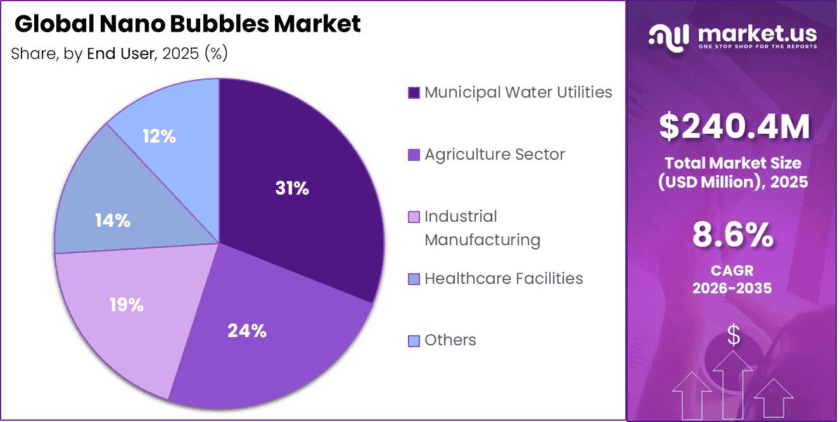
- Among end users, municipal water utilities held a major share in the nano bubbles market, accounting for 31% of the market share.
- Among bubble size types, below 100 nm represented the dominant segment, accounting for around 58% of the revenue share.
- Based on distribution channel, direct/B2B sales dominated the market, capturing approximately 76% of the total market share.
- In 2025, Asia-Pacific was the most dominant region in the nano bubbles market, accounting for 43% of the global market share.
Gas Type Analysis
Oxygen Nano Bubbles dominate with 39.00% due to reliable oxygen delivery across water and treatment applications.
In 2025, Oxygen Nano Bubbles maintained a leading position in the market, accounting for more than a 39.00% share. Their dominance was supported by increasing utilization across municipal water treatment, aquaculture, irrigation, and industrial process applications. These bubbles facilitate efficient gas transfer, remain suspended within liquids for extended periods, and assist facilities in maintaining consistent dissolved oxygen levels. Their ability to integrate with existing circulation systems further encourages adoption across treatment plants and industrial sites. Demand remained strong as operators sought to enhance biological activity and water quality without requiring extensive infrastructure modifications.
- For instance, in August 2025, a New Jersey Institute of Technology team delivered an industrial-grade ozone nanobubble system to a New Jersey farm for field testing, demonstrating growing interest in advanced nanobubble treatment technologies.
Ozone Nano Bubbles are projected to be the fastest-growing segment. Their growth is being driven by increasing requirements for oxidation, disinfection, odour management, and algae control across food processing, healthcare, wastewater treatment, and industrial cleaning applications. Their efficient delivery of ozone into water makes them particularly valuable for sanitation processes and applications aimed at reducing reliance on conventional chemicals.
Technology Type Analysis
Hydrodynamic Cavitation dominates with 34.00% because it enables continuous and scalable nanobubble generation.
In 2025, Hydrodynamic Cavitation held a dominant market position, capturing more than a 34.00% share. Its leadership was strengthened by its practical compatibility with pumps, venturi devices, and recirculation systems deployed across water treatment, aquaculture, agriculture, and industrial processing operations. The technology generates nanobubbles through controlled pressure variations and fluid movement, enabling continuous operation without requiring complex electrical components within the treatment stream. This makes it particularly suitable for high-volume facilities requiring consistent output, adaptable installation, and dependable operation under variable flow conditions.
- For instance, in October 2025, a review published in the Journal of Water Process Engineering identified hydrodynamic cavitation as the most common approach for large-scale nanobubble generation because of its straightforward equipment requirements, continuous operation, and lower energy consumption.
Ultrasonic Generation is projected to be the fastest-growing segment. Expansion is supported by its ability to provide precise bubble formation, compact system configurations, and applications across laboratory environments, medical processes, cleaning operations, and specialized water-treatment systems. Technology providers are enhancing transducer control and operational stability, supporting broader commercial adoption in demanding environments.
Application Type Analysis
Water Treatment dominates with 36.00% as utilities increasingly seek efficient aeration and contaminant-management solutions.
In 2025, Water Treatment held a dominant market position, capturing more than a 36.00% share. Its leadership was driven by increasing adoption across municipal wastewater treatment, drinking-water support, industrial effluent management, and water-reuse applications. Nano bubbles offer a large contact area within liquids, enabling treatment operators to enhance oxidation, flotation, biological processes, and the removal of challenging contaminants. Compact nanobubble generators can also be integrated with tanks, pipelines, and recirculation loops, making the technology suitable for upgrading existing facilities where space availability is constrained. Growing demand for reduced chemical consumption and more consistent treatment performance further supports adoption.
- For instance, in January 2025, the United States Department of Energy completed its environmental review for a University of Tennessee pilot project demonstrating nanobubble-enhanced aeration in biological wastewater treatment.
Agriculture & Aquaculture is expected to record the fastest growth among application segments. Expansion is being encouraged by increasing interest in root-zone management, irrigation-water conditioning, pond restoration, and controlled aquatic production environments. Farmers and aquaculture operators are evaluating nanobubble systems to promote healthier growing conditions, improve resource utilization, and maintain water quality more consistently across intensive production operations.
End User Analysis
Municipal Water Utilities dominate with 31.00% as municipalities prioritize dependable water-quality management.
In 2025, Municipal Water Utilities occupied a leading position in the market, accounting for more than a 31.00% share. Their dominance reflected the need for dependable technologies capable of supporting treatment networks, reservoirs, distribution infrastructure, and wastewater facilities. Nano bubble equipment provides utility operators with a flexible solution for improving circulation, supporting treatment processes, and addressing challenging water conditions within existing infrastructure. Municipal purchasers also value systems that can be implemented in stages, remotely monitored, and adjusted according to seasonal operational requirements. These characteristics contributed to wider adoption among public water agencies seeking measurable performance and manageable maintenance requirements.
- For instance, in November 2025, the United States Environmental Protection Agency reported that the United States Section of the International Boundary and Water Commission had completed a nanobubble ozonation pilot project for the Tijuana River.
Agriculture Sector is projected to be the fastest-growing end-user segment. Growth is being supported by increasing interest in irrigation management, soil-zone conditioning, greenhouse cultivation, and livestock water systems. Agricultural producers are increasingly assessing compact nanobubble equipment that can enhance water management and support more controlled farm operations.
Bubble Size Type Analysis
Below 100 nm dominates with 58.00% because its small size enables stable dispersion and effective surface interaction.
In 2025, Below 100 nm maintained a dominant market position, capturing more than a 58.00% share. Its strong position was supported by its suitability for precision water treatment, advanced cleaning applications, laboratory processes, and controlled biological operations. Bubbles within this size range remain finely dispersed in liquids, provide extensive contact with the surrounding medium, and can travel through narrow spaces where larger bubbles may be less effective. Equipment manufacturers are focusing on accurate bubble-size control, consistent production, and compact generation technologies, strengthening adoption across specialized installations.
- For instance, in September 2025, a peer-reviewed horticulture study described an electromagnetic nanobubble generator and noted that comparable devices can generate bubbles below 100 nm, demonstrating the practical importance of this size category in controlled cultivation systems.
The 100 to 200 nm segment is expected to register the fastest growth. Its expansion is being supported by improved measurement capabilities, stable operating characteristics, and suitability for commercial applications. This size category provides a balance between fine dispersion and production consistency, supporting increased adoption in irrigation, aquaculture, industrial washing, and process-water management.
Distribution Channel Analysis
Direct/B2B Sales dominate with 76.00% because technical equipment often requires consultation, customization, and installation assistance.
In 2025, Direct/B2B Sales held a dominant market position, accounting for more than a 76.00% share. The channel remained the preferred purchasing route because nanobubble systems are frequently configured according to water-flow rates, gas inputs, treatment capacity, operating conditions, and facility layouts. Suppliers typically work directly with municipal utilities, agricultural operations, industrial facilities, and healthcare organizations to evaluate requirements and recommend suitable generators. Direct engagement also facilitates equipment testing, operator training, maintenance planning, and after-sales support, helping customers minimize installation challenges and achieve consistent system performance.
- For instance, in September 2025, Moleaer partnered with Xylem through a global distribution agreement to expand access to nanobubble technology for municipal and industrial wastewater treatment plants worldwide.
Online Industrial Platforms are expected to be the fastest-growing distribution channel. Their expansion is being supported by simplified product comparisons, greater supplier visibility, faster quotation processes, and convenient access to compact or standardized equipment. As technical specifications become increasingly accessible through online channels, smaller businesses and independent operators can assess available systems, communicate directly with suppliers, and initiate procurement without depending entirely on traditional distributor networks.
Emerging Trends
Expanding Industrial and Clean-Energy Applications
Nanobubble technology is moving well beyond conventional water treatment into advanced manufacturing processes for clean energy. On July 31, 2025, Moleaer Inc. announced a patent-pending method that infuses nanobubbles into thin-film fabrication for batteries, fuel cells, and filtration membranes. Independent validation showed PEM fuel cell cathode catalyst layers achieving up to 20% higher power output, ultrafiltration membranes gaining up to a 66% increase in water permeability, and green hydrogen electrolyzer anode catalyst layers improving current density by 17%. The company also reports over 3,500 systems deployed across more than 55 countries, underscoring how far commercial adoption has already progressed.
Nanobubble Aeration Advancing Recirculating Aquaculture Systems
A pilot-scale study published in the peer-reviewed journal Water on November 11, 2025, demonstrates the growing role of nanobubble aeration in recirculating aquaculture systems (RAS). Over a 35-day trial, researchers at Universitas Padjadjaran found that nanobubble aeration achieved a Total Ammonia Nitrogen (TAN) degradation efficiency of 83.33%, compared to just 50% for conventional coarse-bubble aeration. The nanobubble-treated biofilm also reached a maximum thickness of 172.88 µm and supported 293 × 10⁷ CFU of microbial colonies, versus 89 × 10⁷ CFU under coarse-bubble conditions, while delivering an energy efficiency gain of approximately 7.47%.
Nitrogen Removal Innovation in Aquaculture Wastewater
Beyond ammonia control, nanobubble systems are being paired with novel composite materials to tackle nitrogen pollution directly in aquaculture ponds. A study published on ScienceDirect details a nanobubble generator using hydrodynamic cavitation that produced bubbles with an average diameter of 184.12 nanometers, rapidly raising dissolved oxygen (DO) concentrations to 7.21 mg/L. When combined with an iron-based multi-carbon source composite, the system achieved a Total Nitrogen (TN) removal rate of 89.75%, illustrating how nanobubble integration with complementary materials is pushing wastewater treatment performance higher.
Independent Validation Driving Confidence in Nanobubble Stability
Long-term bubble stability has historically been a technical hurdle, but new validation data is changing buyer confidence. NanoBurstX, developed by Air Fluid Innovation, Inc., uses a chemically initiated ultrafine bubble (CIUB) process that was independently tested at the University of California, Irvine, confirming a mean bubble size of approximately 66 nanometers with stability exceeding 192 hours from a single 3-minute infusion. Additional verification was carried out by NJIT, Cornell University, and Malvern Panalytical, reinforcing that third-party validation is becoming a key differentiator for commercial-grade nanobubble generation methods.
Federal R&D Investment Reinforces Long-Term Technology Development
Government-backed research continues to underpin the technical foundations of the nanobubble sector. A patent filed with the U.S. Patent and Trademark Office for a method to quantify nanobubble reactivity in water discloses that the underlying invention was developed with support from the National Science Foundation under award number 1449500, with the application tracing its priority date to a provisional filing on September 9, 2020. This federal funding trail highlights sustained public-sector investment in the fundamental science needed to standardize how nanobubble performance is measured and verified.
Use Cases
Fresh Produce Washing and Pathogen Control
Food processors are turning to ozone nanobubbles as a residue-free alternative to chemical sanitizers in produce washing lines. According to reporting from Food Safety Magazine, trials conducted with produce present showed that ozone nanobubbles achieved over a 4-log (99.99%) reduction in common foodborne pathogens, performing at least 10 times better — a full 1-log improvement — than traditional chemical sanitizers. Because ozone is already GRAS-approved by the U.S. Food and Drug Administration (FDA) for food-contact surfaces, processors are able to adopt nanobubble delivery without introducing new regulatory hurdles, positioning the technology as a scalable upgrade to existing wash-line infrastructure.
Semiconductor Wafer Cleaning and Nanoparticle Removal
As chip manufacturers push toward smaller process nodes, surface nanobubbles are being applied to remove nanoscale contaminants without the substrate damage caused by mega-sonic or laser-based cleaning methods. Research published in the American Chemical Society journal Langmuir describes how a solvent-water exchange (SWE) process generates nanobubbles on silicon wafer surfaces, with nanoscale testing in 2011 demonstrating a particle removal efficiency (PRE) of up to 90%. The study notes that nanoparticles were removed without damaging the wafer surface, a critical requirement as the global semiconductor market continues its rapid expansion and device geometries shrink further.
Water Reclamation in the Car Wash Industry
Water-intensive service industries are deploying nanobubble technology to extend the usable life of reclaimed water. Field results reported by CarwashPro on February 25, 2026, show that operators integrating nanobubble generators into existing reclaim systems achieved fresh water reductions ranging from thirty-five to fifty percent, with one location reporting savings of approximately three million gallons of water per year. The report also notes that the technology has now been deployed at more than four thousand installations across over fifty-five countries, with typical system installations completed in less than one day.
Mineral Processing and Fine-Particle Flotation
In mineral processing, nanobubbles are being used to improve the recovery of fine and ultrafine particles that conventional flotation struggles to capture. A study on flake graphite flotation, published via the National Center for Biotechnology Information (PMC), found that at a flotation recovery of approximately 73%, the nanobubble-enhanced concentrate reached a grade of about 79%, compared with roughly 70% using traditional flotation — a 4 percentage point improvement. The study further reported that nanobubble flotation completed 20 seconds earlier than conventional flotation and produced a minimum particle size of just 2 micrometers, versus 13 micrometers for the traditional process.
Municipal Wastewater Lagoon Remediation
Municipalities are using nanobubble oxygenation as a lower-cost alternative to mechanical dredging for restoring aging wastewater lagoons. In Stockdale, Texas, sludge had accumulated to nearly six feet deep over 30 years, threatening compliance and pushing the city toward a $1.5 million dredging project. After deploying a mobile nanobubble oxygenation system in September 2025 in partnership with E3 Entegral Solutions, the city restored the lagoon within 90 days, without dredging or downtime, generating approximately $1 million in cost savings, according to Nano Gas Environmental.
Conclusion
Nanobubble technology has moved from a laboratory curiosity into a proven operational tool across water treatment, agriculture, aquaculture, food safety, mineral processing, semiconductor manufacturing, and municipal infrastructure, with measurable performance gains — from 83.33% ammonia degradation in pilot-scale aquaculture systems to 90% particle removal efficiency on silicon wafers — reinforcing its credibility with technical and procurement decision-makers alike. Commercial validation is accelerating alongside this technical maturity: Moleaer, the sector’s leading company, closed a $40 million Series C funding round in January 2025, bringing its total capital raised to $61 million, and in September 2025 entered a global distribution and strategic investment partnership with Xylem Inc. (NYSE: XYL) to scale nanobubble deployment across municipal and industrial wastewater treatment plants worldwide. For B2B buyers, these developments signal that nanobubble systems are transitioning from pilot projects to standard infrastructure, supported by growing patent activity, expanding third-party validation, and deepening partnerships with established water-technology providers. Organizations evaluating nanobubble adoption should weigh sector-specific performance data alongside vendor track record, since real-world deployment scale and independent verification are becoming key differentiators as the technology moves further into mainstream industrial and municipal use.
Frequently Asked Questions
What are nanobubbles?
Nanobubbles are ultrafine gas-filled cavities, generally under 200 nanometers in diameter, that remain suspended in liquid for extended periods due to Brownian motion. Unlike ordinary bubbles, they resist rising and popping quickly, enabling prolonged gas transfer, oxidation, and surface-cleaning effects in water-based industrial processes.
How do nanobubbles differ from microbubbles?
Microbubbles typically range from 1 to 100 micrometers and rise or dissolve relatively quickly. Nanobubbles are far smaller, exhibit a negative surface charge, and stay stable in solution for hours or days, making them more effective for sustained oxygenation, disinfection, and contaminant removal applications.
What industries use nanobubble technology?
Nanobubble systems serve water and wastewater treatment, aquaculture, agriculture, food safety, mineral processing, semiconductor manufacturing, and car wash water reclamation. Adoption spans municipal utilities and private industry, driven by chemical-free operation, retrofit compatibility, and measurable gains in oxygen transfer and pathogen control.
Are nanobubbles safe and chemical-free?
Most nanobubble applications use only air, oxygen, or ozone as the injected gas, producing no added chemicals or harmful residues. Ozone-based systems rely on FDA GRAS-approved ozone, allowing food and water processors to reduce chemical sanitizer use while maintaining safety compliance standards.
How are nanobubbles generated?
Nanobubbles are commonly produced through hydrodynamic cavitation, pressurized dissolution, porous ceramic diffusion, or friction-based generation. Each method forces gas into liquid under controlled pressure or mechanical shear, breaking it into nanoscale bubbles suitable for industrial-scale water treatment and process applications.
What is driving growth in the nanobubble market?
Growth is driven by rising demand for chemical-free water treatment, stricter environmental regulations, and proven efficiency gains in aquaculture, agriculture, and industrial cleaning. Recent investment activity, including multi-million-dollar funding rounds and partnerships with established water technology companies, signals accelerating commercial validation.
Can nanobubbles improve agricultural yields?
Field research indicates nanobubble-treated irrigation water can increase crop yields while reducing fertilizer dependency. Studies on rice cultivation found yield gains alongside fertilizer reductions of roughly 25%, driven by improved root oxygenation, enhanced nutrient uptake, and stimulated plant growth hormone activity.
Do nanobubbles help with wastewater treatment?
Nanobubble aeration improves oxygen transfer efficiency in biological wastewater treatment, supporting nitrification, reducing ammonia and nitrogen levels, and stabilizing biofilm performance. Utilities also use the technology for lagoon remediation, reducing sludge without dredging and lowering long-term maintenance costs.
Is nanobubble technology cost-effective for businesses?
Reported outcomes include reduced chemical usage, lower energy consumption, and water savings up to 50% in applications like car wash reclamation. While upfront equipment costs apply, operators generally report measurable operational savings and improved process reliability within months of installation.
What is the outlook for nanobubble adoption?
Adoption is expected to expand as patent activity increases, independent validation studies grow, and major water technology companies form strategic partnerships with nanobubble innovators. Analysts view the technology as transitioning from pilot-stage deployments toward standardized infrastructure across multiple industrial sectors.
Discuss your needs with our analyst
Please share your requirements with more details so our analyst can check if they can solve your problem(s)