Overview
New York, NY – Oct 30, 2026 – The global Beverage Stabilizers Market is gaining importance as beverage manufacturers focus on improving product texture, appearance, consistency, and shelf stability. Beverage stabilizers are functional ingredients used to prevent separation, control sedimentation, maintain viscosity, and improve the distribution of suspended particles.
According to the supplied Market.us report, the global Beverage Stabilizers Market was valued at USD 2.6 billion in 2025 and is projected to reach USD 4.6 billion by 2035, growing at a compound annual growth rate (CAGR) of 6.0% during 2026–2035.
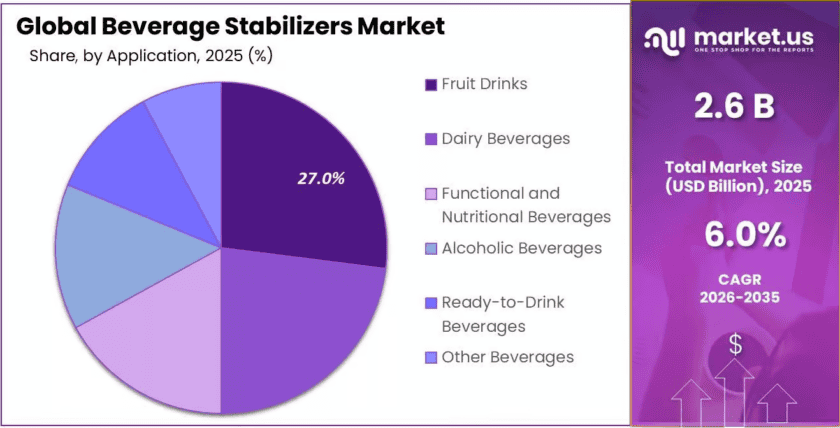
North America dominated the market with a 45.00% share, equivalent to USD 1.1 billion in 2025. Xanthan gum accounted for 28.00%, stabilization held 31.00%, powder formulations represented 68.00%, and fruit drinks accounted for 27.00%. Growing demand for consistent beverage quality, plant-based formulations, and convenient packaged drinks is supporting the adoption of stabilizing ingredients across beverage manufacturing.
Key Takeaways
- Market valuation: The global Beverage Stabilizers Market reached USD 2.6 billion in 2025.
- Future projection: The market is expected to reach USD 4.6 billion by 2035.
- Growth rate: The market is projected to expand at a 6.0% CAGR during 2026–2035.
- Dominating region: North America accounted for 45.00%, representing USD 1.1 billion in 2025.
- Leading ingredient type: Xanthan gum held a 28.00% share.
- Leading function: Stabilization accounted for 31.00% of the market.
- Leading form: Powder formulations captured 68.00% of the market.
- Leading application: Fruit drinks accounted for 27.00% of the market.
Regional Analysis
North America: Dominating Region
North America dominated the Beverage Stabilizers Market in 2025, accounting for 45.00% of global revenue, equivalent to USD 1.1 billion. Regional demand is supported by established beverage manufacturing, packaged drink consumption, dairy processing, and the development of functional beverages. The United States has a strong food processing industry that creates demand for ingredients used to maintain beverage texture and consistency.
According to the U.S. Department of Agriculture, food and beverage manufacturing establishments represented 16.8% of total U.S. manufacturing sales in 2021, while beverage manufacturing accounted for 11.3% of food and beverage manufacturing sales. This industrial base supports demand for stabilizers used in fruit drinks, dairy beverages, and ready-to-drink formulations.
Asia-Pacific: Emerging Growth Opportunities
Asia-Pacific offers opportunities for beverage stabilizer suppliers as beverage manufacturers expand packaged drinks, dairy beverages, fruit-based products, and plant-based formulations. Increasing investment in food processing and the availability of different hydrocolloids create opportunities for xanthan gum, guar gum, pectin, and modified starch suppliers.
Beverage manufacturers are also focusing on improved texture, product appearance, and consistent quality during storage and transportation. The development of functional drinks and ready-to-drink products may further support demand for specialised stabilizer blends. However, the supplied market report does not establish a verified fastest-growing regional CAGR, so Asia-Pacific is presented as an emerging opportunity rather than a confirmed fastest-growing region.
Market Dynamics
Driver: Growing Demand for Consistent and Stable Packaged Beverages
The increasing production of packaged beverages is supporting demand for stabilizing ingredients that maintain texture, prevent ingredient separation, and improve product appearance. Stabilizers such as xanthan gum, pectin, and carrageenan help manufacturers maintain uniformity during processing, transportation, and storage.
According to the USDA Economic Research Service, beverage manufacturing accounted for 11.3% of U.S. food and beverage manufacturing sales in 2021. This highlights the importance of beverage processing within the wider food industry. As manufacturers introduce fruit drinks, dairy beverages, and functional products, the need for ingredients that maintain consistent quality is creating opportunities for beverage stabilizer suppliers.
Trend: Increasing Use of Plant-Based and Clean-Label Stabilizers
Beverage manufacturers are increasingly exploring plant-derived stabilizers and hydrocolloids to improve the texture and stability of modern drink formulations. Ingredients such as pectin, xanthan gum, and guar gum can help control viscosity and suspend particles in fruit-based and plant-based beverages.
The U.S. Food and Drug Administration identifies pectin, guar gum, carrageenan, and xanthan gum among ingredients used as stabilizers, thickeners, and texturizers. This supports their relevance in beverage formulation. Manufacturers are also working on blends that deliver consistent performance while meeting consumer interest in recognisable ingredients and simpler product labels.
Restraint: Changing Beverage Consumption and Formulation Costs
The Beverage Stabilizers Market faces challenges from changing beverage consumption patterns, raw material price fluctuations, and formulation costs. Manufacturers must select stabilizers that work with beverage acidity, protein content, processing temperatures, and storage conditions.
The USDA reported that U.S. per capita fruit juice intake declined by 50%, from 0.46 cup equivalent per day in 2003–2004 to 0.23 cup in 2017–2018. This historical decline highlights changing consumption patterns within an important beverage category. Such changes can influence product development and stabilizer requirements. Manufacturers must also balance ingredient performance, affordability, and consumer preferences when developing new formulations.
Opportunity: Expansion of Functional and Plant-Based Beverages
The expansion of functional beverages, plant-based drinks, and nutritional beverages creates opportunities for specialised stabilizer formulations. These products often contain proteins, fibres, minerals, fruit particles, and other ingredients that can settle or separate during storage. Stabilizers help maintain uniformity, improve mouthfeel, and support consistent product quality.
The FDA identifies several ingredients, including xanthan gum and carrageenan, for technical functions such as stabilizing, thickening, and texturizing. Manufacturers can develop customised ingredient blends for protein drinks, fortified beverages, and fruit-based products. Investment in formulation research and improved processing compatibility can help suppliers expand their presence across emerging beverage categories.
Emerging Trends
1. Growing Use of Xanthan Gum
Xanthan gum is widely used to control beverage viscosity and suspend particles. In 2025, it accounted for 28.00% of the Beverage Stabilizers Market. The FDA recognises its stabilizing, thickening, and texturizing functions in food applications.
2. Increasing Demand for Powder Stabilizers
Powder stabilizers accounted for 68.00% of the market in 2025. Their dry format supports convenient storage, accurate weighing, and blending with other beverage ingredients. Manufacturers use them to achieve consistent formulations and simplify large-scale production.
3. Development of Clean-Label Formulations
Manufacturers are exploring ingredients such as pectin and guar gum to improve beverage texture and stability. The FDA identifies both ingredients as stabilizers or thickeners. This supports their use in formulation development where ingredient functionality and label transparency matter.
4. Expansion of Fruit-Based Beverage Applications
Fruit drinks represented 27.00% of the market in 2025. Stabilizers help control pulp settlement and maintain uniform appearance. USDA research reported a 50% decline in historical U.S. per capita fruit juice intake between 2003–2004 and 2017–2018, highlighting changing beverage consumption patterns.
5. Development of Functional Beverage Stabilizers
Functional and nutritional beverages require ingredients that maintain suspended nutrients and improve texture. The FDA identifies xanthan gum, carrageenan, and pectin as ingredients with stabilizing or thickening functions, supporting their application in specialised beverage formulations.
Use Cases
1. Fruit Juice and Pulp-Based Drinks
Beverage manufacturers use pectin and xanthan gum to control pulp settlement and maintain uniform texture in fruit drinks. This application represented 27.00% of the market in 2025, according to Market.us, reflecting the importance of beverage stability.
2. Dairy-Based Beverages
Dairy beverage manufacturers use carrageenan and other stabilizers to maintain texture and reduce ingredient separation. The USDA reported that dairy manufacturing represented 12.8% of U.S. food and beverage manufacturing sales in 2021, highlighting its industrial importance.
3. Plant-Based Milk Alternatives
Plant-based beverage manufacturers use stabilizers to help suspend proteins, fats, and other ingredients. Xanthan gum and guar gum can support texture and consistency. The FDA recognises both ingredients for stabilizing or thickening functions in food applications.
4. Ready-to-Drink Functional Beverages
Manufacturers use stabilizer blends in ready-to-drink nutritional products to maintain uniform distribution of added ingredients. The FDA identifies xanthan gum under 21 CFR 172.695 for permitted food uses, including stabilizing and thickening functions.
5. Flavoured and Nutritional Drinks
Beverage stabilizers help manufacturers maintain mouthfeel and prevent separation in flavoured and fortified drinks. Pectin is listed by the FDA for stabilizing, thickening, and texturizing functions, making it useful in selected beverage formulation applications.
Frequently Asked Questions on Beverage Stabilizers Market
1. What is the Beverage Stabilizers Market?
The Beverage Stabilizers Market includes ingredients used to improve beverage texture, viscosity, consistency, and shelf stability. Common stabilizers include xanthan gum, carrageenan, pectin, guar gum, gum arabic, and modified starch.
2. What was the market value in 2025?
According to Market.us, the global Beverage Stabilizers Market was valued at USD 2.6 billion in 2025. Demand is supported by packaged beverage manufacturing, fruit drinks, dairy beverages, and functional beverage development.
3. What will be the market value by 2035?
The Beverage Stabilizers Market is projected to reach USD 4.6 billion by 2035, growing at a CAGR of 6.0% during 2026–2035, according to the supplied Market.us report.
4. Which region dominated the market in 2025?
North America dominated the market in 2025, accounting for 45.00% of global revenue, equivalent to USD 1.1 billion. Established beverage manufacturing and demand for packaged drinks support the region’s leading position.
5. Which ingredient type held the largest market share?
Xanthan gum led the type segment in 2025, accounting for 28.00% of the market. Its ability to improve viscosity, suspend particles, and maintain beverage consistency supports its use across different drink formulations.
Conclusion
The Beverage Stabilizers Market is expected to experience steady growth as beverage manufacturers focus on product consistency, texture, and shelf stability. The market is projected to increase from USD 2.6 billion in 2025 to USD 4.6 billion by 2035, at a CAGR of 6.0%.
North America remains the leading region, while xanthan gum, stabilization, powder formulations, and fruit drinks represent important market segments. Future opportunities are expected from plant-based beverages, functional drinks, and customised stabilizer blends. Product innovation, ingredient quality, and regulatory compliance will remain important factors influencing the industry’s competitive development.
Discuss your needs with our analyst
Please share your requirements with more details so our analyst can check if they can solve your problem(s)