Overview
New York, NY – October 22, 2026 – The global Specialty Enzymes Market is gaining importance as pharmaceutical manufacturers, food producers, biotechnology companies, and research laboratories adopt enzymes for specialised industrial and biological processes. Specialty enzymes are biological catalysts that speed up specific reactions and are used in drug development, diagnostic testing, molecular biology, food processing, and other technical applications.
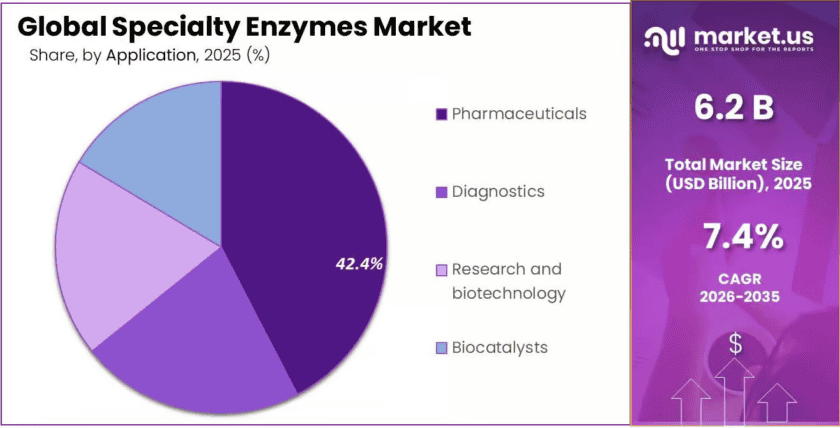
According to the Market.us Specialty Enzymes Market report, the market’s 2025 segmentation shows that proteases accounted for 38.0%, microorganisms represented 68.0% of the source segment, dry formulations held 57.0%, and pharmaceutical applications accounted for 42.0%. North America led regional demand with a 33.0% share, representing a major market for specialised enzyme products and related technologies.
Government-backed research and regulatory programmes also support the development of enzyme-based technologies. The United States Food and Drug Administration regulates applicable enzyme preparations used in food, while the National Institutes of Health supports research involving enzymes in diagnostics, biotechnology, and therapeutic development.
Key Takeaways
- Market value: The Specialty Enzymes Market was valued at USD 6.2 billion in 2025.
- Forecast value: The market is projected to reach USD 12.6 billion by 2035.
- Growth rate: The market is expected to expand at a 7.4% CAGR during 2026–2035.
- Leading enzyme type: Proteases accounted for 38.0% of the market in 2025.
- Leading source: Microorganisms represented 68.0% of the market.
- Leading formulation: Dry enzymes held a 57.0% share.
- Leading application: Pharmaceuticals accounted for 42.0% of the market.
- Regional leader: North America captured 33.0%, worth approximately USD 2.0 billion, in 2025.
Regional Analysis
North America: Dominating Region
North America led the Specialty Enzymes Market in 2025, accounting for 33.0% of global revenue, equivalent to approximately USD 2.0 billion. The region benefits from established pharmaceutical manufacturing, biotechnology research, diagnostic testing, and investment in industrial enzyme development.
The United States also has an extensive biomedical research system. The National Institutes of Health received an overall budget of approximately USD 47 billion in fiscal year 2025, supporting research across multiple areas of biomedical science. These capabilities provide a favourable environment for specialty enzymes used in drug development, laboratory testing, and biotechnology. Regulatory oversight by the Food and Drug Administration also influences the development and use of enzymes in food and pharmaceutical applications.
Europe: Strong Regulatory and Industrial Base
Europe remains an important region because of its pharmaceutical industry, established food processing sector, and focus on resource-efficient manufacturing. Enzymes are used in baking, cheese production, brewing, starch processing, detergents, and industrial biotechnology. The European Commission identifies enzyme-based processing as a useful tool for improving production efficiency and reducing unwanted by-products.
Food enzyme safety and permitted uses are also subject to European regulatory requirements. These conditions encourage suppliers to develop application-specific products and maintain appropriate safety documentation. Demand is supported by industrial innovation, established manufacturing capabilities, and the need to improve process efficiency.
Asia-Pacific: Expanding Industrial Applications
Asia-Pacific offers opportunities for specialty enzyme suppliers as pharmaceutical production, food manufacturing, biotechnology research, and industrial processing expand. Microbial fermentation is particularly relevant because it can support the controlled production of enzymes at commercial scale.
Manufacturers can use specialty enzymes to improve yields, reduce processing steps, and support consistent product quality. Demand varies across individual countries according to manufacturing capacity, research investment, regulatory requirements, and access to technical expertise. Suppliers that establish local distribution, application support, and reliable production capabilities can serve customers across pharmaceutical, diagnostic, food, and biotechnology industries.
Latin America, Middle East and Africa: Emerging Opportunities
These regions offer opportunities in food processing, agricultural biotechnology, pharmaceutical manufacturing, and industrial applications. Enzymes can help improve starch conversion, food texture, cleaning performance, and selected biochemical production processes.
However, adoption can be affected by equipment costs, technical expertise, supply-chain reliability, and access to suitable formulations. Local partnerships and application-specific products can help manufacturers introduce enzyme technologies into existing production systems. Growth prospects will depend on industrial investment, biotechnology capabilities, and the development of reliable distribution networks.
Market Dynamics
1. Driver: Growing Demand for Efficient Bioprocessing
Manufacturers are adopting specialty enzymes to improve production efficiency, control chemical reactions, and reduce unwanted by-products. Enzymes are used in pharmaceuticals, food processing, diagnostics, and industrial biotechnology because they can target specific substances under suitable operating conditions.
The United States Food and Drug Administration lists enzyme preparations used for starch conversion, cheese production, and other food applications. These established uses demonstrate the commercial importance of enzyme-based processing. As businesses seek reliable product quality and efficient resource use, demand for application-specific enzymes can increase. The Market.us report projects the Specialty Enzymes Market to grow at a 7.4% CAGR between 2026 and 2035.
2. Trend: Enzyme Engineering and Artificial Intelligence
Enzyme development is increasingly using computational tools, genetic engineering, and automated laboratory testing to improve performance. These methods help researchers evaluate enzyme variants and identify those with better activity, stability, or suitability for industrial conditions.
The United States Department of Energy reported research in July 2026 combining artificial intelligence, synthetic biology, and automated laboratory systems. In one study, researchers increased the activity of two enzymes by 16-fold and 26-fold, respectively. Such results demonstrate the potential of modern enzyme engineering to improve biocatalyst performance. Commercial adoption will depend on reproducibility, manufacturing costs, regulatory requirements, and performance at industrial scale.
3. Restraint: High Development and Quality-Control Costs
Specialty enzymes often require extensive research, process development, purification, stability testing, and quality controls before commercial use. Pharmaceutical and diagnostic applications can require particularly stringent specifications because variations in purity or activity may affect product performance. Food enzyme preparations must also meet applicable safety and use requirements.
The FDA explains that safety evidence for a food ingredient recognised as generally recognised as safe through scientific procedures must meet the same quantity and quality standards as evidence required for food-additive approval. These technical and regulatory demands can increase development time and cost, making it harder for smaller producers to compete.
4. Opportunity: Expansion of Industrial Biotechnology
Industrial biotechnology offers opportunities for specialty enzymes in chemical production, food processing, diagnostics, and the conversion of renewable materials. Enzymes can enable targeted reactions and may reduce the need for harsh processing conditions in suitable applications.
The United States Department of Energy supports research into biotechnology and biomanufacturing technologies that can improve the conversion of biological resources into useful products. Companies can pursue growth through engineered enzymes, application-specific formulations, and partnerships with industrial manufacturers. The greatest opportunities will depend on demonstrating reliable performance, competitive production costs, and measurable improvements over existing processes.
Emerging Trends in Specialty Enzymes
1. Artificial Intelligence in Enzyme Design
Artificial intelligence helps researchers identify enzyme variants with improved activity and stability. In a 2026 research example reported by the Department of Energy, two engineered enzymes achieved activity increases of 16-fold and 26-fold. Such methods may shorten development cycles and improve industrial performance.
2. Growth in Microbial Enzyme Production
Microorganisms accounted for 68.0% of the Specialty Enzymes Market in 2025, according to Market.us. Fermentation enables manufacturers to produce enzymes under controlled conditions, while strain improvement and process optimisation can increase output, improve consistency, and support large-scale commercial supply.
3. Expansion of Dry Enzyme Formulations
Dry formulations represented 57.0% of the market in 2025. These products are convenient to transport, store, and blend into many manufacturing processes. Advances in drying and stabilisation can help preserve enzyme activity, although suitable moisture control and packaging remain important.
4. More Specialised Diagnostic Enzymes
Enzymes such as DNA polymerases and reverse transcriptases support molecular testing and laboratory research. The Centers for Disease Control and Prevention recognises polymerase chain reaction testing as an important molecular diagnostic method. Improvements in enzyme sensitivity and stability can support reliable testing across different sample types.
5. Greater Focus on Food Enzyme Safety
Food manufacturers must ensure that enzyme preparations are suitable for their intended applications. The FDA identifies specific enzyme preparations in its food regulations, including amyloglucosidase, catalase, and lactase. Regulatory compliance and consistent enzyme activity remain important considerations for commercial food production.
Use Cases of Specialty Enzymes
1. Pharmaceutical Manufacturing
Specialty enzymes help produce selected pharmaceutical ingredients and support biochemical manufacturing. Enzymatic reactions can offer greater selectivity in suitable processes, potentially reducing unwanted by-products. Their use depends on product specifications, validated manufacturing methods, and applicable pharmaceutical quality requirements.
2. Diagnostic Testing
DNA polymerases and other enzymes support laboratory testing by enabling the amplification or detection of biological material. Polymerase chain reaction methods are widely used in molecular diagnostics. Reliable enzyme activity is essential for consistent results, particularly when tests must detect small amounts of target material.
3. Food and Dairy Processing
Enzymes such as lactase, amylase, and milk-clotting enzymes are used in dairy and food manufacturing. Lactase breaks down lactose, while amylase supports starch conversion. The FDA lists specified enzyme preparations in its food regulations, demonstrating their established role in commercial processing.
4. Biotechnology Research
Research laboratories use specialty enzymes to study DNA, RNA, proteins, and other biological materials. Restriction enzymes, polymerases, and proteases support experiments involving genetic analysis and protein processing. Their specificity helps researchers conduct controlled reactions, while consistent purity and activity improve experimental reproducibility.
5. Industrial Biocatalysis
Manufacturers use enzymes to accelerate selected chemical reactions in industrial biotechnology. Enzymes can support the conversion of biological materials into useful ingredients and chemicals. The United States Department of Energy supports research into biotechnology and biomanufacturing, including approaches designed to improve process efficiency and resource use.
Frequently Asked Questions on Specialty Enzymes and the Specialty Enzymes Market
1. What are specialty enzymes?
Specialty enzymes are biological catalysts designed for specific applications in pharmaceuticals, diagnostics, food processing, research, and industrial biotechnology. They accelerate chemical reactions and help improve process selectivity, efficiency, and product consistency under suitable operating conditions.
2. What is the value of the Specialty Enzymes Market?
According to Market.us, the global Specialty Enzymes Market was valued at USD 6.2 billion in 2025. It is projected to reach USD 12.6 billion by 2035, growing at a CAGR of 7.4% during 2026–2035.
3. Which enzyme type dominates the market?
Proteases held the leading position in 2025, accounting for 38.0% of the market. These enzymes break down proteins and support applications in pharmaceutical processing, food production, laboratory research, and other specialised industrial processes.
4. Which source dominates specialty enzyme production?
Microorganisms accounted for 68.0% of the market in 2025. Bacteria and fungi can be cultivated under controlled conditions, making them valuable for fermentation-based enzyme production and supporting consistent manufacturing across several industrial applications.
5. Which enzyme formulation holds the largest share?
Dry formulations held 57.0% of the Specialty Enzymes Market in 2025. Their convenient handling, storage, and transportation make them suitable for several applications, although moisture control, packaging, and product stability remain important for maintaining enzyme activity.
Conclusion
The Specialty Enzymes Market is positioned for continued expansion as pharmaceutical manufacturing, diagnostic testing, food processing, and industrial biotechnology adopt more specialised biological solutions. Market.us projects the market to increase from USD 6.2 billion in 2025 to USD 12.6 billion by 2035, representing a 7.4% CAGR. Proteases, microbial sources, dry formulations, and pharmaceutical applications held leading positions in 2025.
North America remained the dominant region with a 33.0% share. Advances in enzyme engineering, fermentation, and artificial intelligence create additional opportunities. However, manufacturers must manage production costs, product stability, regulatory compliance, and quality requirements to achieve sustainable growth.
Discuss your needs with our analyst
Please share your requirements with more details so our analyst can check if they can solve your problem(s)