Overview
New York, NY – Oct 21, 2026 – The meat speciation testing market is gaining importance as food manufacturers, meat processors, retailers, and regulatory authorities seek reliable ways to verify animal species in meat products. These tests help identify undeclared ingredients, detect meat substitution, verify product labels, and strengthen food authenticity across fresh, cooked, and processed meat supply chains. Polymerase chain reaction (PCR), enzyme-linked immunosorbent assay (ELISA), and other molecular techniques support species identification when visual inspection is insufficient.
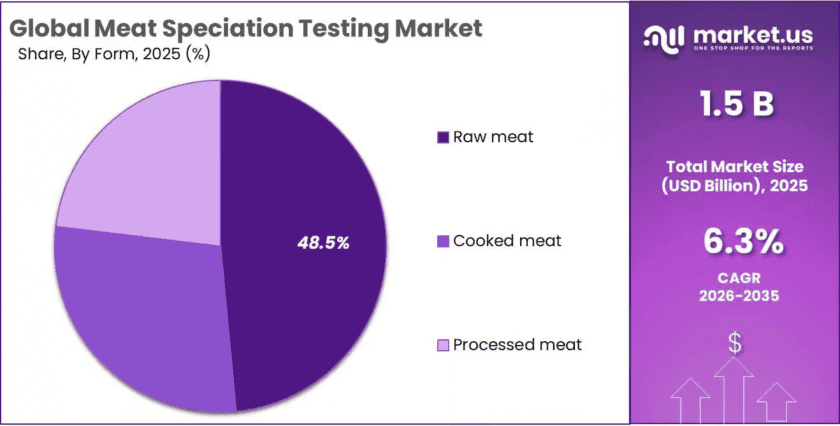
According to the referenced market report, the global market was valued at USD 1.5 billion in 2025 and is projected to reach USD 2.9 billion by 2035, at a compound annual growth rate (CAGR) of 6.3%. Pork/swine accounted for 40.30%, PCR for 46.20%, raw meat for 48.50%, food authenticity and adulteration detection for 51.20%, and food manufacturers for 43.60% of their respective market segments. Europe led the regional market with a 35.80% share, equivalent to USD 0.5 billion in 2025.
Government testing programmes demonstrate the importance of species verification. In 2014, the European Commission coordinated 2,622 tests for horse meat DNA in beef products, identifying 16 positive samples, or 0.61%. These findings illustrate how DNA-based testing supports food authenticity and accurate labelling.
Key Takeaways
- 2025 market value: USD 1.5 billion.
- 2035 projected value: USD 2.9 billion.
- Forecast CAGR: 6.3% for 2026–2035.
- Leading species segment: Pork/swine, with a 40.30% share.
- Leading technology: PCR, with a 46.20% share.
- Leading sample form: Raw meat, with a 48.50% share.
- Leading application: Food authenticity and adulteration detection, with a 51.20% share.
- Leading end user: Food manufacturers, with a 43.60% share.
- Dominating region: Europe, with a 35.80% share and USD 0.5 billion in reported 2025 revenue.
Regional Analysis
Europe: Dominating Region
Europe held the leading position in 2025, accounting for 35.80% of the meat speciation testing market, with a reported value of USD 0.5 billion. Regional demand is supported by food authenticity requirements, established laboratory networks, cross-border meat trade, and the need to verify ingredient declarations.
The European Commission’s coordinated horse meat testing programme identified 16 positive samples from 2,622 tests in 2014, compared with a 4.6% positive rate in 2013. The improvement showed the value of coordinated testing and follow-up controls.
North America
North America benefits from established food testing laboratories, meat processing operations, and official inspection programmes. The United States Department of Agriculture’s Food Safety and Inspection Service (USDA FSIS) provides a real-time PCR method for species identification in meat and poultry products, effective from September 30, 2024. This supports standardized laboratory analysis and helps food businesses investigate suspected mislabelling.
Market Dynamics
1. Driver: Growing Need for Food Authenticity
Food authenticity is a major driver of meat speciation testing because manufacturers and regulators need to confirm that products contain the animal species declared on their labels. DNA-based testing can identify undeclared pork, beef, poultry, or other animal species in fresh and processed products.
The European Commission’s 2014 coordinated programme tested 2,622 beef products and found 16 positive for horse meat DNA, demonstrating the importance of targeted verification. The USDA FSIS also provides a validated real-time PCR method for species identification. These controls encourage food manufacturers, processors, and laboratories to use routine testing and investigate suspected adulteration.
2. Trend: Wider Adoption of DNA-Based Testing
PCR-based methods are becoming increasingly important because they can detect species-specific genetic material in samples where animal identity cannot be established visually. Real-time PCR supports targeted detection, while DNA sequencing can help investigate more complex cases.
The USDA FSIS lists a real-time PCR method for species identification in meat and poultry products, effective September 30, 2024. Laboratories can use validated procedures to improve consistency across testing programmes. Demand for faster reporting, reliable results, and broader species panels is encouraging laboratories to modernize their equipment and sample preparation processes. However, performance depends on sample quality, processing conditions, and method validation.
3. Restraint: Testing Costs and Sample Complexity
Meat speciation testing can be expensive for smaller processors when multiple species must be checked across large product batches. Costs include sample collection, DNA extraction, laboratory equipment, trained staff, reference materials, and confirmatory analysis. Cooked and highly processed foods may contain fragmented DNA or substances that interfere with testing, requiring additional preparation or repeat analysis.
Laboratories must also validate methods for different product types to avoid unreliable results. These challenges can extend turnaround times and make routine testing harder to justify for low-volume producers. More affordable screening kits and shared laboratory services can help reduce the burden without compromising result quality.
4. Opportunity: Multiplex Testing and Supply-Chain Verification
Multiplex PCR creates opportunities to test for multiple animal species within a single analytical workflow, helping laboratories investigate complex meat mixtures more efficiently. This approach can support food manufacturers, retailers, importers, and regulators that need to verify ingredient declarations across several product lines.
The USDA FSIS provides documented laboratory procedures for meat and poultry testing, supporting standardized analysis and quality control. Laboratories can also combine species testing with traceability records and supplier audits to investigate discrepancies more quickly. Commercial opportunities will depend on assay validation, equipment capacity, sample complexity, and the cost savings achieved compared with separate tests for each species.
Emerging Trends
1. Real-Time PCR Testing
Real-time PCR is an established method for identifying animal species in meat products. USDA FSIS Method 20.02 became effective on September 30, 2024, providing a documented procedure for meat and poultry species identification.
2. Multiplex Species Detection
Multiplex assays can screen for several animal species in one workflow. This can help laboratories investigate mixed-meat products and reduce repeated testing, provided the assay is validated for the relevant species and food matrix.
3. Testing of Processed Meat
Cooked and processed products can contain fragmented DNA, making species identification more challenging. Government-supported research has examined DNA methods for meat mixtures and cooked products, helping laboratories improve detection and assess possible substitution.
4. Digital Traceability
Food businesses are increasingly combining laboratory results with digital batch records and supplier documentation. Linking test results to production lots can help investigators trace suspected adulteration and identify affected products more efficiently during recalls or regulatory inspections.
5. Stronger Cross-Border Food Controls
International meat trade increases the importance of consistent species verification. The European Commission’s 2014 programme tested 2,622 samples across participating countries, demonstrating how coordinated controls can support investigations into undeclared meat ingredients.
Use Cases
1. Meat Processing Plants
Meat processors can test incoming raw materials and finished products to confirm declared species. The results help identify possible substitution before products are distributed. USDA FSIS provides a real-time PCR method for species identification in meat and poultry products.
2. Packaged and Processed Foods
Manufacturers of sausages, ready meals, canned meat, and mixed-protein products can use DNA testing to verify ingredient declarations. The method must account for heat treatment and processing, which may affect DNA quality and detection performance.
3. Food Fraud Investigations
Regulators can use species testing to investigate suspected substitution and mislabelling. In 2014, European authorities found horse meat DNA in 16 of 2,622 tested beef products, showing how targeted testing can identify undeclared species.
4. Halal and Kosher Product Verification
Testing laboratories can identify animal species in products intended for religiously certified markets. Detecting undeclared species can support certification checks, although species testing alone does not establish full compliance with religious slaughter, handling, or certification requirements.
5. Retailer and Importer Quality Checks
Retailers and importers can test selected products to verify supplier declarations and investigate inconsistencies. Combining laboratory results with batch records and supplier documentation can improve traceability and support decisions about product release, further investigation, or withdrawal.
Frequently Asked Questions
1. What is meat speciation testing?
Meat speciation testing identifies the animal species present in meat and meat-based products. Laboratories use methods such as PCR and protein-based testing to verify ingredient declarations, investigate adulteration, and support food authenticity checks.
2. What was the market value in 2025?
The referenced market report estimates that the global meat speciation testing market reached USD 1.5 billion in 2025. This is a commercial market estimate and is not an independently verified government valuation.
3. What is the projected market value by 2035?
The referenced report projects that the market will reach USD 2.9 billion by 2035, representing a CAGR of 6.3% over the 2026–2035 forecast period.
4. Which region dominated the market in 2025?
Europe led the market in 2025, with a reported 35.80% share and USD 0.5 billion in revenue. Food authenticity requirements, established testing laboratories, and cross-border trade support regional demand.
5. Why is PCR important in meat speciation testing?
PCR identifies species-specific DNA in meat samples, including products that cannot be reliably identified by appearance. USDA FSIS provides a documented real-time PCR method for species identification in meat and poultry products.
6. What are the main challenges facing the market?
Key challenges include testing costs, DNA degradation in processed meat, complex sample preparation, and the need for validated methods. Laboratories must select appropriate procedures to maintain reliable results across different food products.
Conclusion
The meat speciation testing market is expected to benefit from greater attention to food authenticity, accurate ingredient declarations, and supply-chain transparency. The referenced market report estimates growth from USD 1.5 billion in 2025 to USD 2.9 billion by 2035, at a CAGR of 6.3%.
Europe remains the leading region, while PCR continues to be an important testing technology. Opportunities are emerging in multiplex assays, processed-meat verification, and digital traceability. However, testing costs and sample complexity remain important challenges. Continued improvements in laboratory methods and coordinated food controls will support the industry’s development.
Discuss your needs with our analyst
Please share your requirements with more details so our analyst can check if they can solve your problem(s)