Overview
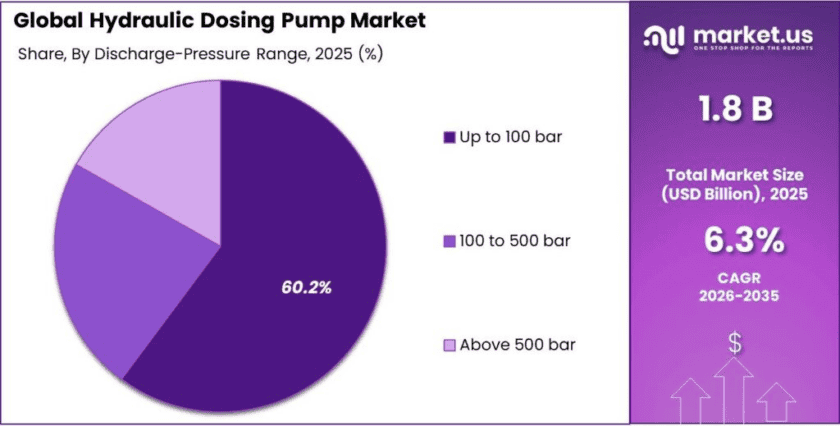
New York, NY – October 9, 2026 – The global Hydraulic Dosing Pump Market is gaining momentum as industries invest in accurate chemical injection, water treatment, and automated process control. According to the supplied Market.us report, the market was valued at USD 1.8 billion in 2025 and is projected to reach USD 3.3 billion by 2035, registering a compound annual growth rate (CAGR) of 6.3% from 2026 to 2035.
Hydraulic dosing pumps deliver controlled quantities of chemicals, additives, and treatment agents into industrial processes. They are widely used in water and wastewater treatment, oil and gas, chemicals and petrochemicals, power generation, and food and beverage production. Their ability to maintain controlled dosing under pressure makes them suitable for applications requiring consistent chemical delivery.
Asia Pacific led the market in 2025, accounting for 38.34% of global revenue, equivalent to approximately USD 0.6 billion. Diaphragm pumps held a leading position with a 45.23% share, while automatic stroke adjustment accounted for 54.22%. The water and wastewater treatment segment represented 37.21% of the market. Continued investment in water infrastructure, tighter pollution-control requirements, and growing industrial automation are creating opportunities for pump manufacturers. Digital controls, remote monitoring, and improved chemical compatibility are also expected to influence product development over the coming years.
Key Takeaways
- The global market is projected to grow from USD 1.8 billion in 2025 to USD 3.3 billion by 2035, at a reported CAGR of 6.3%.
- Asia Pacific held a 38.34% share, generating approximately USD 0.6 billion in revenue in 2025.
- Diaphragm pumps captured 45.23% of the market, supported by their suitability for controlled chemical dosing.
- Automatic systems accounted for 54.22%, reflecting demand for adjustable dosing and process automation.
- Pumps operating at up to 100 bar held 60.02% of the market.
- Water and wastewater treatment accounted for 37.21%, supported by chemical injection requirements in treatment processes.
Regional Analysis
Asia Pacific led the Hydraulic Dosing Pump Market in 2025, with a reported 38.34% share and approximately USD 0.6 billion in revenue. Industrial expansion, urbanisation, water-treatment investment, and manufacturing activity support demand for chemical dosing equipment. The Asian Development Bank identifies significant ongoing investment needs in water supply, sanitation, and wastewater infrastructure across the region. These applications require controlled chemical injection for disinfection, pH adjustment, coagulation, and treatment processes. China, India, Japan, and South Korea offer opportunities for pump suppliers serving municipal utilities and industrial facilities.
Market Dynamics
Driver: Growing Investment in Water and Wastewater Treatment
Investment in water and wastewater treatment is a major driver of the Hydraulic Dosing Pump Market. Treatment plants use dosing pumps to deliver disinfectants, coagulants, pH-control chemicals, and other treatment agents in controlled quantities. In November 2025, the US Environmental Protection Agency announced USD 6.5 billion in WIFIA funding and another USD 550 million through State WIFIA.
These programmes support water infrastructure investment, creating potential demand for chemical-feed equipment. Industrial wastewater treatment and water reuse also require accurate chemical dosing. As treatment systems expand, operators increasingly need reliable pumps that can maintain consistent delivery and reduce chemical wastage.
Trend: Automatic Dosing and Digital Process Control
Hydraulic dosing pumps are increasingly integrated with automatic controls, process sensors, and remote monitoring systems. Automatic stroke adjustment accounted for 54.22% of the market in 2025, according to the supplied report. Automated systems can adjust chemical feed rates according to process conditions, helping operators maintain stable treatment performance.
The US Department of Energy notes that pumping systems account for approximately 27% of electricity used by industrial systems in the manufacturing sector, highlighting the importance of efficient pump operation. Although this figure covers industrial pumping systems broadly, it reinforces the value of reviewing pump sizing, controls, and operating conditions to reduce energy use.
Restraint: Maintenance Costs and Chemical Compatibility
Hydraulic dosing pumps must handle chemicals that may be corrosive, abrasive, hazardous, or sensitive to contamination. Selecting unsuitable diaphragm materials, seals, valves, or wetted components can lead to leakage, inaccurate dosing, and unplanned maintenance. Operators may need specialised spare parts, regular calibration, and trained technicians, increasing total ownership costs.
High-pressure applications can add further engineering and inspection requirements. Smaller facilities may prefer simpler equipment if their process conditions are stable and dosing accuracy requirements are modest. Manufacturers can reduce these barriers through modular designs, clear material-compatibility guidance, accessible maintenance support, and products suited to different pressure and chemical requirements.
Opportunity: Water Reuse and Advanced Industrial Treatment
Water reuse and advanced wastewater treatment create opportunities for hydraulic dosing pump suppliers. Reuse facilities may require controlled injection of disinfectants, pH-adjustment chemicals, coagulants, antiscalants, and cleaning agents. In the United States, the EPA’s 2025 WIFIA announcement made USD 7.05 billion available across the WIFIA and State WIFIA programmes to support water infrastructure financing.
These funds are not reserved specifically for dosing pumps, but eligible treatment projects can require chemical-feed equipment. Suppliers can pursue opportunities by offering complete dosing skids, automatic controls, remote diagnostics, and service contracts that help utilities manage treatment reliability and chemical consumption.
Emerging Trends in Hydraulic Dosing Pumps
1. Automatic Stroke Adjustment
Automatic stroke adjustment helps operators change chemical delivery rates as process conditions change. The segment accounted for 54.22% of the market in 2025, according to Market.us. Integration with flow meters and process sensors can improve dosing consistency and reduce manual adjustments.
2. Advanced Diaphragm Materials
Diaphragm pumps accounted for 45.23% of the market in 2025. Manufacturers are focusing on materials that withstand corrosive chemicals and demanding operating conditions. Better material selection can reduce leakage risks, extend component life, and support more dependable chemical delivery in industrial treatment applications.
3. Energy-Efficient Pump Operation
The US Department of Energy reports that pumps represent 27% of electricity used by industrial systems in manufacturing. Better pump sizing, appropriate control settings, and efficient operation can help reduce energy waste across industrial pumping applications, including chemical treatment systems.
4. Digital Monitoring and Remote Control
Digital monitoring can help operators track pump status, identify abnormal operation, and plan maintenance. Hydraulic dosing pumps connected to plant-control systems can support remote adjustments and operating records. This approach is useful for facilities managing several chemical injection points or operating across multiple treatment stages.
5. Growth in Water Infrastructure Projects
The US EPA announced USD 6.5 billion in WIFIA funding and USD 550 million through State WIFIA in November 2025. Water infrastructure projects supported through these programmes can create opportunities for dosing pumps used in treatment, disinfection, and water reuse.
Use Cases of Hydraulic Dosing Pumps
1. Drinking Water Treatment
Water treatment facilities use dosing pumps to deliver disinfectants and pH-control chemicals. EPA’s WIFIA programme announced USD 6.5 billion in available financing for water systems in 2025, supporting infrastructure improvements where accurate chemical delivery can be essential.
2. Industrial Wastewater Treatment
Factories use hydraulic dosing pumps to inject coagulants, flocculants, neutralising agents, and other chemicals into wastewater streams. The goal is to support contaminant removal and maintain suitable treatment conditions before discharge or reuse. Pump capacity depends on flow rate and chemical demand.
3. Oil and Gas Operations
Oil and gas facilities use dosing pumps to inject corrosion inhibitors, scale-control chemicals, and other process additives. Accurate delivery can help protect pipelines and equipment. Pump selection depends on injection pressure, chemical properties, flow requirements, and the operating environment.
4. Chemical and Petrochemical Processing
Chemical plants use hydraulic dosing pumps to deliver additives and process chemicals at controlled rates. Pumps operating at up to 100 bar accounted for 60.02% of the market in 2025, according to Market.us, reflecting the importance of lower-pressure dosing applications.
5. Power Generation and Cooling Systems
Power plants use dosing pumps to feed water-treatment chemicals, corrosion inhibitors, and conditioning agents into boiler and cooling-water systems. Correct chemical dosing helps control scale and corrosion. Pump materials and flow capacity must match the plant’s chemistry and operating conditions.
Frequently Asked Questions About Hydraulic Dosing Pumps Market
1. What is a hydraulic dosing pump?
A hydraulic dosing pump is a precision pump that delivers controlled quantities of chemicals or additives into a process. It is used in water treatment, oil and gas, chemical manufacturing, power generation, and other industrial applications.
2. What is the projected size of the Hydraulic Dosing Pump Market by 2035?
According to the supplied Market.us report, the market is projected to reach USD 3.3 billion by 2035, compared with USD 1.8 billion in 2025. The report forecasts a CAGR of 6.3% from 2026 to 2035.
3. Which region leads the Hydraulic Dosing Pump Market?
Asia Pacific led the market in 2025, accounting for 38.34% of global revenue, equivalent to approximately USD 0.6 billion. Industrial growth, water-treatment investment, and manufacturing activity support regional demand.
4. Which pump type holds the largest market share?
Diaphragm pumps held the leading position in 2025, capturing 45.23% of the market. Their sealed pumping design and chemical-handling capabilities make them suitable for controlled dosing in water treatment and industrial processes.
5. Which stroke-adjustment method dominates the market?
Automatic stroke adjustment led the market in 2025, with a reported 54.22% share. These systems allow dosing rates to be adjusted according to operating requirements, supporting process consistency and reducing the need for repeated manual intervention.
Conclusion
The Hydraulic Dosing Pump Market is expected to expand as industries invest in water treatment, wastewater management, chemical processing, and automated fluid control. According to the supplied report, the market will grow from USD 1.8 billion in 2025 to USD 3.3 billion by 2035, at a CAGR of 6.3%.
Asia Pacific leads the market, while diaphragm pumps, automatic stroke adjustment, and water-treatment applications remain important segments. Maintenance costs and chemical compatibility continue to challenge adoption. However, water infrastructure funding, advanced treatment requirements, digital monitoring, and more efficient dosing systems create opportunities for manufacturers and service providers.
Discuss your needs with our analyst
Please share your requirements with more details so our analyst can check if they can solve your problem(s)