Overview
New York, NY – Sep 21, 2026 – The global Starter Feed Market is gaining importance as livestock and aquaculture producers focus on stronger early-life nutrition, faster growth, better feed efficiency, and healthier young animals. Starter feeds are specially formulated for chicks, piglets, calves, young ruminants, and juvenile aquatic species during the most sensitive stage of development.
The market was valued at USD 34.4 billion in 2025 and is projected to reach USD 61.2 billion by 2035, expanding at a CAGR of 6.0% from 2026 to 2035. Demand is supported by large poultry and swine populations, growing aquaculture output, and wider use of balanced protein, energy, vitamins, minerals, amino acids, and functional additives. In the United States, producers raised 9.40 billion broilers in 2025, while 33.5 million pigs were weaned between March and May 2026.
Starter feed suppliers are also responding to tighter feed-safety rules, antimicrobial stewardship, ingredient-price movements, and demand for consistent pellet and crumble quality. North America remained the leading regional market in 2025, supported by large commercial livestock systems and established feed manufacturing infrastructure. Canada also produced 1.6 billion kilograms of poultry in 2025, showing the broad North American production base that continues to support starter-feed consumption and sales.
Key Takeaways
- The global Starter Feed Market reached USD 34.4 billion in 2025 and is expected to reach approximately USD 61.2 billion by 2035, expanding at a 6.0% CAGR during 2026–2035.
- Non-medicated starter feed led the type category in 2025 with more than a 56.40% share, supported by routine nutritional use and growing antimicrobial stewardship.
- Corn accounted for more than a 37.00% share, remaining a major energy ingredient in starter-feed formulations.
- Pellets dominated the form category with more than a 60.00% share, supported by consistent nutrient delivery and convenient commercial handling.
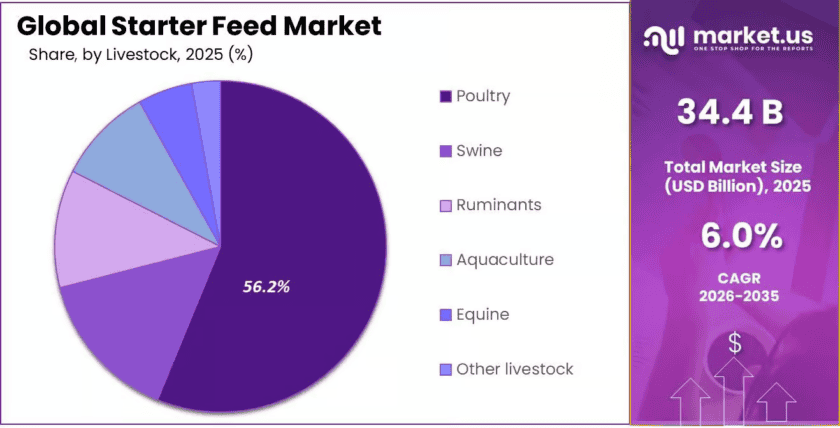
- Poultry represented more than a 56.00% share, reflecting the large number of chicks entering commercial production every year.
- Direct sales captured more than a 48.00% share, supported by bulk purchasing from large livestock operations and integrated producers.
- North America held more than a 38.00% share and generated approximately USD 13.07 billion in 2025.
Regional Analysis
North America Leads with 38.00% Share and USD 13.07 Billion Revenue
North America held the leading Starter Feed Market position in 2025, accounting for more than a 38.00% share and generating approximately USD 13.07 billion in revenue. The region benefits from large commercial poultry, swine, dairy, and beef industries that create recurring demand for early-life animal nutrition. U.S. producers raised 9.40 billion broilers in 2025, with broiler live-weight production reaching 62.2 billion pounds. As of June 2026, U.S. farms held 73.7 million hogs and pigs, while 33.5 million pigs were weaned between March and May. The United States also recorded a 2025 calf crop of 32.9 million head, providing another large user base for starter diets. Canada strengthens regional demand, with poultry production reaching 1.6 billion kilograms in 2025. These large young-animal populations, established feed mills, intensive farming systems, and structured distribution networks support steady regional consumption of pellets, crumbles, non-medicated feeds, and specialized starter formulations.
Market Dynamics
Driver – Rising Young-Animal Production Supports Starter Feed Demand
Rising output of young poultry, pigs, and calves is a major driver for starter feed demand because every new production cycle creates a fresh early-life feeding requirement. USDA reported that U.S. producers raised 9.40 billion broilers in 2025, up 1% from the previous year. In June 2026, U.S. farms held 73.7 million hogs and pigs, while 33.5 million pigs were weaned from March through May. The 2025 U.S. calf crop was estimated at 32.9 million head. These large animal populations support regular demand for nutrient-dense starter diets designed for early growth, digestive development, immunity, and feed conversion across commercial farms.
Trend – Non-Medicated Nutrition and Antimicrobial Stewardship Gain Attention
A clear trend is the shift toward more carefully controlled medicated feed use and stronger interest in non-medicated nutrition. FDA reported that U.S. sales and distribution of medically important antimicrobials for food-producing animals in 2024 were 27% below the 2015 peak, although sales increased 16% from 2023. Medically important antimicrobial drugs used in feed remain subject to veterinary oversight through the Veterinary Feed Directive. This encourages feed companies to improve nutrition, gut support, ingredient quality, and management instead of relying on routine medication. The trend supports demand for precise starter formulations, enzymes, probiotics, organic acids, and other non-antibiotic nutritional tools.
Restraint – Feed Ingredient Volatility and Compliance Pressure
Feed ingredient volatility remains an important restraint because starter diets depend heavily on energy grains and protein ingredients. USDA estimated a record U.S. corn crop of 17.0 billion bushels for 2025/26, but projected 2026/27 production at 16.0 billion bushels, about 6% lower. Harvested corn area was forecast to fall 4% to 87.4 million acres. Such changes can affect feed costs, purchasing plans, and formulation decisions. Compliance also adds pressure. Canada’s Feeds Regulations, 2024 introduced preventive controls, traceability, and licensing requirements, with several major provisions fully effective by December 17, 2025, increasing documentation and quality-control needs for feed businesses across operations.
Opportunity – Aquaculture Expands the Addressable Starter Feed Base
Aquaculture and specialized early-life nutrition create a strong opportunity for starter feed suppliers. FAO forecast global fisheries and aquaculture production at 197 million tonnes in 2025, up 1.7% from the previous year, with aquaculture contributing 104.2 million tonnes. Hatcheries and intensive fish and shrimp farms require small, digestible, nutrient-dense feeds for juvenile animals, creating room for micro-pellets, crumble technologies, functional ingredients, and species-specific formulas. Similar opportunities exist in poultry and swine, where producers need consistent early growth and survival. Suppliers that combine precise formulation, feed safety, palatability, and reliable distribution can capture higher-value demand across intensive animal-production systems worldwide today.
Emerging Trends
1. Growing Preference for Non-Medicated Nutrition
Non-medicated starter feed is gaining attention as producers strengthen antimicrobial stewardship. FDA reported 2024 sales of medically important antimicrobials were 27% below the 2015 peak, encouraging nutrition-led approaches that support gut health, immunity, and early animal performance in modern farms.
2. Strong Role of Corn in Starter Diets
Corn-based starter formulations remain important because grain availability supports consistent energy supply. USDA estimated 17.0 billion bushels of U.S. corn production in 2025/26 and 6.2 billion bushels of feed and residual use, reinforcing corn’s role in feed at scale today.
3. Higher Chick Output Supports Continuous Feed Demand
Poultry starter demand is becoming more continuous as chick output rises. USDA reported 888.6 million broiler-type chicks hatched in January 2026, up 2.2% year over year, supporting repeated demand for carefully balanced early-stage feeds across commercial broiler operations each cycle.
4. Greater Focus on Post-Weaning Pig Nutrition
Post-weaning pig nutrition is receiving greater focus as producers target smoother transitions and stable growth. USDA reported 33.5 million pigs were weaned from March through May 2026, averaging 11.87 pigs per litter, creating a large market for starter diets today.
5. Expansion of Aquaculture Starter Feeds
Aquaculture starter feeds are becoming more important as farmed seafood output expands. FAO forecast aquaculture production at 104.2 million tonnes in 2025 within total fisheries and aquaculture production of 197 million tonnes, supporting demand for specialized juvenile feeds worldwide today.
Use Cases
1. Broiler Chick Nutrition
Broiler starter feed supports chicks during rapid early growth when nutrient density and feed consistency are critical. U.S. producers raised 9.40 billion broilers in 2025, creating a large recurring need for starter rations across integrated poultry production systems nationwide today.
2. Post-Weaning Piglets
Piglet starter feed helps newly weaned pigs move from milk to solid feed while maintaining intake and growth. USDA recorded 33.5 million pigs weaned between March and May 2026, showing the large commercial requirement for digestible post-weaning nutrition at scale.
3. Calf Starter Feeding
Calf starter feed is used to encourage early solid-feed intake and support rumen development before animals rely more heavily on forage. USDA estimated the 2025 U.S. calf crop at 32.9 million head, supporting continued demand across dairy and beef farms.
4. Turkey Starter Programs
Turkey starter feed provides concentrated nutrition during the first growth stage, when young birds need balanced protein, energy, vitamins, and minerals. USDA reported 194 million turkeys were raised in 2025, creating an important specialized use case for early-life feed programs.
5. Juvenile Fish and Shrimp
Aquaculture starter feed is used for juvenile fish and shrimp requiring small particle sizes and high digestibility. FAO forecast 104.2 million tonnes of aquaculture production in 2025, highlighting growing demand for micro-feeds across hatcheries and intensive farming systems worldwide today.
Frequently Asked Questions on Starter Feed and Starter Feed Market
What is starter feed?
Starter feed is a nutrient-dense diet designed for young animals during early growth. It typically supplies digestible energy, protein, amino acids, vitamins, minerals, and other functional ingredients before animals move to grower or finishing feeds.
How large is the Starter Feed Market?
The global Starter Feed Market was valued at USD 34.4 billion in 2025 and is projected to reach USD 61.2 billion by 2035, expanding at a CAGR of 6.0% during 2026–2035.
Which starter feed type leads the market?
Non-medicated starter feed led the market in 2025 with more than a 56.40% share. Its position reflects broad routine use, growing antimicrobial stewardship, and demand for balanced early-life nutrition without routine medicinal ingredients.
Which ingredient dominates starter feed formulations?
Corn held more than a 37.00% market share in 2025. It remains important because it supplies readily available energy, blends well with protein and micronutrient ingredients, and is widely available across major livestock-producing regions.
Which starter feed form is most widely used?
Pellets accounted for more than a 60.00% share in 2025. Their popularity is linked to uniform nutrient delivery, reduced ingredient separation, easier handling, and compatibility with automated feeding systems used by commercial livestock producers.
Which livestock segment uses the most starter feed?
Poultry held more than a 56.00% share in 2025. Large broiler and layer populations, short production cycles, and the need for carefully balanced nutrition during the chick stage support high starter-feed consumption.
Which region leads the Starter Feed Market?
North America led the market in 2025 with more than a 38.00% share and about USD 13.07 billion in revenue, supported by large poultry, swine, cattle, feed-manufacturing, and commercial farming systems.
What factors are supporting future market growth?
Growth is supported by expanding poultry and aquaculture production, large piglet and calf populations, demand for feed efficiency, improved early-life nutrition, antimicrobial stewardship, feed-safety requirements, and wider adoption of specialized pellet, crumble, and micro-feed products.
Conclusion
The Starter Feed Market is positioned for steady expansion as producers place greater attention on early-life nutrition, animal performance, and feed efficiency. Market value is projected to rise from USD 34.4 billion in 2025 to USD 61.2 billion by 2035 at a 6.0% CAGR. Poultry remains the largest livestock segment, while corn and pellets hold leading positions in ingredient and form categories. North America continues to lead regional demand. Future growth will be supported by poultry, swine, calf, and aquaculture production, together with antimicrobial stewardship, feed-safety controls, precision formulation, and demand for specialized, digestible starter products worldwide through 2035 globally.
Discuss your needs with our analyst
Please share your requirements with more details so our analyst can check if they can solve your problem(s)