Overview
New York, NY – Nov 06, 2026 – The global Gas Engine Market is gaining importance as industries, utilities, and commercial facilities seek reliable and flexible power generation solutions. Gas engines are widely used in electricity generation, combined heat and power (CHP) systems, industrial mechanical drives, distributed energy projects, and backup power applications. Their ability to operate on natural gas, biogas, and other gaseous fuels makes them suitable for different industrial and energy requirements.
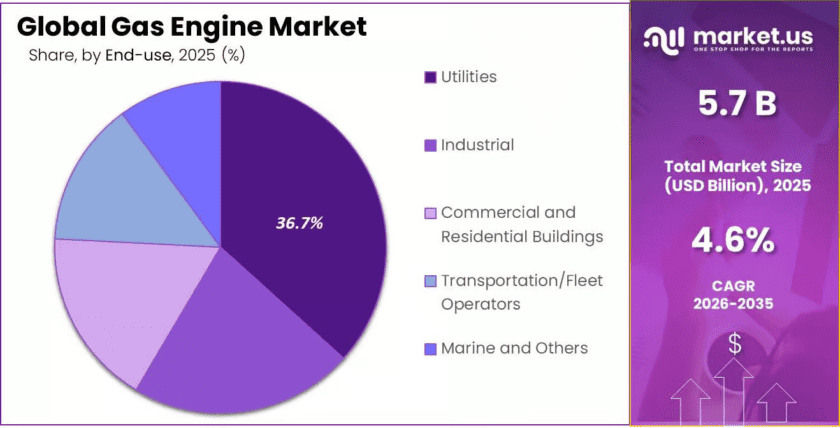
In 2025, the global market was valued at USD 5.7 billion and is projected to reach USD 9.0 billion by 2035, registering a compound annual growth rate (CAGR) of 4.6% during 2026–2035. Natural gas engines remain important for facilities requiring dependable electricity and continuous operations.
Growing electricity consumption, industrial development, and investments in decentralized energy systems are supporting demand. At the same time, manufacturers are improving engine efficiency, reducing emissions, and developing technologies compatible with hydrogen and renewable gases. These developments are creating new opportunities across power generation, manufacturing, utilities, and commercial infrastructure.
Key Takeaways
- Market size: The global Gas Engine Market was valued at USD 5.7 billion in 2025.
- Future outlook: The market is expected to reach USD 9.0 billion by 2035.
- Growth rate: The market is projected to expand at a 4.6% CAGR during 2026–2035.
- Leading fuel: Natural gas accounted for a dominant 61.23% share in 2025.
- Leading application: Power Generation (Base and Peak) captured 58.45% of the market.
- Power output: The 2.1–5 MW category accounted for 37.56%.
- Leading end user: Utilities held a 36.78% share.
- Dominating region: Asia-Pacific accounted for 38.78%, equivalent to USD 2.2 billion, in 2025.
Regional Analysis
Asia-Pacific – Dominating Region
Asia-Pacific dominated the Gas Engine Market in 2025, accounting for 38.78% of global revenue, valued at USD 2.2 billion. The region’s position is supported by industrial expansion, rising electricity consumption, manufacturing growth, and investments in distributed power generation.
China, Japan, and South Korea are important markets for gas engine technologies across utilities, industrial facilities, and commercial infrastructure. According to the International Energy Agency (IEA), China’s electricity demand exceeded 9,500 TWh in 2025, increasing by 5.1%. Growing power requirements and the need for reliable electricity are supporting the use of gas engines in industrial power generation and combined heat and power applications.
Market Dynamics
Driver: Rising Global Electricity Demand
Increasing electricity consumption across industrial, commercial, and residential sectors is a major driver of the Gas Engine Market. Gas engines provide flexible power generation for facilities requiring reliable electricity and continuous operations. They are also suitable for distributed generation, where electricity is produced close to the point of consumption.
According to the IEA, global electricity demand increased by approximately 3% in 2025, compared with 4.4% in 2024. Natural gas contributed 17% of global energy demand growth during 2025. These developments support demand for gas-based power equipment, particularly in regions experiencing industrial expansion and increasing electricity requirements.
Trend: Growing Adoption of Renewable Gas and Advanced Engines
The development of engines compatible with biogas, biomethane, and other alternative gaseous fuels is becoming an important industry trend. Manufacturers are improving combustion systems, fuel flexibility, and engine controls to support different gas qualities.
According to the IEA, global biogas and biomethane production reached 1,785 petajoules in 2025, with biogas accounting for 78% of total production. The agency expects global biogas production to increase by 18% between 2026 and 2031 in its main forecast. This creates opportunities for gas engine manufacturers to develop equipment suited to renewable gas applications.
Restraint: Emission Regulations and Compliance Costs
Strict emission requirements remain a challenge for gas engine manufacturers and operators. Stationary engines can release nitrogen oxides, carbon monoxide, formaldehyde, and other pollutants, requiring suitable emission control systems and regular monitoring.
In the United States, the Environmental Protection Agency regulates stationary reciprocating internal combustion engines through National Emission Standards for Hazardous Air Pollutants and New Source Performance Standards. These requirements can increase equipment costs, maintenance expenses, and compliance responsibilities.
Smaller operators may face additional financial pressure when upgrading older engines or installing emission-control equipment. Manufacturers therefore need to balance engine performance, operating costs, and environmental compliance.
Opportunity: Expansion of Combined Heat and Power Systems
Combined heat and power (CHP) installations offer an important growth opportunity because they generate electricity and useful heat from the same fuel source. Gas engines are suitable for factories, hospitals, commercial buildings, and industrial facilities that require both power and thermal energy.
According to the US Environmental Protection Agency, CHP systems generally achieve total efficiencies of 60% to 80%, compared with approximately 50% to 55% for separate electricity and heat production. This efficiency advantage can help businesses reduce fuel waste and improve energy management. Increasing investment in onsite generation and industrial energy efficiency is expected to support further gas engine deployment.
Emerging Trends in the Gas Engine Market
1. Hydrogen-Compatible Gas Engines: Manufacturers are developing engines that can operate with hydrogen blends and alternative gaseous fuels. These technologies can support industrial decarbonization. The development of renewable gases is gaining importance, with global biogas and biomethane production reaching 1,785 petajoules in 2025.
2. Growth of Renewable Gas Applications: Gas engines are increasingly being adapted to use biogas and biomethane produced from agricultural waste, wastewater, and organic materials. The IEA expects global biogas and biomethane production to increase by 18% between 2026 and 2031, creating new fuel opportunities.
3. High-Efficiency CHP Technology: Engine manufacturers are improving heat recovery systems to increase the combined output of electricity and useful heat. According to the EPA, CHP installations can achieve total system efficiencies of 60% to 80%, encouraging adoption in industrial and commercial facilities.
4. Digital Engine Monitoring: Advanced sensors, automated controls, and remote monitoring are becoming important in gas engine operations. These systems help operators track fuel consumption, temperature, operating conditions, and maintenance requirements. The increasing need for reliable power is encouraging investment in connected engine management technologies.
5. Demand from Data Centre Infrastructure: Expanding data centre operations are increasing the need for reliable electricity and backup generation. According to the IEA, global data centre electricity consumption increased by approximately 17% in 2025, creating additional opportunities for onsite gas engine power systems.
Use Cases of Gas Engines
1. Utility Power Generation: Gas engines are used by utilities and independent power producers to generate electricity and support local power networks. In 2025, natural gas supplied approximately 41% of US utility-scale electricity generation, highlighting the importance of gas-based power infrastructure.
2. Industrial Combined Heat and Power: Manufacturing facilities use gas engines to produce electricity and recover heat for industrial processes. According to the EPA, CHP systems can achieve efficiencies of 60% to 80%, helping factories reduce fuel waste while meeting their electricity and heating requirements.
3. Data Centre Backup Power: Data centres use gas engine generator systems to support electricity availability during grid interruptions and periods of high demand. Global data centre electricity consumption increased by 17% in 2025, strengthening the need for dependable onsite power infrastructure.
4. Wastewater Treatment Facilities: Wastewater treatment plants can use biogas produced during anaerobic digestion to operate gas engines and generate electricity and heat. Global biogas and biomethane production reached 1,785 petajoules in 2025, supporting opportunities for renewable-gas-based power generation.
5. Oil and Gas Operations: Gas engines are used to drive pumps, compressors, and other industrial equipment in oil and gas facilities. The EPA identifies stationary reciprocating engines as important equipment for powering pumps and compressors in manufacturing and power plants.
Frequently Asked Questions on Gas Engine Market
1. What is a gas engine?
A gas engine is an internal combustion engine that uses gaseous fuels such as natural gas, biogas, or biomethane to produce mechanical power or electricity for industrial, commercial, and utility applications.
2. What is the global Gas Engine Market size in 2025?
The global Gas Engine Market was valued at approximately USD 5.7 billion in 2025. The market is projected to reach USD 9.0 billion by 2035, supported by demand for reliable power generation.
3. Which fuel type dominates the Gas Engine Market?
Natural gas dominates the market, accounting for 61.23% of the total share in 2025. Its established supply infrastructure and widespread use in electricity generation support its leading position.
4. Which application holds the largest market share?
Power Generation (Base and Peak) holds the leading application position, accounting for 58.45% of the market in 2025. Gas engines support electricity supply for utilities, industrial facilities, and distributed power systems.
5. Which region dominates the Gas Engine Market?
Asia-Pacific dominated the global market in 2025, capturing 38.78% of revenue, equivalent to USD 2.2 billion. Industrial development, electricity demand, and investments in power infrastructure support its position.
Conclusion
The Gas Engine Market is expected to experience steady development as electricity demand, industrial expansion, and distributed power generation increase globally. The market is projected to grow from USD 5.7 billion in 2025 to USD 9.0 billion by 2035, at a CAGR of 4.6%. Asia-Pacific remains the leading regional market, supported by industrial development and rising power requirements.
Natural gas engines continue to serve utilities, manufacturing facilities, and commercial infrastructure. Meanwhile, renewable gas compatibility, hydrogen-ready technologies, digital monitoring, and combined heat and power systems are creating new business opportunities. Manufacturers focusing on efficiency, reliability, and emission reduction are positioned to address changing energy requirements.
Discuss your needs with our analyst
Please share your requirements with more details so our analyst can check if they can solve your problem(s)