Overview
New York, NY – Nov 06, 2026 – The global ketones market is supported by the wide use of ketone-based chemicals in paints, coatings, adhesives, printing inks, pharmaceuticals, personal care products, and other industrial applications. Ketones such as acetone, methyl ethyl ketone (MEK), and methyl isobutyl ketone (MIBK) are valued for their solvent properties and their role as chemical intermediates. They help dissolve resins, support formulation processes, and enable the production of several downstream chemicals.
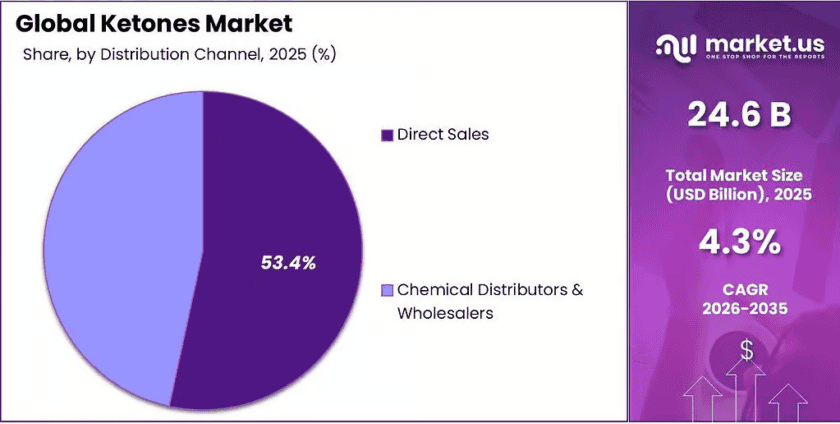
According to the supplied Market.us report, the global ketones market was valued at USD 24.6 billion in 2025 and is projected to reach USD 37.5 billion by 2035, at a compound annual growth rate (CAGR) of 4.3%. Asia-Pacific accounted for 38.21%, representing USD 9.3 billion, in 2025. Demand is linked to manufacturing activity, particularly in coatings, adhesives, and specialty chemicals. However, producers also face pressure from volatile feedstock costs, workplace-safety requirements, and the shift toward lower-solvent formulations.
Key Takeaways
- The global ketones market was valued at USD 24.6 billion in 2025.
- The market is projected to reach USD 37.5 billion by 2035, registering a CAGR of 4.3%.
- Ketone oil led the product-type segment with a 54.12% share in 2025.
- Paints and coatings represented the leading application segment, with a 44.53% share.
- Direct sales accounted for 53.45% of distribution-channel revenue.
- Asia-Pacific dominated the regional market with a 38.21% share, valued at USD 9.3 billion in 2025.
- Industrial demand is supported by the use of ketones in coatings, adhesives, printing inks, and chemical manufacturing.
Regional Analysis
In 2025, Asia-Pacific held a dominant position in the ketones market, accounting for 38.21% of the global market and generating USD 9.3 billion in revenue. The region benefits from its large chemical manufacturing base and demand from paints, coatings, adhesives, printing inks, and other industrial sectors. China, Japan, South Korea, and other regional manufacturing centres contribute to the demand for industrial solvents and chemical intermediates. The supplied Market.us report identifies Asia-Pacific as the leading regional market.
The region’s industrial base provides opportunities for ketone suppliers, particularly those serving large-volume chemical and manufacturing customers. Government information from Canada and the UK also confirms the broad industrial use of ketones, including in paints, plastics, adhesives, and printing inks. These applications are relevant to manufacturing economies across Asia-Pacific, although the government sources do not provide a separate regional ketone market-growth rate.
North America and Europe remain important markets because of their established chemical, automotive, pharmaceutical, and coatings industries. Future demand across regions will depend on industrial output, solvent regulations, production economics, and the ability of suppliers to provide consistent grades for specialised applications.
Market Dynamics
Driver: Demand from Coatings, Adhesives, and Industrial Manufacturing
Demand from paints, coatings, adhesives, and printing inks is a major driver for industrial ketones. Acetone and MEK are used as solvents because they can dissolve several resins and support product formulation. The UK government identifies MEK as an industrial solvent used in paints, plastics, adhesives, and printing inks.
It also lists applications in synthetic resins, lacquers, varnishes, glues, and sealants. As construction, automotive production, packaging, and industrial manufacturing expand, demand for solvent-based products can support ketone consumption. The scale of this driver depends on the share of formulations that continue to use ketone-based solvents.
Trend: Greater Focus on High-Purity and Application-Specific Grades
Ketone buyers increasingly need products that meet specific purity, performance, and handling requirements. This is relevant in pharmaceutical processing, specialty chemicals, coatings, and other applications where impurities can affect the final product. The Canadian government identifies ketones as substances used not only in industrial solvents but also in cosmetics, natural health products, and some food-related applications.
These varied uses require suppliers to understand the requirements of each customer and application. This is encouraging greater attention to product specifications, quality testing, and consistent supply. The trend is toward matching ketone grades to end-use requirements rather than relying only on standard bulk solvent products.
Restraint: Health, Safety, and Environmental Compliance
Ketones such as MEK are volatile and flammable, creating safety requirements during production, storage, transport, and use. The UK government describes MEK as a highly flammable liquid, while the US National Institute for Occupational Safety and Health warns that exposure can affect workers through inhalation, swallowing, or skin and eye contact.
Manufacturers must therefore invest in ventilation, safe storage, protective equipment, employee training, and exposure controls. These measures increase operating and compliance costs, particularly for facilities handling large volumes. Environmental rules and the move toward lower-solvent formulations can also limit demand growth in selected applications.
Opportunity: Speciality Chemical and High-Performance Applications
Suppliers can create growth opportunities by developing high-purity ketones and application-specific solvent grades for customers with strict technical requirements. Ketones are used as chemical intermediates and in products such as coatings, adhesives, inks, and synthetic resins.
The US National Institute for Occupational Safety and Health also documents their use in chemical manufacturing, extraction processes, and resin-based formulations. Producers that improve purification, product consistency, packaging, and technical support may be better positioned to serve specialised buyers. Opportunities also exist in solvent recovery and reuse, which can help industrial customers manage material costs and reduce waste.
Emerging Trends
1. High-purity ketone grades: Manufacturers are focusing on tighter purity and impurity controls for specialised chemical applications. OSHA provides chemical-specific monitoring and exposure information for MEK and MIBK, reflecting the need for controlled handling and product-specific quality management.
2. Improved workplace monitoring: Industrial users are giving greater attention to measuring solvent vapours and protecting workers. OSHA lists an 8-hour permissible exposure limit of 200 parts per million (ppm) for MEK, supporting the need for routine exposure monitoring.
3. Solvent recovery and reuse: Chemical plants are seeking to reduce solvent losses during storage, transfer, and cleaning. The US Environmental Protection Agency identifies tank evaporation, equipment leaks, and solvent handling as MEK emission sources, and describes covers and enclosed systems as possible controls.
4. Application-specific solvent selection: Buyers are selecting ketones according to evaporation rate, solvent strength, and compatibility with the materials being processed. NIOSH identifies these properties as factors that influence industrial ketone use across coatings, inks, adhesives, and chemical manufacturing.
5. Greater attention to chemical safety: Companies are reviewing storage, ventilation, and handling procedures for flammable ketones. NIOSH sets a recommended acetone exposure limit of 250 ppm as an 8-hour time-weighted average, highlighting the importance of worker protection.
Use Cases
1. Paints and protective coatings: MEK and other ketones help dissolve resins used in selected paint and coating formulations. The UK government confirms MEK use in surface coatings, paints, lacquers, and varnishes, supporting its role in industrial finishing applications.
2. Adhesives and sealants: Ketones are used in some adhesive formulations to dissolve resins and support application performance. UK government information lists MEK use in glues, sealants, and adhesives, including products used in industrial and manufacturing settings.
3. Printing inks: MEK is used as a solvent in printing inks, helping dissolve formulation components and support ink application. The UK government identifies printing inks among its industrial uses, while NIOSH also lists printing-plant workers among potentially exposed occupational groups.
4. Chemical manufacturing: Acetone and other ketones serve as chemical intermediates in the production of downstream materials. NIOSH documents their use in chemical manufacturing and resin processing, making them useful inputs for several industrial chemical production chains.
5. Industrial cleaning and extraction: Ketones are used in selected cleaning and extraction operations because of their solvent properties. NIOSH identifies extraction of lubricating oil and wax refining among ketone applications. Safe handling is essential because MEK and acetone are volatile and flammable.
Frequently Asked Questions on Ketones and the Ketones Market
1. What are ketones?
Ketones are organic chemical compounds containing a carbonyl group between two carbon atoms. Commercial examples include acetone, methyl ethyl ketone, and methyl isobutyl ketone, which are used in industrial solvents and chemical manufacturing.
2. What is the global ketones market size?
According to the supplied Market.us report, the global ketones market was valued at USD 24.6 billion in 2025. This is a market estimate from the report, not a government-reported industry statistic.
3. What is the projected value of the ketones market by 2035?
The supplied Market.us report projects that the global ketones market will reach USD 37.5 billion by 2035, growing at a CAGR of 4.3% over the stated forecast period.
4. Which region leads the ketones market?
Asia-Pacific led the ketones market in 2025, accounting for 38.21% of the global market and generating an estimated USD 9.3 billion in revenue, according to the supplied Market.us report.
5. What are the major applications of ketones?
Ketones are used in paints, coatings, adhesives, printing inks, synthetic resins, chemical manufacturing, and selected cleaning and extraction processes. Their role depends on the chemical grade and the performance requirements of each application.
6. What factors are driving demand for ketones?
Demand is supported by industrial use in coatings, adhesives, printing inks, and chemical intermediates. Manufacturing activity and the need for solvents with suitable dissolving and evaporation properties influence purchases across these applications.
Conclusion
The ketones market is expected to maintain steady growth, supported by demand from paints, coatings, adhesives, printing inks, and chemical manufacturing. According to the supplied Market.us report, the market is projected to increase from USD 24.6 billion in 2025 to USD 37.5 billion by 2035, at a CAGR of 4.3%.
Asia-Pacific is expected to remain an important market because of its established manufacturing and chemical industries. However, workplace safety, environmental compliance, raw material costs, and alternative formulations will influence future demand. Suppliers focusing on product quality, reliable supply, and specialised applications may strengthen their market position.
Discuss your needs with our analyst
Please share your requirements with more details so our analyst can check if they can solve your problem(s)