Overview
New York, NY – Nov 13, 2026 – The global Portable Filtration Systems Market is gaining importance as industrial facilities focus on equipment reliability, fluid cleanliness, and efficient use of operating liquids. Portable filtration systems are mobile units used to remove particles, water, sludge, and other contaminants from hydraulic oil, lubricants, fuels, coolants, and process liquids.
According to the referenced Market.us report, the global market was valued at USD 0.65 billion in 2025 and is projected to reach USD 1.15 billion by 2035, registering a CAGR of 5.8%. Asia-Pacific led the market in 2025 with a 42.34% share, representing revenue of USD 0.2 billion. Systems accounted for 63.45% of the type segment, while pressure filtration held 46.22% of the technology segment.
Demand is supported by applications in power generation, oil and gas, chemicals, mining, pulp and paper, and food processing. Portable units help operators clean fluids during routine maintenance, equipment commissioning, fluid transfer, and selected recovery operations. Their mobility also allows one unit to serve multiple assets, making them useful where fixed filtration installations are not practical or economical.
Key Takeaways
- The global Portable Filtration Systems Market was valued at USD 0.65 billion in 2025 and is projected to reach USD 1.15 billion by 2035, at a CAGR of 5.8%.
- Asia-Pacific dominated the market in 2025, accounting for 42.34% of global revenue, or USD 0.2 billion.
- Systems led the type segment with a 63.45% market share in 2025.
- Pressure Filtration held the leading technology position with a 46.22% share.
- The 0–10 GPM flow-rate segment accounted for 53.45% of the market.
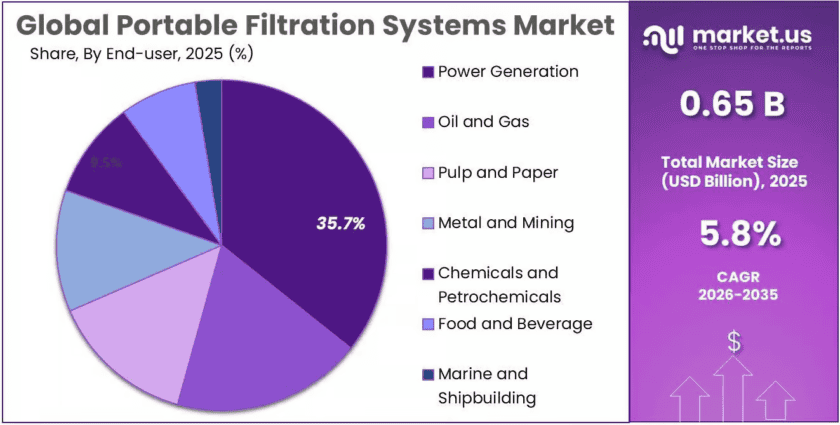
- Power Generation was the leading end-user segment, capturing 35.78% of the market in 2025.
Regional Analysis
Asia-Pacific dominated the Portable Filtration Systems Market in 2025, accounting for 42.34% of global revenue, equivalent to USD 0.2 billion. The region benefits from industrial manufacturing, power generation, chemicals, mining, and oil and gas activities. Investment in manufacturing and supply chains is also supporting industrial expansion. According to the ASEAN Investment Report 2025, foreign direct investment inflows into ASEAN increased by 8.5% in 2024 to USD 226 billion. Manufacturing and services were among the main targets for new investment projects, creating opportunities for industrial equipment and maintenance suppliers.
North America remains an important market because of its established power generation, oil and gas, and manufacturing industries. USGS estimated that self-supplied industrial water withdrawals reached 14.8 billion gallons per day in 2015, while 1,122 utility-scale thermoelectric power plants withdrew approximately 103 billion gallons per day. These figures highlight the scale of industrial and energy operations that require fluid and water management.
Europe presents opportunities through industrial maintenance, fluid recovery, and wastewater treatment requirements. Latin America has potential from oil and gas, mining, and manufacturing operations, while the Middle East and Africa offer applications in energy, petrochemicals, and industrial water management. The available Market.us report summary identifies Asia-Pacific as the leading region but does not provide comparable revenue shares for every other region.
Market Dynamics
Driver: Increasing Focus on Industrial Equipment Reliability
Industrial facilities require clean hydraulic oil, lubricants, coolants, and process liquids to support reliable equipment operation. Portable filtration units allow maintenance teams to clean fluids across multiple machines without installing separate permanent systems.
The USGS estimated that self-supplied industrial water withdrawals in the United States reached 14.8 billion gallons per day in 2015, representing around 5% of total withdrawals. Industries such as food processing, paper, chemicals, refined petroleum, and primary metals use water for processing, cooling, and cleaning. This wide industrial requirement supports demand for flexible filtration and fluid-conditioning equipment.
Trend: Mobile Filtration and Industrial Water Reuse
The market is seeing greater interest in mobile filtration equipment that can support fluid cleaning, temporary treatment, and industrial water recovery. The US Environmental Protection Agency (EPA) provides more than 100 case studies showing how water reuse applications work across different industries.
Its Industrial Wastewater Treatment Technology Database also contains performance information from more than 200 peer-reviewed articles, alongside other technical sources. These resources help facilities compare treatment options for specific pollutants. This is encouraging interest in modular filtration arrangements that can be moved between production areas and adapted to different treatment requirements.
Restraint: Fluid Compatibility and Treatment Limitations
Portable filtration systems are not suitable for every fluid, contaminant, or operating condition. Differences in viscosity, temperature, particle size, water content, and required flow rate can affect equipment selection and filtration performance. The EPA’s Industrial Wastewater Treatment Technology Database evaluates treatment performance by pollutant and technology, reflecting the need for application-specific solutions.
Its records include pilot-scale and full-scale treatment systems rather than assuming that one process works for every wastewater stream. Companies may also face additional costs for filter elements, testing, maintenance, and operator training, which can limit adoption among smaller facilities.
Opportunity: Industrial Water Recovery and Reuse
Industrial water recovery creates an opportunity for portable filtration suppliers to serve facilities seeking more efficient water management. USGS released a detailed dataset in April 2026 covering industrial water use in 2020, with estimates organized by county, watershed, and month.
The EPA also provides more than 100 industrial and other water reuse case studies, along with treatment-performance information for different pollutants. Portable filtration units can support selected pretreatment, side-stream cleaning, and temporary treatment tasks within wider reuse systems. Suppliers offering adaptable equipment and application support can address facilities that need flexible treatment without major permanent installations.
Emerging Trends
1. Compact low-flow filtration units: Compact equipment is important for smaller machines and maintenance areas. Market.us reports that the 0–10 GPM flow-rate segment held a 53.45% share in 2025, reflecting the importance of portable systems designed for controlled, lower-volume filtration tasks.
2. Growing use of pressure filtration: Pressure filtration remains an important technology because it pushes fluids through filter media to remove suspended contaminants. Market.us reports that this technology accounted for 46.22% of the market in 2025, supporting its position across industrial fluid-cleaning applications.
3. Expansion of industrial water reuse: Industrial facilities are exploring treatment and reuse options to manage water resources. The EPA’s water reuse guidance includes more than 100 case studies, giving manufacturers examples of treatment approaches used across different industrial applications.
4. Greater focus on treatment performance data: Facilities increasingly need to match treatment technologies with specific pollutants. The EPA’s Industrial Wastewater Treatment Technology Database includes information from more than 200 peer-reviewed articles, supporting evaluation of established and emerging treatment methods.
5. Demand from power and energy facilities: Power generation remains an important application for portable filtration equipment. USGS assessed water use across 1,122 utility-scale thermoelectric plants, which collectively withdrew approximately 103 billion gallons per day in 2015, highlighting the scale of this industrial sector.
Use Cases
1. Power generation equipment maintenance: Power plants use portable systems to clean turbine oil, lubricants, and hydraulic fluids during maintenance. USGS estimated that 1,122 thermoelectric plants withdrew around 103 billion gallons of water per day in 2015, highlighting the scale of power operations.
2. Oil and gas fluid conditioning: Portable filtration units help remove particles and water from lubricants, hydraulic fluids, and selected process liquids. US crude oil production averaged a record 13.6 million barrels per day in 2025, demonstrating the scale of the sector.
3. Manufacturing process-fluid cleaning: Manufacturing facilities use portable units to clean process liquids, coolants, and hydraulic oils across production equipment. USGS estimated industrial water withdrawals at 14.8 billion gallons per day in 2015, showing the importance of industrial fluid management.
4. Industrial wastewater treatment support: Portable filtration can support selected pretreatment and side-stream treatment tasks before water enters a wider reuse process. The EPA provides more than 100 case studies on water reuse applications across industrial and other settings.
5. Mining and metal processing: Mining and metal facilities can use mobile filtration to condition hydraulic oils, lubricants, and process liquids around heavy machinery. The EPA’s treatment database includes industrial wastewater performance information from more than 200 peer-reviewed articles, helping operators assess pollutant-specific treatment options.
Frequently Asked Questions on Portable Filtration Systems and the Portable Filtration Systems Market
1. What are portable filtration systems?
Portable filtration systems are mobile units designed to remove solid particles, water, sludge, and other contaminants from industrial fluids. They are commonly used for hydraulic oils, lubricants, fuels, coolants, and selected process liquids.
2. What is the global Portable Filtration Systems Market size?
According to Market.us, the global market was valued at USD 0.65 billion in 2025 and is projected to reach USD 1.15 billion by 2035, growing at a CAGR of 5.8%.
3. Which region dominates the Portable Filtration Systems Market?
Asia-Pacific dominated the market in 2025 with a 42.34% share, representing revenue of USD 0.2 billion. Industrial manufacturing, power generation, mining, and energy-related activities support regional demand.
4. Which product type holds the largest market share?
Systems led the type segment in 2025, capturing 63.45% of the market. Their mobility and ability to serve different machines, storage tanks, and production areas support their use across industrial maintenance applications.
5. Which technology dominates the market?
Pressure filtration held the leading technology position in 2025 with a 46.22% share. It uses pressure to move fluids through filter media, helping separate suspended particles and contaminants from industrial liquids.
6. Which flow-rate segment leads the market?
The 0–10 GPM category accounted for 53.45% of the market in 2025. These systems are suited to smaller equipment, individual machines, and maintenance tasks requiring controlled fluid-cleaning capacity.
7. Which end-user segment leads the market?
Power Generation was the leading end-user segment in 2025, accounting for 35.78% of the market. Portable systems help power facilities maintain turbine oils, lubricants, and hydraulic fluids during equipment servicing.
8. What factors are driving market growth?
Demand is supported by industrial equipment maintenance, fluid contamination control, and interest in water recovery. Manufacturing, power generation, oil and gas, chemicals, and mining are important application areas for portable filtration systems.
9. What are the main challenges for manufacturers?
Manufacturers must address fluid compatibility, filtration performance, flow-rate requirements, filter replacement costs, and maintenance needs. Different industrial applications require specific treatment technologies, making product selection and technical support important.
10. What is the market growth forecast through 2035?
Market.us projects the Portable Filtration Systems Market to grow at a 5.8% CAGR from 2025 to 2035, reaching USD 1.15 billion by the end of the forecast period.
Conclusion
The Portable Filtration Systems Market is expected to grow from USD 0.65 billion in 2025 to USD 1.15 billion by 2035, registering a 5.8% CAGR. Asia-Pacific currently leads the market, supported by industrial and manufacturing activity. Systems, pressure filtration, low-flow equipment, and power generation remain important market segments.
Growing attention to equipment reliability, fluid cleanliness, and industrial water reuse is creating further opportunities. However, suppliers must address fluid compatibility, operating costs, and application-specific performance requirements. Companies offering flexible equipment, dependable filtration results, and strong technical support are well positioned to serve industrial customers.
Discuss your needs with our analyst
Please share your requirements with more details so our analyst can check if they can solve your problem(s)