Overview
New York, NY – Nov 13, 2026 – The global Plant-based Supplements Market is gaining attention as consumers look for nutritional products made from plant-derived ingredients. The market includes plant-based protein, vitamin and mineral supplements, botanical extracts, prebiotics, probiotics, and functional nutrition products.
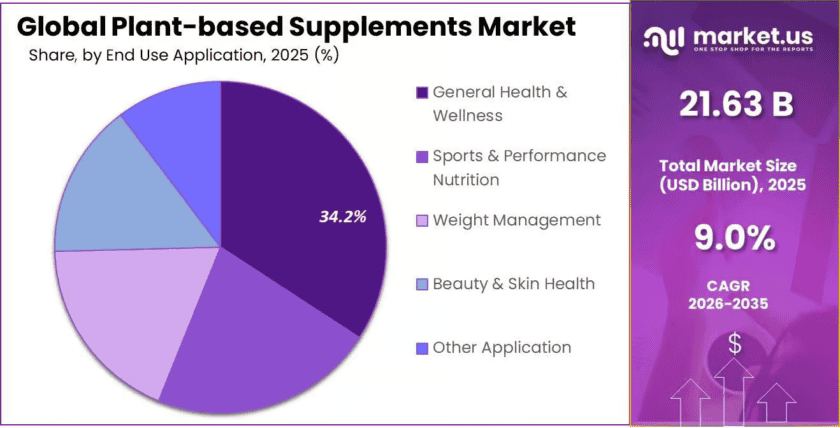
According to the referenced Market.us report, the market was valued at USD 21.6 billion in 2025 and is projected to reach USD 50.9 billion by 2035, registering a compound annual growth rate (CAGR) of 9.0% from 2026 to 2035. North America led the market in 2025 with a 32.12% share, equal to USD 6.9 billion in revenue.
Demand is supported by interest in daily nutrition, plant-based diets, sports nutrition, and convenient supplement formats. Products are available as capsules, tablets, powders, gummies, liquids, and tinctures. In the United States, 57.6% of adults aged 20 and above reported using dietary supplements in 2017–2018, showing an established consumer base for supplementation, although this figure covers all dietary supplements and not plant-based products alone.
Manufacturers are focusing on ingredient quality, clear labelling, product safety, and formulations that meet different nutritional needs.
Key Takeaways
- The global Plant-based Supplements Market was valued at USD 21.6 billion in 2025 and is projected to reach USD 50.9 billion by 2035, at a CAGR of 9.0%.
- Vitamin and Mineral Supplements led the product category in 2025, accounting for 33.12% of the market.
- Capsules and Tablets dominated by supplement form, with a 41.23% share in 2025.
- General Health and Wellness was the leading end-use application, capturing 34.21% of the market.
- Supermarkets and Hypermarkets held a 32.78% share of the distribution channel in 2025.
- North America remained the leading regional market, with a 32.12% share and revenue of USD 6.9 billion in 2025.
Regional Analysis
North America dominated the Plant-based Supplements Market in 2025, accounting for 32.12% of global revenue, valued at USD 6.9 billion. The region benefits from established supplement brands, wide retail availability, and consumer interest in preventive nutrition. U.S. government data shows that 60.2% of adults used at least one dietary supplement during August 2021 to August 2023. This figure covers all supplement types, not plant-based products alone, but indicates a strong overall supplement-use base.
Asia-Pacific offers further growth opportunities through demand for plant-derived ingredients, sports nutrition and everyday wellness products. Japan imported approximately USD 1.19 billion in plant-based and animal protein ingredients in 2023, compared with USD 748.2 million in 2019. Agriculture and Agri-Food Canada reported a 12.4% CAGR in the value of these imports over the period. These figures cover a wider range of protein ingredients, rather than supplements alone, but show the region’s growing ingredient trade.
Europe remains an important market for botanical and plant-derived nutrition products. However, manufacturers must pay close attention to ingredient evidence and health-claim rules. A Court of Justice of the European Union ruling on April 30, 2025, clarified restrictions on certain botanical health claims used in supplement advertising.
Latin America and the Middle East and Africa also form part of the market’s regional coverage. Their future opportunities include plant-protein products, botanical formulations and wider access through retail and online channels. The publicly available report summary does not provide comparable market-share figures for these regions.
Market Dynamics
Driver: Growing Interest in Everyday Nutrition and Healthy Ageing
Growing interest in everyday nutrition and healthy ageing is supporting demand for plant-based supplements. The World Health Organization projects that the number of people aged 60 and above will rise from 1 billion in 2020 to 1.4 billion by 2030, equal to one in six people worldwide.
In the United States, 60.2% of adults used at least one dietary supplement during August 2021 to August 2023, compared with 53.8% in 2013–2014. This wider supplement habit creates a potential customer base for plant-derived vitamins, minerals, protein and botanical products. These figures are broader indicators, not plant-based supplement adoption rates.
Trend: Plant-Protein Blends and Convenient Supplement Formats
Product development is moving toward plant-protein blends, clean-label ingredients and convenient formats such as powders, capsules, tablets and gummies. OECD and FAO reported global pulse consumption of 101 million tonnes in 2024, with average annual growth of 2% over the previous decade, supporting ingredient availability for pea, lentil and bean proteins. Online retail is also gaining importance.
U.S. e-commerce sales reached USD 1.2337 trillion in 2025, representing 16.4% of total retail sales and 5.4% annual growth. Census data covers all retail, but supports the wider shift toward digital shopping.
Restraint: Product Safety and Health-Claim Requirements
Safety, quality and health-claim rules can raise costs and slow product launches. The U.S. Food and Drug Administration does not approve dietary supplements before marketing; manufacturers must ensure product safety and accurate labelling. Its manufacturing rules require identity testing of dietary ingredients and documented supplier controls.
In Europe, the Court of Justice ruled on April 30, 2025, that certain botanical health claims cannot be used until authorised or covered by transitional rules. Companies must therefore invest in ingredient verification, testing, evidence review and compliant labels. Weak evidence or interactions with medicines can also reduce consumer confidence.
Opportunity: Targeted Nutrition and Verified Plant Ingredients
An opportunity exists in targeted plant-based formulations that address clear nutrition needs. The National Institutes of Health lists 2.4 micrograms as the adult daily requirement for vitamin B12 and notes that plant foods do not naturally contain B12 unless fortified, creating a role for carefully labelled fortified or supplement options.
Plant-protein blends also have a broad raw-material base: global pulse consumption reached 101 million tonnes in 2024. Suppliers can develop smaller servings, blended proteins and traceable botanical extracts, provided they verify composition and avoid unsupported disease-treatment claims.
Emerging Trends
1. Plant-protein blends: Plant-protein blends are gaining attention as pulse supply expands. OECD and FAO report global pulse consumption reached 101 million tonnes in 2024, after average annual growth of 2% over the previous decade, supporting pea, lentil and bean protein ingredients.
2. Vegan-friendly vitamin formulations: Vegan-friendly vitamin formulations are receiving attention because plant foods do not naturally contain vitamin B12 unless fortified. NIH lists 2.4 micrograms as the recommended daily intake for adults, creating a clear reference for supplement and fortified-food products for vegan consumers.
3. Healthy-ageing products: Healthy-ageing formulas are becoming more relevant as populations grow older. WHO projects 1.4 billion people will be aged 60 or above by 2030, equal to one in six people worldwide, supporting interest in convenient daily nutrition products for older adults.
4. Online supplement sales: Online supplement discovery and repeat purchasing are supported by wider e-commerce use. The U.S. Census Bureau estimated USD 1.2337 trillion in retail e-commerce sales in 2025, equal to 16.4% of total retail sales, up 5.4% year over year in the United States.
5. Ingredient traceability: Ingredient traceability and botanical standardization are becoming important product-development priorities. FDA rules require manufacturers to verify each dietary ingredient’s identity through an appropriate test or examination, unless an approved exemption applies, strengthening quality-control expectations across sourcing and production networks globally.
Use Cases
1. Sports and exercise nutrition: Plant-based protein powders from pea, soy or rice can be mixed into shakes after training or between meals. CDC reported adults obtained 15.5% of calories from protein in 2021–2023, providing broad nutrition context as context only.
2. Vegan nutrient support: Vitamin B12 products may help vegans meet daily requirements when food intake is insufficient. NIH states plant foods contain no natural B12 unless fortified, and the adult recommended intake is 2.4 micrograms per day for healthy adults.
3. Healthy ageing: Older adults may use plant protein and vitamin or mineral products to complement meals when dietary intake falls short. WHO expects the population aged 60 and above to reach 1.4 billion by 2030, or one in six people.
4. General wellness: Consumers may use plant-derived vitamins, minerals and botanicals as part of a daily nutrition routine, where appropriate. CDC found 60.2% of U.S. adults used a dietary supplement in 2021–2023; the figure covers all supplement types, not plant-specific demand.
5. Digestive health: Fibre-rich plant ingredients and prebiotic blends can be used in products designed to complement a fibre-containing diet. U.S. dietary guidance identifies 14 grams of fibre per 1,000 calories as a reference intake level for daily planning in adults.
Frequently Asked Questions on Plant-based Supplements and the Plant-based Supplements Market
1. What are plant-based supplements?
Plant-based supplements are dietary products made partly or wholly from plant-derived ingredients, including pea or soy protein, botanical extracts, plant-based vitamins, minerals, fibre, prebiotics and probiotics. Their ingredients and intended uses vary by product.
2. Are plant-based supplements suitable for vegans?
Many are formulated without animal-derived ingredients, but capsules, coatings, vitamin sources and other ingredients can vary. Consumers should check the full ingredient list and any vegan certification rather than relying only on front-label wording.
3. Do plant-based supplements provide all essential nutrients?
No. A plant-based supplement does not automatically provide every essential nutrient. NIH notes that plant foods do not naturally contain vitamin B12 unless fortified, and the recommended adult intake is 2.4 micrograms daily.
4. What is the global Plant-based Supplements Market size?
Market.us estimates the market at USD 21.6 billion in 2025, rising to USD 50.9 billion by 2035, at a projected CAGR of 9.0% from 2026 to 2035. These are market-report estimates, not government statistics.
5. Which region leads the Plant-based Supplements Market?
North America led in 2025 with a 32.12% share and USD 6.9 billion in revenue. This regional figure comes from the referenced Market.us report, while CDC supplement-use data provides broader context rather than plant-based-only usage.
6. Which product segment holds the largest market share?
Vitamin and Mineral Supplements led the product categories in 2025 with a 33.12% share. The segment includes formulations using plant-derived or vegan-compatible nutrient sources, depending on the product’s ingredient composition and manufacturing process.
7. Which supplement form dominates the market?
Capsules and Tablets held the largest supplement-form share at 41.23% in 2025. They are easy to store, carry and use, while powders, gummies, liquids, tinctures and softgels serve consumers with different preferences.
8. Are plant-based supplements safe to use?
Safety depends on ingredients, dosage, product quality and possible interactions. FDA does not approve dietary supplements before sale; manufacturers are responsible for safety and compliance. Consumers should consult healthcare professionals, especially when taking medicines.
9. Can plant-based supplements replace a balanced diet?
No. Supplements should not replace a balanced diet or prescribed treatment. FDA advises consumers not to substitute supplements for medicines or a varied diet, and recommends checking possible medicine interactions before starting use.
10. What should consumers check before buying a plant-based supplement?
Consumers should check ingredient amounts, serving size, manufacturer details, allergens, testing and health claims. NIH warns that quality seals do not guarantee safety or effectiveness, so certification should not replace professional advice.
Conclusion
The Plant-based Supplements Market is positioned for continued expansion, with Market.us estimating growth from USD 21.6 billion in 2025 to USD 50.9 billion by 2035, at a 9.0% CAGR. North America currently leads, while Asia-Pacific offers opportunities through growing interest in plant-derived ingredients and protein products.
Vitamin and mineral supplements, capsules and tablets, and general wellness products remain important market categories. Future progress will depend on reliable ingredient sourcing, product quality, clear labelling and evidence-based claims. Manufacturers that balance convenient formulations with safety and transparent information will be better placed to serve changing consumer nutrition needs.
Discuss your needs with our analyst
Please share your requirements with more details so our analyst can check if they can solve your problem(s)