Overview
New York, NY – Nov 05, 2026 – The global Offshore ROV Market is gaining importance as offshore oil and gas operators, renewable energy developers, and marine research organisations increase their use of underwater robotic systems. Offshore ROVs are remotely controlled underwater vehicles used for subsea inspection, drilling support, construction, maintenance, repair, and marine exploration.
The global Offshore ROV Market was valued at USD 8.8 billion in 2025 and is projected to reach USD 17.3 billion by 2035, registering a compound annual growth rate (CAGR) of 7.0% from 2026 to 2035. Growing offshore oil and gas production, deepwater exploration, and offshore wind development are supporting market expansion. Heavy work-class ROVs, electro-hydraulic systems, and deepwater vehicles are gaining importance because they can perform demanding underwater operations.
The market is also benefiting from increasing investment in subsea infrastructure and the need for regular inspection of underwater pipelines, wellheads, offshore platforms, and power cables. The U.S. Bureau of Ocean Energy Management reported approximately 668 million barrels of offshore oil production and 700 billion cubic feet of natural gas production during FY2024.
Key Takeaways
- Market Valuation: The global Offshore ROV Market was valued at USD 8.8 billion in 2025.
- Future Projection: The market is expected to reach USD 17.3 billion by 2035.
- Growth Rate: The market is projected to expand at a CAGR of 7.0% during 2026–2035.
- Dominating Region: North America accounted for 33.20%, representing USD 2.9 billion in market revenue in 2025.
- Leading Vehicle Class: Heavy / work-class ROVs held a dominant position with a 34.00% share.
- Leading Power Type: Electro-hydraulic ROVs accounted for 42.00% of the market.
- Leading Water Depth: Deepwater ROVs captured 44.60% of the market.
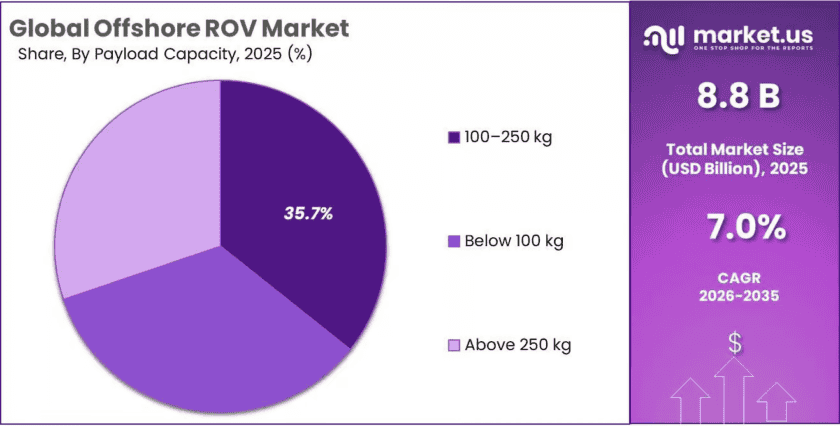
- Leading Payload Capacity: ROVs with a 100–250 kg payload capacity held a 35.00% share.
- Leading Application: Drilling and well-completion support accounted for 25.00% of the market.
- Leading End User: Offshore oil and gas held a dominant position with a 61.30% share.
Regional Analysis
North America – Dominating Region
North America held a dominant position in the Offshore ROV Market in 2025, accounting for 33.20% of the global market, valued at USD 2.9 billion. The region benefits from established offshore oil and gas operations, deepwater exploration, and significant subsea infrastructure in the Gulf of Mexico. The United States remains an important market because offshore operators require regular inspection of subsea wells, pipelines, production equipment, and underwater structures.
According to the Bureau of Ocean Energy Management (BOEM), the United States had approximately 2,227 active offshore oil and gas leases covering around 12.1 million acres as of April 2025. Offshore federal production during FY2024 reached approximately 668 million barrels of oil and 700 billion cubic feet of natural gas. These activities support demand for heavy work-class ROVs, subsea intervention systems, and inspection services.
Asia-Pacific – Expanding Offshore Infrastructure
Asia-Pacific offers strong opportunities for offshore ROV suppliers because of expanding offshore energy projects, deepwater exploration, and marine infrastructure development. China, Japan, South Korea, and Australia are investing in offshore energy and underwater infrastructure.
According to the Global Wind Energy Council’s 2025 report, Asia-Pacific accounted for approximately 53.5 GW, or 58% of global offshore wind capacity, at the end of 2025. Offshore wind farms require regular underwater inspections of turbine foundations, subsea cables, anchor systems, and supporting structures. Growing offshore energy activity is also increasing the need for underwater surveys, maintenance, and inspection equipment. The region is therefore creating opportunities for observation-class, work-class, and hybrid ROV systems.
Europe – Strong Subsea Technology Base
Europe remains an important market because of its established offshore oil and gas industry, North Sea operations, and offshore wind infrastructure. Countries such as Norway, the United Kingdom, Germany, and France require advanced underwater inspection and maintenance solutions.
Offshore wind projects are increasing demand for ROV-based foundation inspections, cable surveys, and subsea monitoring. The European market also benefits from established offshore engineering companies, specialist vessel operators, and advanced subsea technology providers. Continued development of offshore renewable energy and the maintenance of mature oil and gas fields are supporting the region’s long-term ROV requirements.
Market Dynamics
1. Driver – Increasing Deepwater Oil and Gas Activities
Increasing offshore oil and gas exploration is a major driver of the Offshore ROV Market. Deepwater projects require underwater robots to inspect subsea wells, pipelines, risers, production systems, and offshore equipment. According to BOEM, the United States managed approximately 2,227 active offshore oil and gas leases across 12.1 million acres as of April 2025.
Offshore federal production reached approximately 668 million barrels of oil and 700 billion cubic feet of natural gas during FY2024. These operations require regular inspection, maintenance, and underwater intervention. Heavy work-class and electro-hydraulic ROVs are particularly important for complex subsea activities where human divers face significant operational limitations.
2. Trend – Growing Adoption of Advanced and Hybrid ROV Systems
The offshore industry is increasingly adopting advanced ROV systems with improved cameras, sonar, navigation, robotic arms, and digital monitoring capabilities. Hybrid ROV and autonomous underwater vehicle technologies are also gaining attention because they can support longer surveys and reduce dependence on continuous manual control.
In April 2025, NOAA conducted a 28-day underwater exploration expedition using remotely operated vehicles. The programme completed 16 successful dives, reached depths of 5,186 metres, and collected approximately 248 samples. Such operations demonstrate the growing capabilities of underwater robotic systems. Improved imaging, remote piloting, and automated data collection are expected to support wider ROV adoption.
3. Restraint – High Equipment and Operational Costs
High equipment costs and operational expenses remain important restraints for the Offshore ROV Market. Heavy work-class ROVs require specialised vessels, launch and recovery systems, trained pilots, maintenance teams, and advanced underwater communication equipment. Operating in deepwater conditions also increases equipment design and maintenance requirements.
According to BSEE, offshore operations recorded 192 injuries, 401 lifting incidents, and 182 fires in 2025. These figures highlight the challenging operating environment and the importance of safety management. Companies must invest in equipment reliability, crew training, vessel support, and maintenance to reduce operational risks. These costs can limit adoption among smaller offshore contractors.
4. Opportunity – Expansion of Offshore Wind and Subsea Infrastructure
The expansion of offshore wind energy and subsea infrastructure is creating new opportunities for ROV manufacturers and service providers. Offshore wind projects require underwater surveys, turbine foundation inspections, cable monitoring, and maintenance of anchoring systems. According to BOEM, the Sunrise Wind project in the United States has an approved capacity of 924 megawatts and includes up to 84 wind turbines.
Its infrastructure also includes offshore transmission cables and associated underwater components. These installations create opportunities for observation-class and work-class ROVs. Increasing investment in subsea power connections, offshore renewable energy, and marine infrastructure is expected to support demand for specialised inspection and robotic systems.
Emerging Trends
1. Hybrid ROV and AUV Technologies
Hybrid ROV and autonomous underwater vehicle systems are gaining attention because they combine remote control with automated underwater movement. NOAA’s 2025 ocean exploration activities included 16 successful ROV dives, demonstrating the growing importance of advanced underwater robotic technologies.
2. Deepwater Robotic Operations
Deepwater ROVs are becoming important for offshore exploration and subsea maintenance. NOAA’s 2025 exploration expedition successfully operated ROVs at depths of 5,186 metres, demonstrating the ability of advanced underwater systems to collect information in challenging deep-sea environments.
3. High-Resolution Imaging and Sonar
Advanced cameras, lighting systems, and sonar equipment are improving underwater inspection accuracy. During NOAA’s 2025 expedition, underwater mapping operations collected more than 48,000 square kilometres of seafloor bathymetry, highlighting the growing importance of detailed subsea data collection.
4. Offshore Wind Inspection Robotics
Offshore wind development is creating demand for ROVs used to inspect foundations, cables, and underwater structures. The Sunrise Wind project approved by BOEM includes up to 84 turbines and 924 MW of capacity, creating potential inspection requirements.
5. Remote Monitoring and Digital Data Collection
Remote piloting and digital data collection are helping offshore operators reduce the need for personnel to work directly underwater. NOAA’s 2025 expedition collected 248 samples through ROV operations, demonstrating how underwater robotics support detailed scientific and technical data gathering.
Use Cases
1. Offshore Oil and Gas Inspection
ROVs inspect subsea pipelines, wellheads, production equipment, and offshore structures. BOEM reported approximately 668 million barrels of offshore federal oil production in FY2024, demonstrating the scale of offshore infrastructure requiring regular underwater inspection and maintenance.
2. Offshore Wind Farm Maintenance
ROVs examine turbine foundations, anchor systems, and subsea power cables to identify underwater damage. The 924 MW Sunrise Wind project, which includes up to 84 turbines, provides an example of offshore infrastructure requiring underwater surveys and inspection.
3. Deep-Sea Scientific Research
Scientific organisations use ROVs to explore deep-sea habitats, collect samples, and map the ocean floor. NOAA completed 16 ROV dives during its 2025 expedition, collecting 248 samples and gathering important underwater information.
4. Subsea Pipeline and Cable Inspection
ROVs use cameras, sonar, and sensors to examine underwater pipelines and communication cables. NOAA’s 2025 expedition mapped more than 48,000 square kilometres of seafloor, demonstrating the value of underwater mapping and data collection for marine infrastructure assessments.
5. Offshore Construction and Decommissioning
ROVs support underwater construction, equipment positioning, structural assessment, and offshore decommissioning. BSEE reported 2,227 active offshore oil and gas leases under BOEM management in April 2025, reflecting the scale of infrastructure requiring inspection and eventual removal or maintenance.
Frequently Asked Questions
1. What is the Offshore ROV Market?
The Offshore ROV Market covers underwater robotic vehicles and related equipment used for offshore inspection, drilling support, subsea construction, maintenance, repair, and marine exploration across oil and gas, renewable energy, and research industries.
2. What was the global Offshore ROV Market size in 2025?
The global Offshore ROV Market was valued at USD 8.8 billion in 2025. Demand was supported by offshore oil and gas exploration, deepwater infrastructure development, subsea inspection, and growing offshore renewable energy activities.
3. What is the expected market size by 2035?
The Offshore ROV Market is projected to reach USD 17.3 billion by 2035, registering a CAGR of 7.0% during 2026–2035, supported by increasing offshore operations and underwater maintenance requirements.
4. Which region dominates the Offshore ROV Market?
North America dominated the Offshore ROV Market in 2025, accounting for 33.20%, equivalent to USD 2.9 billion. Its position is supported by Gulf of Mexico operations, deepwater exploration, and established subsea infrastructure.
5. Which vehicle class holds the largest market share?
Heavy / work-class ROVs dominated the vehicle class segment in 2025, capturing 34.00%. These systems perform demanding underwater tasks such as subsea construction, drilling support, equipment handling, and maintenance.
6. Which power technology leads the Offshore ROV Market?
Electro-hydraulic ROVs held the leading position in 2025, accounting for 42.00% of the market. They combine electrical control with hydraulic power, making them suitable for underwater activities requiring strong and controlled movements.
Conclusion
The Offshore ROV Market is expected to experience strong growth as offshore energy operators increase their investment in underwater inspection, maintenance, and intervention technologies. The market is projected to grow from USD 8.8 billion in 2025 to USD 17.3 billion by 2035, at a CAGR of 7.0%.
North America remains the leading regional market, supported by established offshore oil and gas operations. Heavy work-class and electro-hydraulic ROVs continue to serve demanding subsea applications. Meanwhile, offshore wind development, deepwater exploration, hybrid robotics, and advanced imaging technologies are creating additional opportunities for manufacturers and service providers.
Discuss your needs with our analyst
Please share your requirements with more details so our analyst can check if they can solve your problem(s)